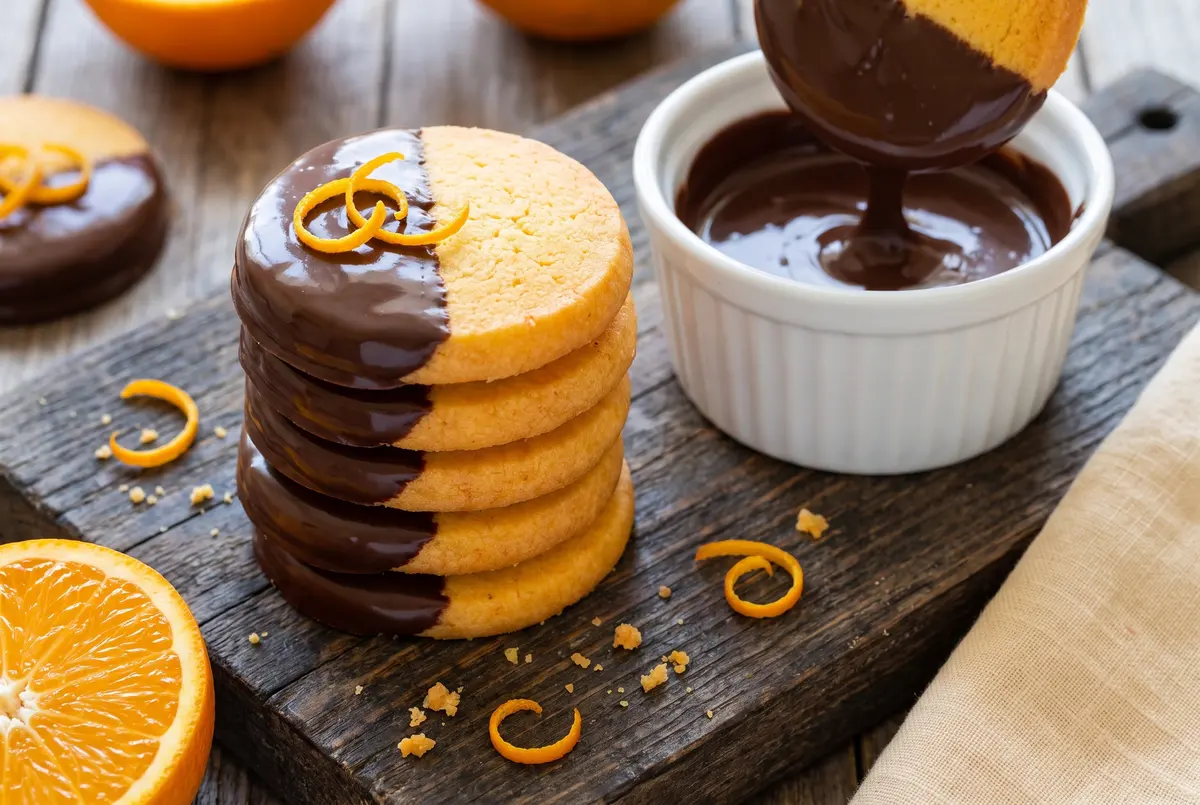
There’s something quietly magical about a slice-and-bake cookie. You roll the dough into a log, slide it into the fridge, and somehow two hours later you have a tray of bakery-perfect rounds ready to slice and bake. I’ve been making these orange shortbread cookies for years — they are the cookies I bring to every holiday cookie exchange because they look impressive, taste like a million bucks, and take less than an hour of actual work. The chocolate dip on top is the showstopper that makes people stop and ask, “Wait, you made these?”
The first time I made them, it was for a Christmas open house. I had a stack of cookie recipes bookmarked and zero time. I went with this one because the dough could sit in the fridge for days while I figured out my life. Three days later, when I finally got around to slicing and baking them, the house smelled like a French bakery and the cookies disappeared in under an hour. That was the year my friends started calling me “the cookie lady.” I’m not complaining.
Why Slice-and-Bake Changes the Cookie Game
If you’ve never made a slice-and-bake cookie before, here’s the whole beautiful idea: you make the dough, form it into a log, chill it until firm, and then slice off rounds whenever you want a fresh batch of cookies. The dough keeps in the fridge for up to a week and in the freezer for three months, which means you can do the messy work (zesting, creaming, mixing) on a Sunday afternoon and have warm cookies in under fifteen minutes any time you want them. It’s a small kitchen revolution.
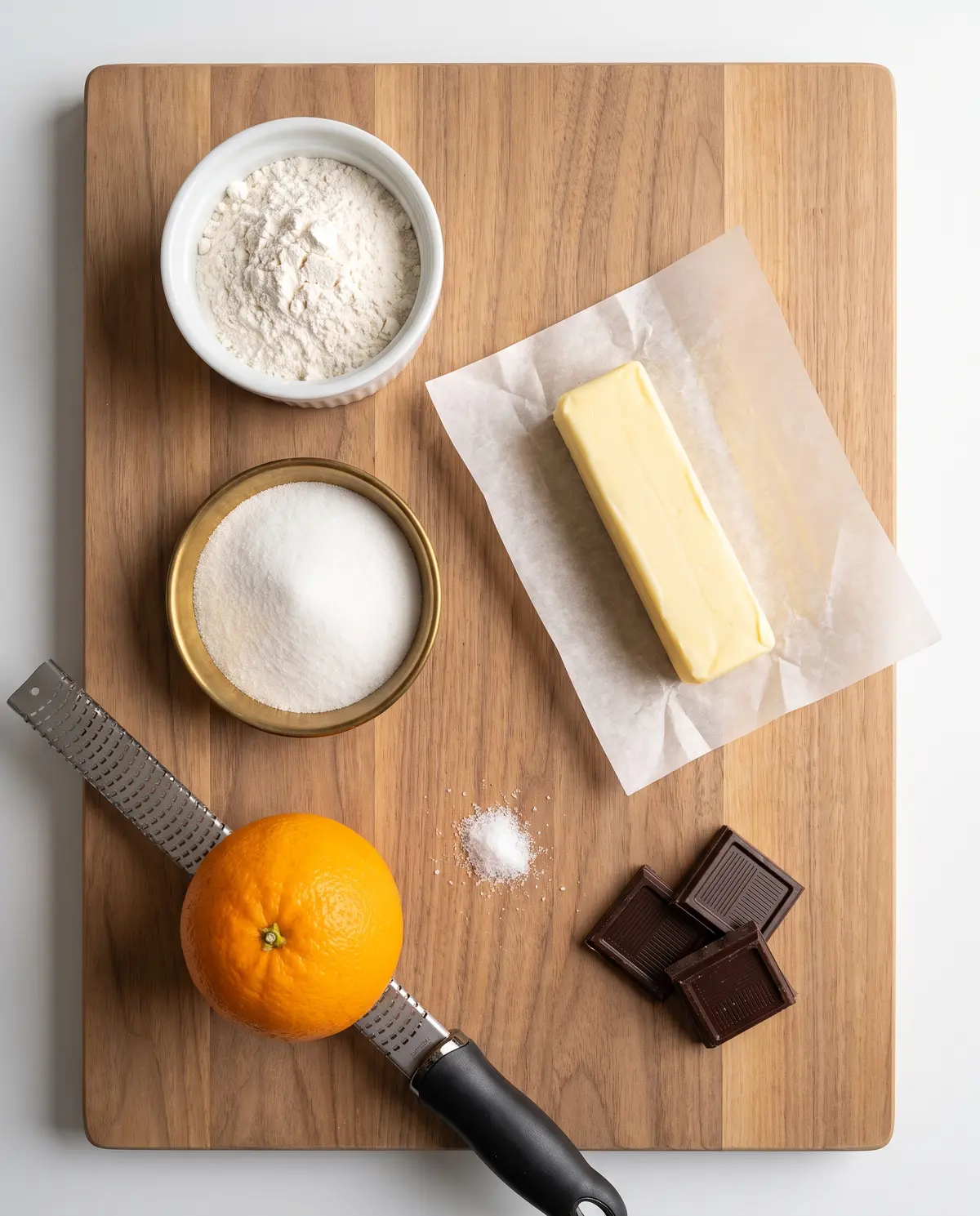
The other reason I love this particular recipe is the orange shortbread base. Shortbread is one of those classic cookie doughs that feels like a basic skill every home baker should have — butter, sugar, flour, a pinch of salt, and in our case, fresh orange zest. There’s no leavening agent, which is what gives shortbread that signature sandy, tender crumb that just melts on the tongue. The orange zest perfumes the whole dough with a bright, sunny fragrance that pairs absurdly well with dark chocolate. The chocolate dip on top is technically optional, but if you skip it, you’re missing the whole point.
One quick note on chocolate: use a good 60–70% dark chocolate bar (not chocolate chips — those have stabilizers that don’t melt as smoothly). I keep a few bars of good European-style dark chocolate in my pantry specifically for dipping projects like this. A little goes a long way, and the better the chocolate, the better your cookies taste.
Ingredients
From Dough Log to Cookie Platter — My Method
Step 1: Make the orange sugar. In the bowl of a food processor, combine the sugar with the zest of one whole orange. Pulse for about 30 seconds until the zest is finely ground and the sugar takes on a pale orange tint and a moist, fragrant feel. If you don’t have a food processor, you can rub the zest into the sugar with your fingertips in a bowl — it just takes a couple of minutes of dedicated rubbing to release the oils. Either way, this step is what gives the cookies their bright citrus flavor, so don’t skip it.
Step 2: Form the dough. Add the flour, softened butter, salt, and (if using) the orange extract to the food processor with the orange sugar. Pulse to combine, then run the machine until the dough comes together into a ragged clump — this should take under a minute. Turn the dough out onto a clean surface and bring it together with your hands so there are no crumbly parts left. It should feel like soft, slightly greasy play dough.
Step 3: Shape into logs and chill. Divide the dough in half and form each half into a log about 6 inches long and 2 inches in diameter. Wrap each log tightly in plastic wrap and refrigerate for at least 2 hours, or up to 5 days. The chilling is non-negotiable — it firms up the butter so the cookies hold their shape in the oven, and it lets the orange flavor fully infuse the dough.
Step 4: Slice and bake. Preheat your oven to 350°F (175°C) and line two baking sheets with parchment paper. Unwrap one log of dough and use a sharp knife to slice it into rounds about 1/3 to 1/2 inch thick. Place the rounds on the prepared baking sheets, about 2 inches apart. Bake for 10 to 12 minutes, until the edges are just barely turning golden but the tops are still pale. Pull them out — they’ll firm up as they cool on the pan for 5 minutes, then transfer to a wire rack to cool completely before dipping.
Step 5: Melt the chocolate. Chop the dark chocolate finely and melt it in a heatproof bowl over a saucepan of barely simmering water (a bain-marie), or in the microwave in 20-second bursts, stirring well between each. The bain-marie method gives you more control and a smoother melt, but the microwave is faster. Either way, the chocolate should be glossy and pourable, around 88–90°F if you have a thermometer handy.
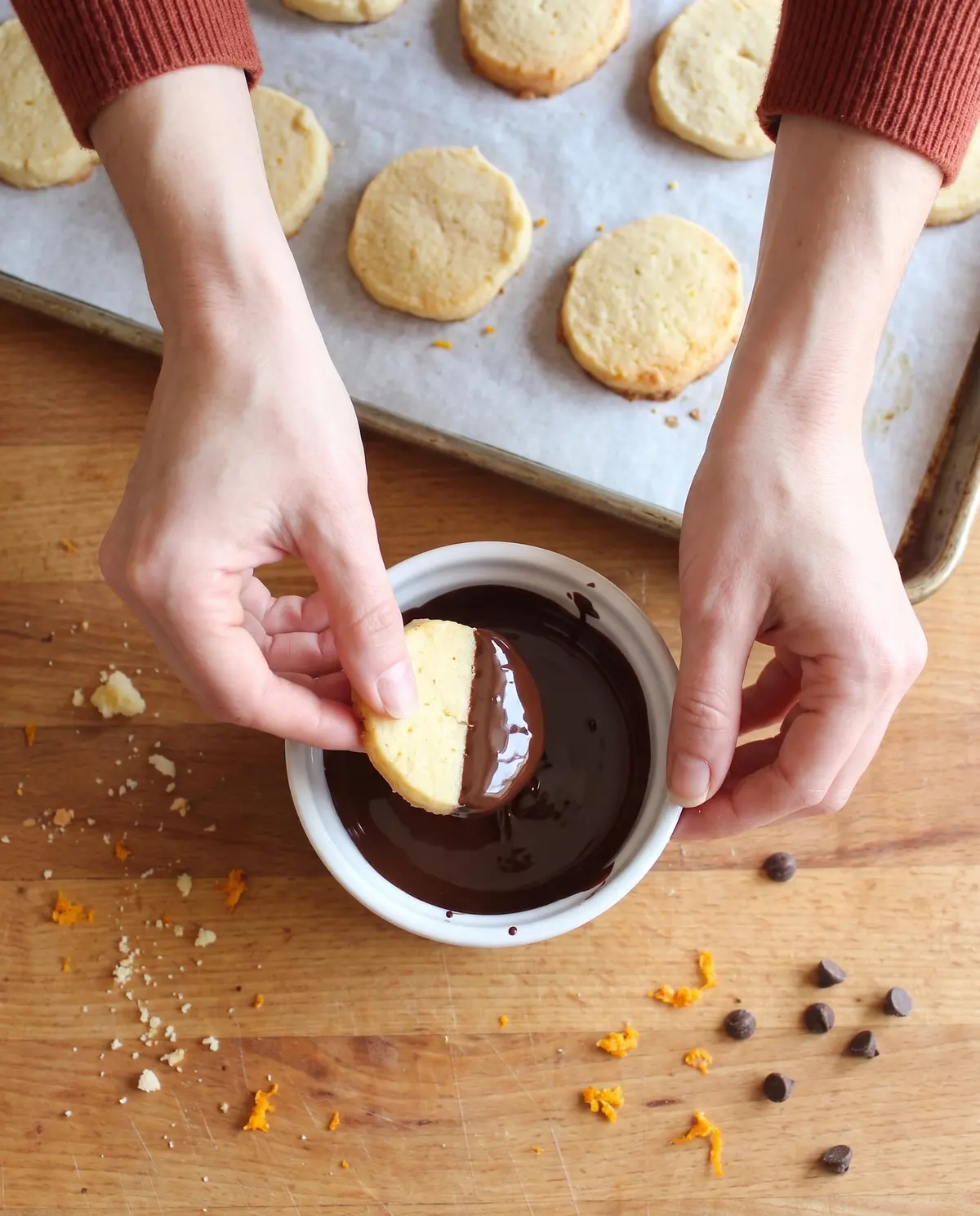
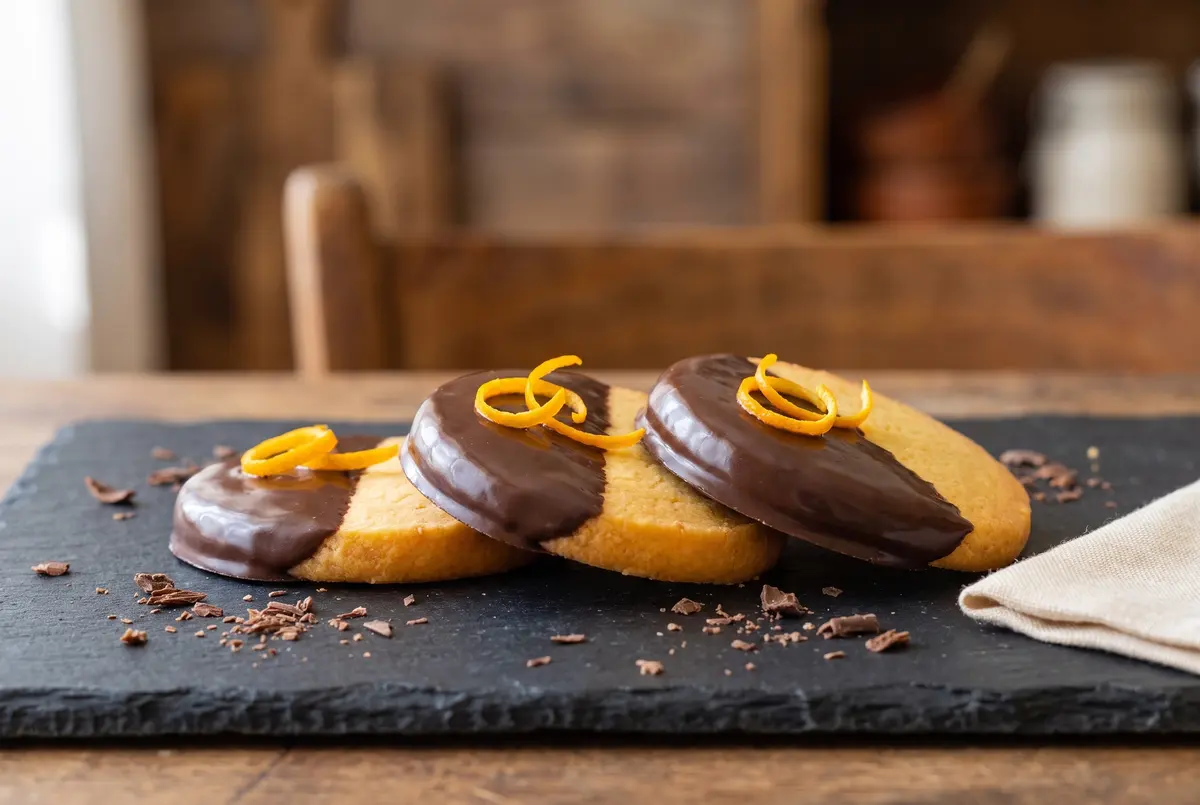
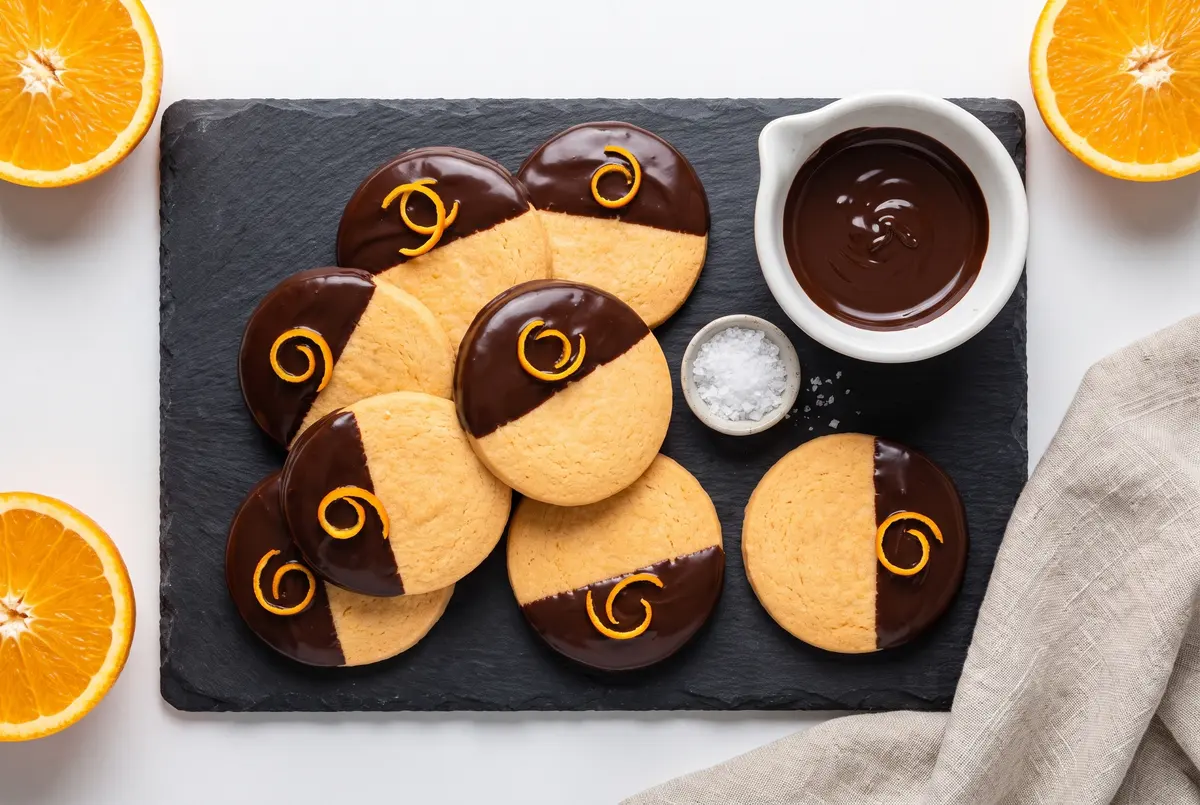
Step 6: Dip and set. Pour the melted chocolate into a small, deep cup (a 1-cup glass measuring cup works beautifully) so you can dunk each cookie about halfway. Dip each cooled cookie into the chocolate, let the excess drip off for a second, then place on a parchment-lined baking sheet. While the chocolate is still wet, sprinkle a few curls of fresh orange zest on top for a pop of color and a fragrant finish. Let the cookies sit at room temperature (or in the fridge for 10 minutes if you’re impatient) until the chocolate is fully set.
Creative Twists Worth Trying
- Bittersweet blood orange version: Swap the regular orange for blood oranges when they’re in season. The cookies take on a soft pink hue and a slightly berry-like flavor that is genuinely stunning.
- Citrus trio: Use half orange zest and half lemon zest in the sugar. The cookies become bright, sunny, and pair beautifully with white chocolate for the dip.
- Cointreau or Grand Marnier: Add a tablespoon of orange liqueur to the dough along with the orange extract. It deepens the citrus flavor and adds a sophisticated grown-up edge.
- Salted dark chocolate finish: Sprinkle flaky sea salt on top of the wet chocolate before it sets. The sweet-salty contrast is irresistible.
- Pistachio crunch: Roll the dipped chocolate edge in finely chopped pistachios before the chocolate sets. The color is gorgeous and the nutty crunch is perfect against the sandy shortbread.
Serving & Pairing Ideas
These cookies are at their absolute best on day two — the orange flavor deepens and the chocolate has time to meld with the shortbread. Serve them at room temperature with a small espresso, a glass of cold milk, or alongside a cup of Earl Grey tea. They’re also wonderful crumbled over vanilla ice cream as a quick dessert, or served on a cookie platter with a few squares of good dark chocolate and some fresh orange segments.
For a holiday cookie box, pair them with a sturdier cookie like gingerbread or shortbread and add a small bundle of candied orange peel on the side. They travel beautifully and look festive on any platter.
Storage & Make-Ahead Tips
The unbaked dough logs keep in the fridge for up to 5 days, wrapped tightly in plastic wrap. You can also freeze the logs for up to 3 months — slice them straight from the freezer and add an extra minute or two to the bake time. The baked, undipped cookies keep in an airtight container at room temperature for a week, and the dipped cookies keep just as long (the chocolate acts as a protective layer).
One more tip: if you’re making these for a dinner party or to give as a gift, dip the cookies the morning of and let them set on a parchment-lined baking sheet in a single layer. Don’t stack them until the chocolate is completely hard, or you’ll end up with cookies stuck together and a slightly messy chocolate situation. Ask me how I know.
Common Mistakes & Easy Fixes
Cookies spread into one big blob: Your dough wasn’t cold enough. Slice-and-bake cookies need at least 2 hours of chilling to firm up the butter, and if your kitchen is warm, an extra 30 minutes won’t hurt. If the dough gets soft while you’re slicing, pop it back in the fridge for 15 minutes.
Cookies are too crumbly: Either the butter was too cold when you mixed it in, or you didn’t bring the dough together fully with your hands before shaping the logs. If your dough is falling apart when you slice it, knead it gently with your hands for 30 seconds to warm up the butter slightly, then re-shape the log and chill again.
Chocolate is thick and clumpy when dipping: Your chocolate is too cold. Chocolate seizes up if it gets below about 80°F, especially in a cool kitchen. Warm it back up over a bain-marie for 30 seconds, stirring constantly, and it should loosen right up.
Cookies are too sweet: The orange zest is doing double duty here as a flavor brightener, and if you skip the orange extract or skimp on the zest, the cookies taste flat and overly sweet. Be generous with the zest — use the zest of a full large orange, not just a sprinkle.
Your Cookie Questions, Answered
Can I use salted butter instead of unsalted? You can, but skip the extra 1/2 teaspoon of salt in the dough. Salted butter varies a lot between brands, so the final flavor can be unpredictable if you don’t account for it.
Can I roll the dough in sugar before baking? Absolutely. Rolling the log in coarse sugar before slicing gives you a sweet crunch on the edges of each cookie. It’s a great move if you’re planning to skip the chocolate dip or if you want extra sparkle on a holiday cookie tray.
What if I don’t have a food processor? You can absolutely make this by hand. Rub the zest into the sugar with your fingertips until fragrant, then cut the butter into the dry ingredients with a pastry cutter or two knives until you have a coarse meal. Add the extract and bring the dough together with your hands. The texture will be a bit more rustic, but the cookies will be just as good.
How long does the chocolate take to set? At room temperature, about 30–45 minutes. In the fridge, 10–15 minutes. Don’t try to speed it up in the freezer — the chocolate can sweat when it comes back to room temperature and lose its snap.
Can I make these with gluten-free flour? A 1:1 gluten-free flour blend (like King Arthur Measure for Measure) works well here. The texture will be slightly more delicate, so handle the dough a little more gently and add an extra minute to the bake time.
A Little Goodbye from My Kitchen
If you’ve been on the fence about slice-and-bake cookies, this is the recipe that will make you a believer. There is something deeply satisfying about having a log of dough tucked in your fridge, ready to slice and bake whenever a cookie craving (or an unexpected guest) shows up. These orange shortbread cookies have been my quiet kitchen workhorse for years, and I hope they become yours too.
Let me know how yours turn out — and please, please try the pistachio version at least once. The first time I made that twist, I actually sent a photo to my sister at 11pm because I couldn’t believe how pretty they were. Have you ever had a cookie that looked as good as it tasted? That’s the one.
Until next time, happy baking.
—Marina Caldwell
Chocolate-Dipped Orange Shortbread Cookies (Slice & Bake, Easy)
Ingredients
- 1 cup (200 g) granulated sugar
- Zest of 1 large orange (just the orange part, no white pith)
- 4 cups (500 g) all-purpose flour
- 2 cups (450 g) unsalted butter, softened
- 1/2 tsp fine sea salt
- 1 1/2 tsp orange extract (optional, can sub vanilla)
- 8 oz (225 g) dark or semi-sweet chocolate (60–70% cocoa), chopped
- Extra orange zest curls, for garnish
Instructions
- 1Make the orange sugar: combine the granulated sugar and orange zest in a food processor and pulse for 30 seconds until the zest is finely ground and the sugar is moist and pale orange. (No food processor? Rub the zest into the sugar with your fingertips in a bowl for 2 minutes.)
- 2Form the dough: add the flour, softened butter, salt, and orange extract (if using) to the food processor with the orange sugar. Pulse to combine, then run the machine until the dough comes together into a ragged clump (under 1 minute). Turn out and bring together with your hands.
- 3Shape into logs: divide the dough in half and form each half into a 6-inch log about 2 inches in diameter. Wrap tightly in plastic wrap and refrigerate for at least 2 hours, or up to 5 days. (Dough can also be frozen for up to 3 months.)
- 4Slice and bake: preheat the oven to 350°F (175°C) and line two baking sheets with parchment paper. Slice one log into 1/3 to 1/2 inch rounds and place them 2 inches apart on the baking sheets. Bake for 10 to 12 minutes, until the edges are just barely golden but the tops are still pale.
- 5Cool: let the cookies cool on the pan for 5 minutes, then transfer to a wire rack to cool completely before dipping. They firm up as they cool.
- 6Melt the chocolate: finely chop the dark chocolate and melt it in a heatproof bowl over a saucepan of barely simmering water (bain-marie), or in the microwave in 20-second bursts, stirring between each. The chocolate should be glossy and pourable.
- 7Dip and set: pour the melted chocolate into a small deep cup. Dip each cooled cookie halfway into the chocolate, let the excess drip off, then place on a parchment-lined baking sheet. While the chocolate is still wet, sprinkle a few curls of fresh orange zest on top. Let set at room temperature (about 30–45 minutes) or in the fridge for 10–15 minutes.
Notes
Use the zest of a full large orange — don’t skimp, since the zest is doing double duty as the flavor brightener.
Salted butter works in place of unsalted; just skip the extra 1/2 tsp salt in the dough.
Use a good 60–70% dark chocolate bar, not chocolate chips — chips have stabilizers that don’t melt as smoothly for dipping.
For a salted version, sprinkle flaky sea salt on the wet chocolate before it sets.
For a pistachio crunch version, roll the dipped chocolate edge in finely chopped pistachios before the chocolate sets.
The cookies are even better on day two, once the orange flavor has had time to meld with the shortbread.