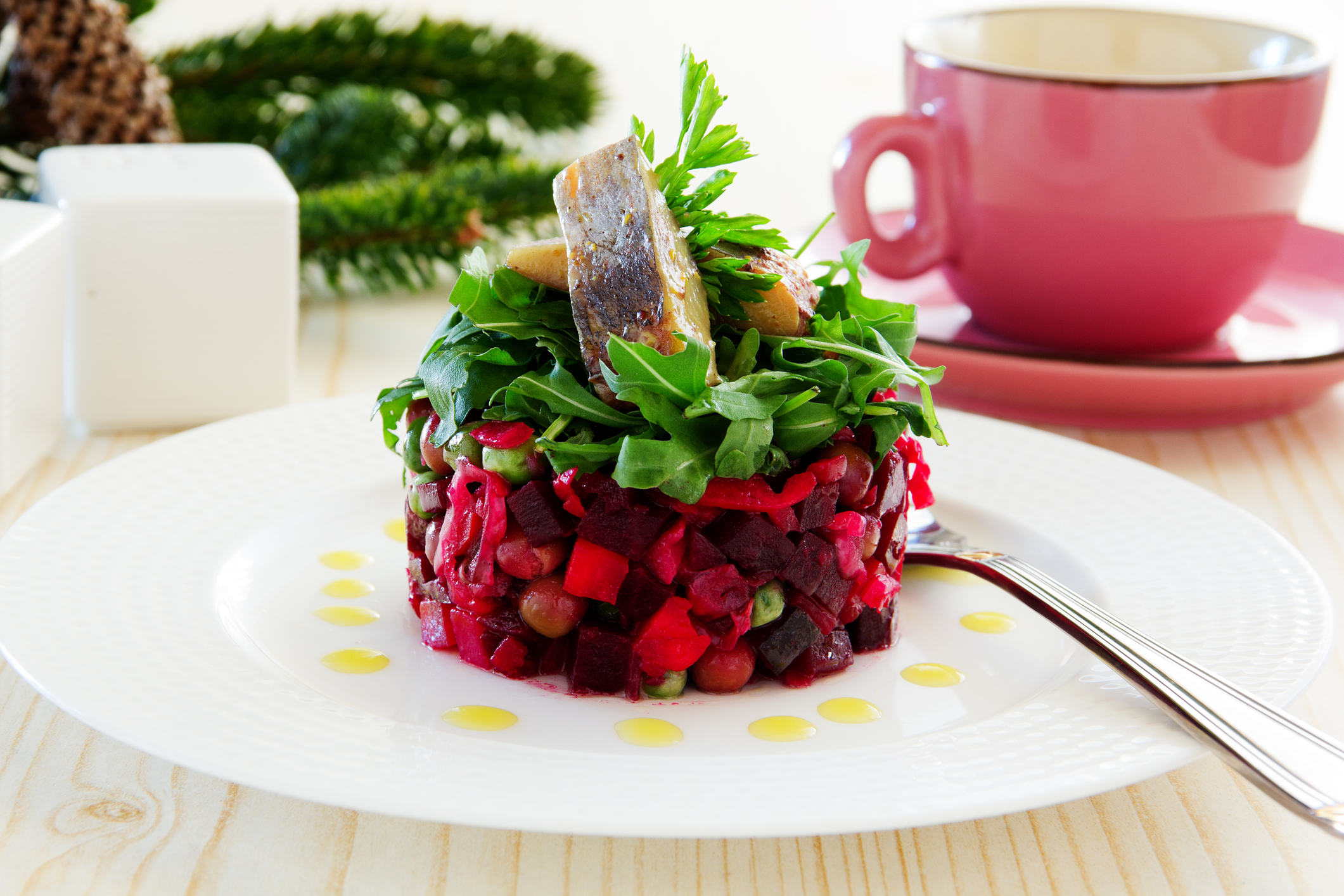
Nobody Warned Me About the Beets
My cutting board looked like a crime scene by the time I got through the beets. I’d made vinaigrette salad before — the basic kind, no fish — and somehow I’d convinced myself this version would go faster.
It did not go faster.
The herring was the part I stalled on. I stood at the counter for a full minute holding the open tin before I committed. Forty grams of oil came with it, and I used some of that too — it loosens everything without adding anything sharp.
Something I didn’t expect: once the beets hit the rest of the vegetables, they pull everything pink within about three minutes. If you want any color contrast when you serve it, you have maybe a two-minute window between tossing and plating. After that it’s all the same deep magenta and you’re just accepting it.
I thought about layering them separately — actually no, I didn’t bother. The flavor is the same either way and I was already impatient by that point.
Quick tip: Boil the beets last, not first, so they’re still slightly warm when you peel them. The skin comes off in one pull instead of fighting you in pieces.
The Vegetables Don’t Forgive Rushing
Beets, potatoes, carrots — all boiled separately. Not because it’s precious or difficult, but because they don’t cook at the same rate and if you throw them in together the potatoes go soft before the beets are done.
Carrots took about 15 minutes. Potatoes, 18. Beets needed a full 22 before a fork went through without resistance.
Cut everything into half-inch cubes. Smaller and it turns to mush when you toss it. I learned this when I cut the potatoes too small my first attempt and ended up with something closer to a pink potato paste than a salad. I served it anyway.
Keep the vegetables separate on the board until you’re ready to combine. Not optional.
The cucumbers were pickled, not brined — there’s a difference in sharpness, and brined ones can make the whole salad taste like it’s been sitting in a jar. My neighbor Vera uses brined every time and insists it’s better. She’s wrong.
About the Dressing.
Most dressings for this salad are just oil. That’s it. No mustard, no vinegar, nothing with any tension in it. A few tablespoons of sunflower oil over vegetables that are half-sweet from the beets and that’s supposedly enough.
It’s not enough.
Two tablespoons of apple cider vinegar and a full tablespoon of Dijon — whisked with the oil until it actually emulsifies rather than just floating on top — cuts through the sweetness and the oiliness of the herring in a way that makes the whole thing taste intentional rather than assembled.
Whisk fast, in a small bowl, and use it immediately. It separates within about five minutes if it sits.
Salt and pepper go into the dressing, not onto the salad afterward. I used to season at the end and always ended up with some bites oversalted and some bites flat. One teaspoon in the dressing distributes evenly.
Does the mustard flavor come through strongly? Honestly, I’m not sure — it might be doing more structural work than flavor work. I tasted it both ways and couldn’t fully decide.
The Herring Situation
Herring in oil, from a tin, chopped into bite-sized pieces — not shredded, not minced. Pieces you can actually identify on the fork.
A lot of recipes tell you to drain the herring completely and discard the oil. They’re skipping the best part. A small amount of that oil — maybe a tablespoon — added directly to the bowl gives the salad a depth that the vegetable oil in the dressing doesn’t replicate.
The herring goes in before the dressing, not after.
I had a tin that was labeled “herring fillets” but turned out to be mostly broken pieces and a lot of oil. The salad was still fine. Honestly? It’s not that deep — the fish disappears into the other ingredients anyway and nobody’s going to ask for a whole fillet.
Half a cup of diced onion goes in raw. Some people blanch it first to take the edge off. I don’t, because I like the sharpness. If raw onion bothers you, soak the diced pieces in cold water for ten minutes before adding.
Resting It and Finishing It
Ten to fifteen minutes of resting. This is the part I always try to skip and always regret skipping.
The dressing soaks into the potatoes and the beet juice continues moving through everything. After 12 minutes it tastes like one dish. Before that it tastes like a bowl of separate things that happen to be touching.
Parsley on top at the end — not mixed in, just scattered.
Serve it cold or at room temperature. I prefer room temperature because the oil in the dressing goes slightly flat when refrigerated and takes a few minutes to come back. Cold is fine if it’s been sitting overnight — it’s a different salad by then, more compressed, almost marinated.
I’d had it as a child at a family gathering, made by someone whose name I never caught, served in a big ceramic bowl with a cracked handle. It tasted exactly like this. That’s either a coincidence or a sign that there really is only one way to make this salad, and everyone arrives at it eventually.
The leftovers the next morning — cold, straight from the container with a fork — were better than the first serving. I’m not sure what that means for how I served it the first time.
—Step 1: Boil beets, potatoes, and carrots in separate pots of salted water. Carrots will take about 15 minutes, potatoes 18, beets closer to 20–22. Test with a fork — it should slide through without pushing hard. Drain each and let them cool before peeling.
Step 2: Peel and dice all three vegetables into half-inch cubes. Keep them in separate piles on the board until you’re ready to combine everything. (If the beets touch the potatoes now, you’ll lose all distinction in the final bowl — it’s not a flavor problem but it bothered me enough to mention.)
Step 3: Dice the pickled cucumbers to match the other vegetables in size. Chop the herring fillets into bite-sized chunks — roughly the same size as the vegetable dice, or slightly larger. Set both aside.
Step 4: Whisk together the vegetable oil, apple cider vinegar, Dijon mustard, salt, and pepper in a small bowl. Whisk hard and fast for about 30 seconds until it holds together. Use it within five minutes or it will separate.
Step 5: Add beets, potatoes, carrots, cucumbers, peas, and diced onion to a large mixing bowl. Toss once gently to combine. Add the herring pieces and a tablespoon of the herring oil directly from the tin.
Step 6: Pour the dressing over the salad and fold everything together slowly. Don’t stir aggressively — the potatoes will break. You want to coat everything without turning it into mush.
Step 7: Let the salad rest at room temperature for 10–15 minutes. Don’t skip this. Have you tried resting a salad like this before? Did it make a difference? Share below!
Step 8: Taste and adjust salt and pepper. Transfer to a serving platter or keep it in the bowl. Scatter fresh parsley over the top. Serve chilled or at room temperature.
Ways to Change It Up
Try this: Swap the herring for smoked mackerel. It’s oilier and more assertive — the salad becomes something closer to a meal than a side.
Try this: Add a hard-boiled egg, quartered, on top just before serving. It changes the texture and makes the whole thing more filling without touching the base recipe.
Try this: Leave out the fish entirely and add a tablespoon of capers instead. The brine from the capers does some of the same work the pickled cucumbers are doing, but sharper.
Which would you go for? Drop it in the comments.
How to Serve It
On its own as a cold lunch with dark rye bread alongside. The bread soaks up whatever dressing pools at the bottom of the bowl.
As a side next to something plain and hot — roast chicken, boiled pork, anything that doesn’t already have a lot going on. The salad has enough acid and fat that it doesn’t need company, but it holds its own next to something simple.
Straight from the fridge the next day with nothing at all.
What would you pair it with?
—Storing It Without Ruining It
Keep it in an airtight container in the fridge. It holds well for up to three days — the flavors actually improve overnight as the dressing fully absorbs.
Don’t freeze it. The potatoes go grainy and the cucumbers turn limp in a way that can’t be fixed. I tried once, mostly out of curiosity. Regretted it immediately.
No reheating needed — this is a cold salad and it should stay cold. If it comes out of the fridge and the dressing looks thick or separated, let it sit at room temperature for 10 minutes and give it one gentle fold.
The parsley goes sad faster than everything else. If you’re making it ahead, hold the parsley and add it just before serving.
Have you ever saved leftovers like this? Tell me below!
Mistakes I Made So You Don’t Have To
I once boiled all three vegetables in the same pot to save time. The carrots were overdone, the beets were fine, and the potatoes had taken on a faint pink tinge before they were even peeled. The whole thing tasted muddled.
I mixed the beets in first, directly, without keeping them separate. By the time everything else went in, the bowl was one color and one color only. The salad tasted right but looked like it had given up.
I drained the herring tin completely — every drop — because I was worried about it being too oily. The salad was dry and flat. The herring oil is not the enemy; it’s doing something the dressing alone can’t do.
Did something like this happen to you?
Questions People Actually Ask
Can I use canned peas instead of cooked fresh peas? Yes. Drain them well — canned peas carry a lot of liquid and they’ll water down the dressing if you don’t. I use canned every time. About 3/4 cup drained is right.
How long does it keep in the fridge? About 3 days. Day two is actually better than day one. But by day four the cucumbers start to go soft and the whole thing loses structure. And the parsley will be completely gray by then — pull it off before storing.
Does the herring flavor take over the whole salad? It depends on how much oil you include from the tin. With just the fillets and one tablespoon of their oil, it’s present but not aggressive. I tried it once with the full tin’s oil poured in — that was too much. The fish sat on top of everything else instead of sitting inside it.
Can I make this the night before? You can. But hold the parsley until serving. The salad will be slightly more compressed the next day — the dressing absorbs fully and the whole thing becomes denser. Some people prefer it that way. But the texture is different. Not worse, different.
Do the beets have to be boiled, or can I roast them? You can roast them. Roasting concentrates the sweetness and makes them earthier. The flavor shifts noticeably — sweeter, less sharp. And they take longer, about 45 minutes at 400°F wrapped in foil. I’ve done it both ways. Boiled keeps the other ingredients more balanced.
What if I don’t like raw onion? Soak the diced onion in cold water for 10 minutes, then drain. It softens the sharpness without cooking out the texture. But if you genuinely can’t tolerate raw onion, leave it out — the salad doesn’t collapse without it. Just flat in one particular way.
Which answer helped you most?
What I’d Tell Someone Making This for the First Time
It takes longer than you think. Not because any one step is hard, but because boiling three vegetables separately and waiting for them to cool before cutting adds up to real time. Budget 70 minutes and don’t start it when you’re already hungry.
Strong>Fun fact: Herring is one of the most omega-3-rich fish available — a single serving contains more than most people get in a full day — which makes this salad considerably more nutritious than it looks.
The dressing is the part most people get wrong because they skip it entirely and just use oil. Don’t do that. The mustard and vinegar matter — not for flavor complexity but for balance. Without them, the beet sweetness takes over everything.
Don’t rush the rest period. I know 10 minutes feels like nothing but those 10 minutes are when the salad stops being a bowl of separate things and starts being an actual dish.
Will you make this soon?
The first time I made this version — with the herring, with the Dijon — I wasn’t sure it was right. It didn’t look like what I remembered. It looked more like something assembled than something made. I still haven’t decided if that’s a problem or just how it is.
Happy cooking! —Marina Caldwell
Russian Vinaigrette Salad Adds Herring Twist
Ingredients
- 2 medium beets, boiled and diced
- 2 medium potatoes, boiled and diced
- 2 medium carrots, boiled and diced
- 1 cup diced pickled cucumbers
- 1 can (250g) herring fillets in oil, chopped
- 1/2 cup diced onion
- 3/4 cup cooked green peas
- 1/4 cup vegetable oil
- 2 tablespoons apple cider vinegar
- 1 tablespoon Dijon mustard
- 1 teaspoon salt
- 1/2 teaspoon black pepper
- 2 tablespoons fresh parsley, chopped
Instructions
- 1Boil beets, potatoes, and carrots separately until tender (15-20 minutes each). Cool and peel if needed.
- 2Dice all boiled vegetables into 1/2-inch cubes, keeping them separate to prevent color bleeding.
- 3Dice pickled cucumbers and chop herring fillets into bite-sized pieces.
- 4In a small bowl, whisk together vegetable oil, vinegar, mustard, salt, and pepper to make vinaigrette.
- 5In a large mixing bowl, combine diced beets, potatoes, carrots, cucumbers, peas, and diced onion.
- 6Add chopped herring fillets with a small amount of their oil to the vegetable mixture.
- 7Pour vinaigrette over the salad and toss gently but thoroughly to combine all ingredients.
- 8Let the salad rest for 10-15 minutes to allow flavors to meld.
- 9Adjust seasoning with salt and pepper if needed.
- 10Transfer to serving platter, garnish with fresh parsley, and serve chilled or at room temperature.
Notes
See full recipe for nutritional information.