The first one always goes wrong.
My husband watched me flip the first crepe straight onto the burner at 7 in the morning, batter dripping down the side of the pan, and just handed me a coffee without saying a word.
That was three years ago, and I still think about it every time I make these.
About the batter rest — it’s not optional.
I skipped it the first time I actually followed through with the recipe.
The crepes came out rubbery at the edges and had these little holes all over — not the charming kind, the kind that means you rushed. Thirty minutes in the fridge makes the gluten relax and the batter go from slightly thick and uneven to something that spreads almost like water across a hot pan.
I thought about adding vanilla extract to the batter — actually yes, I do add it now, about half a teaspoon, and it makes the crepes smell incredible while they cook.
What the strawberries do while you wait.
Macerating.
Three tablespoons of sugar and a tablespoon of lemon juice, tossed with sliced strawberries, sitting in a bowl while the batter rests. By the time you’re ready to fill, the berries have released their own juice and turned into something that’s almost a sauce on its own — glossy, a little tart, soaking into the crepe the second you spoon it on.
Have you ever let fruit sit long enough that it actually transforms? It’s different from just cutting it and serving it, and once you notice the difference it’s hard to go back.
Okay, the pan situation.
Medium-high heat, an 8-inch nonstick, and just enough butter that the surface looks slick but not pooled.
The pour has to be fast — about a quarter cup — and you immediately tilt the pan in circles so the batter runs to the edges before it sets. I used to pour too slowly, and the center would cook before the edges got coverage, leaving thick patches. The edges should lift from the pan cleanly at around 90 seconds, which is when you know it’s ready to flip.
Quick tip: Keep your finished crepes in a 200°F oven loosely covered with foil while you work through the rest of the batch — they stay warm and don’t dry out.
It looked wrong. It wasn’t.
The second side only needs about 30 seconds, and it comes out spottier and paler than the first — that’s fine, that side faces inward once you fold.
My neighbor Rosa saw them stacked on the counter and asked if they were done yet, because they looked undercooked to her. They were done. The pale second side threw her off, same as it threw me off the first few times,
and now I just tell people in advance so they don’t worry.
The fold and the finish.
Spoon the macerated strawberries — and whipped cream if you want it — down the center, then fold into quarters.
A shower of powdered sugar right before serving. Not a dusting. Enough that you can actually taste it.
My kids ate four each and I called it a win.
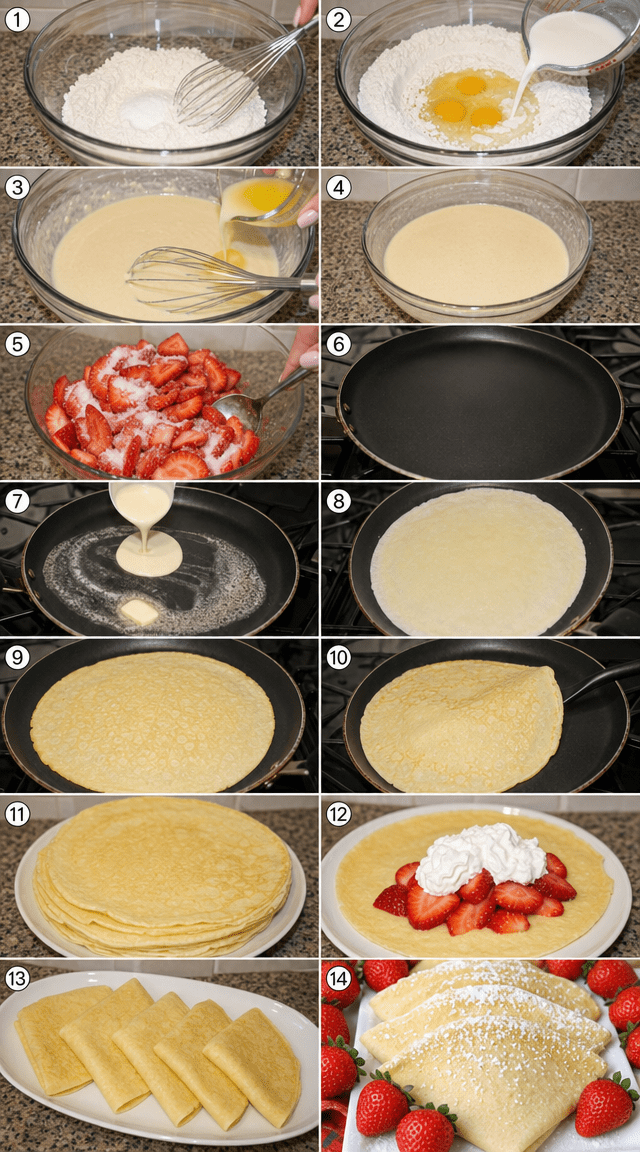
Step 1: Whisk 1 cup all-purpose flour and 1/4 teaspoon salt together in a large bowl, then make a well in the center. Drop in 2 large eggs and start whisking from the middle out, slowly pulling in the flour as you add 1/2 cup whole milk and 1/2 cup water. Keep whisking until the batter is smooth with no dry streaks. (If you see lumps, strain the batter through a fine mesh sieve — it takes 30 seconds and saves the whole batch.)
Step 2: Fold in 2 tablespoons of melted butter, then cover the bowl and refrigerate the batter for at least 30 minutes. Do not skip this. I did once and regretted it within the first two crepes — they tore when I tried to flip them and stuck in patches even on a nonstick pan.
Step 3: While the batter rests, hull and slice 1 pound of fresh strawberries and toss them with 3 tablespoons sugar and 1 tablespoon lemon juice. Let them sit at room temperature for the full 30 minutes. They’ll release a surprising amount of juice and look almost syrupy by the time you come back to them.
Step 4: Heat an 8-inch nonstick pan over medium-high heat and brush lightly with butter from your reserved 2 tablespoons. Pour roughly 1/4 cup of batter into the center and immediately tilt the pan in circular motions to spread it thin and even. This part takes practice — the first crepe is almost always a test one. What does your first crepe usually look like? Share below!
Step 5: Cook until the edges start to lift and look dry, about 1 to 2 minutes. Flip carefully with a thin spatula — or your fingers if you’re brave and the pan isn’t screaming hot — and cook the second side for about 30 seconds. Slide onto a plate and repeat with the remaining batter, stacking crepes between sheets of parchment.
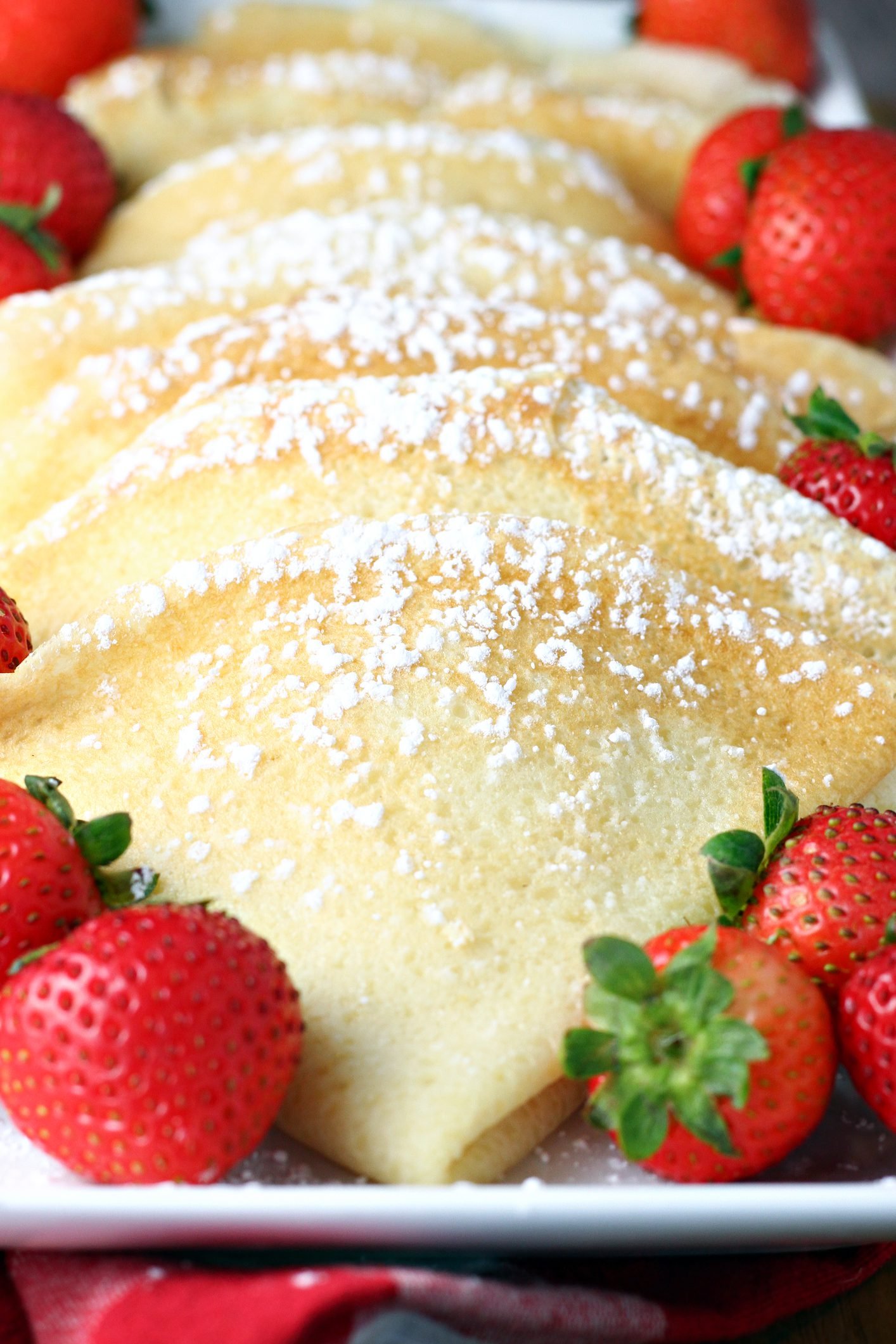
Step 6: Spoon the macerated strawberries and their juice down the center of each crepe, add a dollop of whipped cream if you’re using it, and fold into quarters. Arrange on a platter and dust generously with powdered sugar right before serving.
Ways to Change It Up
Try this: Swap the strawberries for thinly sliced peaches macerated with a little brown sugar and a pinch of cinnamon — the juice goes golden and caramel-adjacent.
Try this: Add a tablespoon of orange zest directly to the batter before resting, then fill with a simple mixture of ricotta, honey, and crushed pistachios instead of fruit.
Try this: Go savory — skip the sugar in the batter, fill with sautéed mushrooms and gruyère, fold into a half-moon, and eat them for dinner. I’ve done this more times than I’ve done the dessert version.
Which would you go for? Drop it in the comments.
How to Serve It
Stack four folded crepes on a plate with the powdered sugar and serve with a small pitcher of the leftover strawberry juice on the side — people pour it over like a sauce and it’s a good call.
Lay them out flat on a large platter with the filling exposed before folding, then fold at the table so guests can see what’s inside. It’s a small thing but it makes the presentation feel more intentional.
With a strong espresso or a glass of cold sparkling water with lemon — not juice, just the lemon — this becomes a meal that doesn’t need anything else next to it.
What would you pair it with?
Storing It Without Ruining It
Unfilled crepes keep in the fridge for up to 3 days, stacked with parchment between each one and wrapped tightly in plastic.
For the freezer, stack them the same way, wrap the whole stack in foil, and they’ll hold for about 2 months. Thaw overnight in the fridge, not on the counter — I’ve done it on the counter and the condensation makes them stick together in a way that’s fixable but annoying.
To reheat, 20 seconds in the microwave between damp paper towels works fine. Or lay them flat in a dry pan over low heat for about 30 seconds per side — they come back almost exactly as they were.
Store the macerated strawberries separately in a jar in the fridge. They last about 2 days and get more syrupy as they sit, which is not a bad thing.
Have you ever saved leftovers like this? Tell me below!
Mistakes I Made So You Don’t Have To
I once poured the batter into a pan that wasn’t hot enough yet, and the crepe spread unevenly and then went pale and gummy in the center — it never really cooked through properly. The pan needs to be genuinely hot before the batter hits it.
I used a pan that was too large the second time I made these. A 10-inch pan with a quarter cup of batter gives you a crepe so thin in the middle it tears when you try to fold it. Eight inches is right for that amount of batter.
The first batch I ever served, I filled the crepes 20 minutes before anyone sat down. The strawberry juice soaked straight through and the bottoms turned soggy. Fill them right before serving, not before.
Did something like this happen to you?
Questions I Actually Get Asked
Can I make the batter the night before? Yes, and honestly it’s better that way. Twenty-four hours in the fridge gives the batter time to fully hydrate and the crepes come out noticeably smoother. Just give it a quick stir before cooking — it settles a bit.
Do I need a special crepe pan? No. A regular 8-inch nonstick works. I tried a dedicated crepe pan once and didn’t notice a meaningful difference. What matters more is the heat and the tilt speed after the pour.
My crepes keep tearing when I flip them — what am I doing wrong? It depends on whether the batter rested and whether the edges are lifting before you flip. If the edges aren’t pulling away from the pan on their own, it’s not ready. Also, I tried flipping too early in my first few attempts and tore nearly every single one.
Can I use frozen strawberries? It depends on how frozen they are going in. Fully frozen berries release a lot more water when they macerate and the result is thinner and less flavorful. Fresh is the move here. But if frozen is what you have, drain off some of the excess liquid before filling.
How many crepes does this recipe make? About 10 to 12, depending on how thin you go. I usually land at 10 with a quarter cup of batter per crepe in an 8-inch pan.
Can I make these gluten-free? I tried a 1:1 gluten-free flour swap once and the crepes were edible but more fragile — they tore at the edges when I folded them. And the texture was slightly grainier. It works in a pinch, but it’s not the same result.
Which answer helped you most?
Go make them this weekend.
This is the kind of recipe that looks more complicated than it is. Two bowls, one pan, thirty minutes of doing nothing while the batter rests.
The strawberries do most of the work themselves once you toss them with sugar and lemon. By the time you’re flipping crepes, the filling is already waiting.
Strawberries are about 91% water, which is why they release so much juice when macerated — that liquid is essentially a natural syrup that forms without any cooking.
I’ve made these for a slow Tuesday breakfast and for a table full of people on a Sunday morning and the reaction is the same both times — quiet, and then someone asks if there are more.
Will you make this soon?
Leave a comment and let me know how yours turn out, or what you changed. I read all of them.
Happy cooking! —Marina Caldwell
Thin French Crepes Bursting With Fresh Strawberries
Ingredients
- 1 cup all-purpose flour
- 1/4 teaspoon salt
- 2 large eggs
- 1/2 cup whole milk
- 1/2 cup water
- 2 tablespoons butter, melted
- 2 tablespoons butter, for pan
- 1 pound fresh strawberries, hulled and sliced
- 3 tablespoons sugar
- 1 tablespoon lemon juice
- 2 tablespoons powdered sugar, for dusting
- 1/2 cup whipped cream, optional
Instructions
- 1Whisk together flour and salt in a large bowl, creating a well in the center for the wet ingredients
- 2Drop eggs into the well and slowly incorporate milk and water, whisking outward until a smooth batter forms
- 3Fold in melted butter, then cover the batter and allow it to rest undisturbed for 30 minutes
- 4Meanwhile, toss sliced strawberries with sugar and lemon juice, letting them macerate until juicy
- 5Warm an 8-inch nonstick pan over medium-high heat and brush lightly with butter
- 6Pour roughly 1/4 cup batter into the pan, immediately tilting it in circular motions to coat evenly
- 7Cook until edges lift and the underside turns golden, approximately 1-2 minutes
- 8Flip carefully and cook the second side for 30 seconds, then slide onto a waiting plate
- 9Repeat the cooking process with remaining batter, stacking finished crepes between parchment
- 10Spoon macerated strawberries and optional whipped cream down the center of each crepe
- 11Fold into quarters, arrange elegantly on a platter, and shower with powdered sugar before serving
Notes
– Resting the batter is non-negotiable — it relaxes the gluten and produces noticeably silkier, hole-free crepes – Keep finished crepes warm in a 200°F oven loosely tented with foil while you complete the batch – For deeper flavor, add a splash of vanilla extract or orange zest directly into the batter