The Peaches Sat There for Three Days First
I left them on the counter longer than I meant to, and by the time I sliced into them the juice ran immediately — which is actually what you want, even if it felt like a mistake at the time.
The first time I made this cobbler it came out pale on top and soupy underneath, and I stood there looking at it for a moment before just spooning it into bowls anyway.
Nobody complained.
My neighbor Deb had been asking me for a peach cobbler recipe for months — she kept saying hers turned out watery — and I kept putting it off because I wasn’t entirely sure mine didn’t have the same problem. That first batch confirmed it did. The cornstarch helps, but only if the peaches have had a chance to sit with the sugar long enough to pull out their liquid before you transfer them to the dish.
Five minutes is listed in most recipes. I go closer to eight now, and I tilt the bowl slightly to watch what’s pooled at the bottom before I decide it’s ready.
Observation only someone who’s made it a few times would have: the filling always looks like too much fruit when you spread it in the dish. It isn’t. It compresses significantly in the oven, and if you shortchange the fruit you end up with batter-to-peach ratio that leans too bready.
About the Batter.
Drop biscuit. Not a poured batter, not a rolled crust — just cold butter cut into flour until the pieces are roughly the size of small peas, then milk stirred in until you can barely call it combined.
I thought about adding a little almond extract here — actually no, I skipped it. It would compete.
Most recipes tell you to spread the batter evenly over the top. They’re wrong. You want gaps. Steam needs to escape from the peaches underneath, and if you seal the whole surface you get a layer that’s cooked on top and gummy on the bottom where it touches the fruit.
Spoon it in rough islands. Uneven is correct here.
Quick tip: The butter must be cold — not cool, cold. I cube mine and put it back in the freezer for ten minutes after cutting it, because by the time you’ve measured out everything else your hands have already warmed it once.
The coarse sugar on top is not optional, not to me. It gives the batter a slight crunch that contrasts with the soft peaches underneath, and without it the whole thing reads a bit flat texturally.
It Looked Wrong at the 30-Minute Mark.
Pale, barely set, with the edges only just starting to bubble.
I opened the oven twice — which I know you’re not supposed to do — and both times I closed it again and set another timer because it genuinely wasn’t ready.
Forty minutes is the real floor, not a suggestion. By 42 minutes the top had gone genuinely golden in a way the oven light had been lying to me about for the previous fifteen.
The bubbling at the edges is what you’re actually watching for. Not color alone — color can fool you, especially if your oven runs hot and browns the surface before the center is done.
Thick bubbling, like something is actually cooking underneath, not just trembling at the perimeter. That’s the sign.
Ten Minutes Is Not a Suggestion Either.
The cobbler needs to sit after it comes out, and ten minutes is genuinely the minimum before the filling stops moving like liquid when you tilt the dish.
I’ve rushed this. The ice cream melts into soup before it has a chance to do anything interesting against the warm fruit, and the whole thing becomes one temperature instead of two.
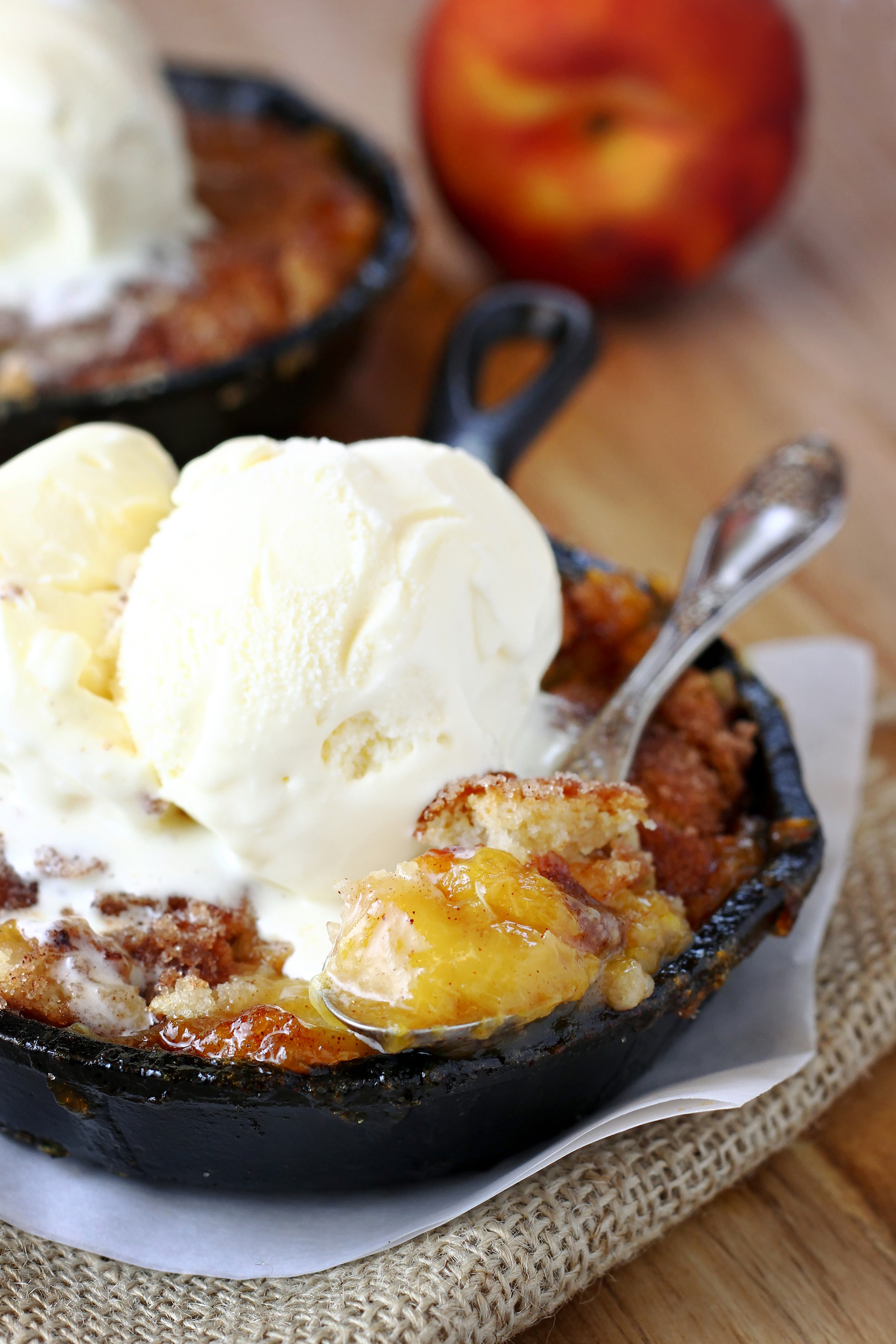
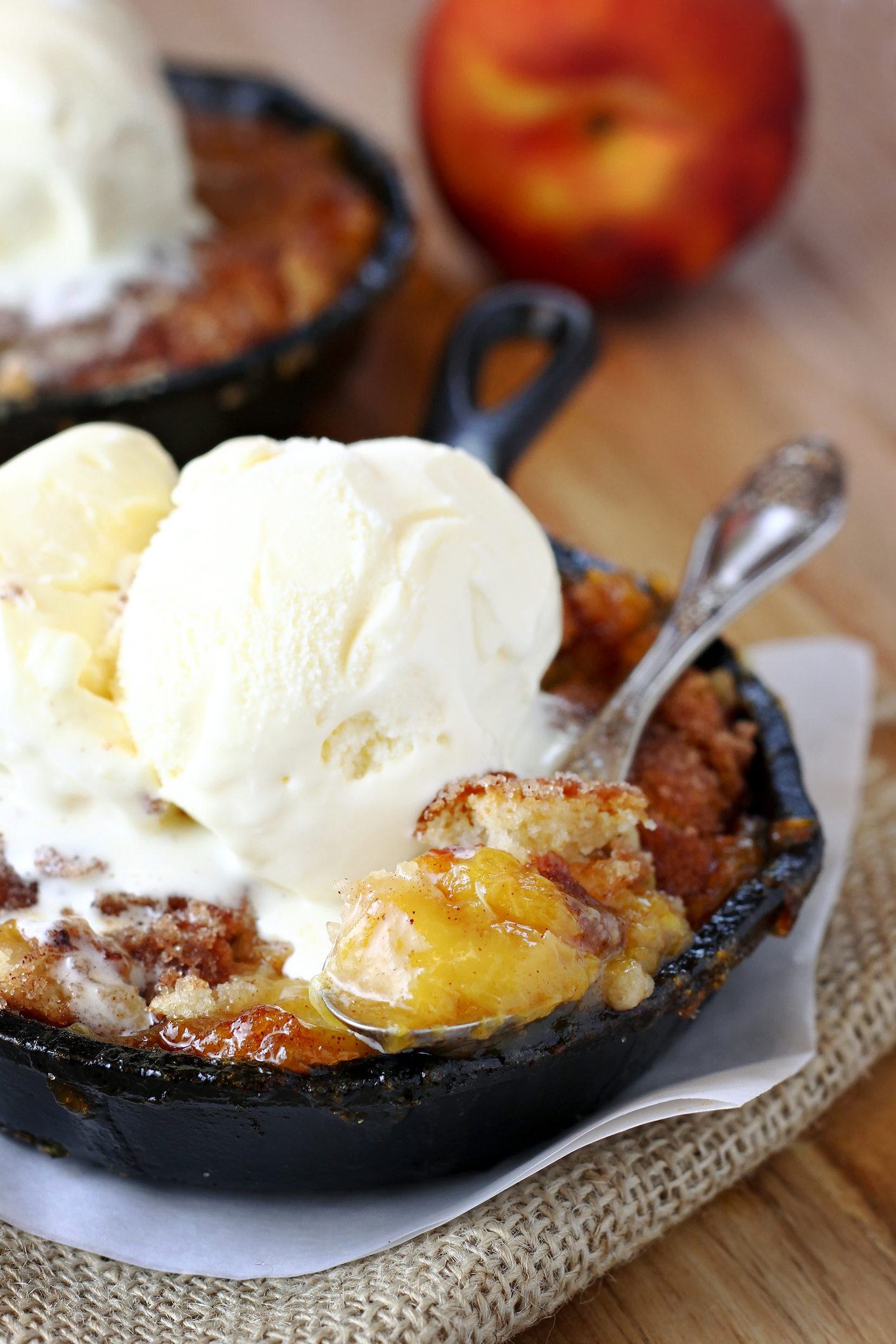
The contrast — warm cobbler, cold ice cream — is almost the entire point.
There’s something that happens right at the border where the ice cream starts melting into the peach juices that I’m not sure I can explain except to say: that’s the bite you’re making this for. It happens faster than you expect, which is why you serve it immediately once you’ve plated it, not five minutes later.
What I’d Do Differently Next Time.
More lemon. The quarter teaspoon of nutmeg is right, but the one tablespoon of lemon juice disappears a little into everything else, and I think the filling could handle another half tablespoon without going sharp.
Honestly? The vanilla ice cream does a lot of lifting here. Which means a mediocre ice cream genuinely shows.
I used a grocery store brand once when I was out of my usual, and the whole dessert felt less like itself — flatter, slightly too sweet without anything to anchor it. Use the good stuff or make your own if you’re feeling ambitious. I was not feeling ambitious that particular evening, and the cobbler paid for it.
Does the peach variety matter? Freestone peaches are easier to work with, but I’ve used whatever was ripe at the market and the results have been fine as long as the fruit was genuinely ripe — not hard, not mealy, ripe.
Hard peaches in this recipe produce a filling that’s more jam-like in all the wrong ways. They don’t soften the same way in 40 minutes of baking.
The Part About Serving It to Anyone.
My daughter watched me scoop the first portion and asked why it looked “messy.” I told her that was how it was supposed to look.
She ate two servings.
Cobbler isn’t meant to be neat — the batter isn’t a crust that holds a clean edge, the fruit isn’t firm, and the ice cream starts melting immediately. If you want something that photographs cleanly, make a tart. This is something else entirely.
There’s a version of this that sits on the table at the end of a long day and asks nothing from you except a spoon. That’s the version I keep coming back to.
I’m still not entirely sure whether eight minutes on the peach-sugar maceration is genuinely better than five or whether I’ve just convinced myself it is. Maybe I’ll test it more carefully next time.
How to Make Warm Peach Cobbler with Vanilla Ice Cream
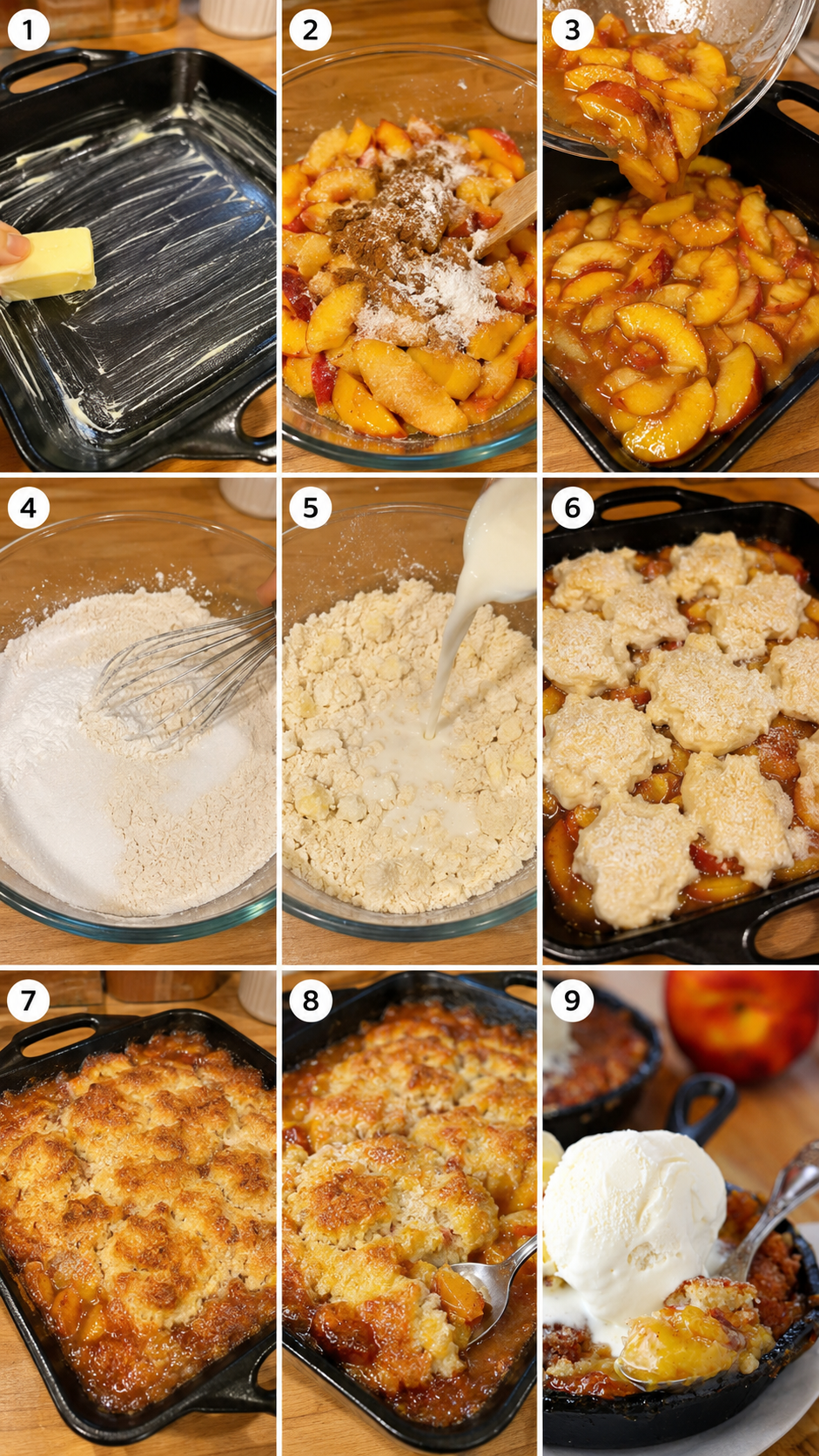
Step 1: Preheat your oven to 375°F (190°C) and butter a 9×13-inch baking dish thoroughly — sides included, not just the bottom. The peach juices will climb the sides as they bubble, and they will stick if you haven’t buttered up there.
Step 2: In a large bowl, combine the 6 sliced, peeled peaches with ½ cup granulated sugar, ¼ cup brown sugar, 1 tablespoon cornstarch, ½ teaspoon cinnamon, ¼ teaspoon nutmeg, ¼ teaspoon salt, 1 tablespoon lemon juice, and 1 teaspoon vanilla extract. Toss gently — you don’t want to break up the slices — then let the bowl sit for at least 5 minutes. (Closer to 8 if your peaches are very juicy; you want enough liquid pooled at the bottom that the cornstarch actually has something to thicken.)
Step 3: Transfer the peach mixture into the prepared baking dish and spread it into an even layer. Pour any accumulated juices from the bowl over the top. Don’t skip this — that’s flavor sitting in the bowl.
Step 4: In a separate bowl, whisk together 1 cup all-purpose flour, ½ cup granulated sugar, 1½ teaspoons baking powder, and ¼ teaspoon salt. Add the 6 tablespoons of cold cubed butter and cut it in with a pastry cutter or your fingertips until the mixture resembles coarse crumbs with some pea-sized pieces remaining. Stir in ½ cup whole milk until just combined — a few streaks of flour are fine. **Did you let your butter get warm while you were prepping? Share below!**
Step 5: Drop spoonfuls of the batter over the peaches in rough clusters, leaving deliberate gaps between them. Sprinkle 1 tablespoon of coarse sugar evenly over the batter. I always feel like I haven’t used enough batter at this point — you haven’t. It spreads and puffs as it bakes.
Step 6: Bake for 40 to 45 minutes. Start checking at 40 — you’re looking for deep golden color on the batter and thick, active bubbling around the edges of the dish, not just a shimmer. If the top is browning faster than the edges are bubbling, tent it loosely with foil for the last 10 minutes.
Step 7: Remove from the oven and let the cobbler rest for 10 minutes before serving. It will look more set after resting than it does the moment it comes out. Serve warm with a generous scoop of vanilla ice cream directly on top of the hot cobbler, not on the side.
Ways to Change It Up
Try this: Swap two of the peaches for nectarines — you don’t even need to peel them, and the flavor is a bit sharper, which plays well against the sweetness of the batter.
Try this: Add ¼ cup of blueberries to the peach mixture. They burst in the oven and turn the juices a deep purple-pink that looks considerably more interesting than the plain version.
Try this: Replace the whole milk in the batter with heavy cream and add a pinch of cardamom to the dry ingredients. The batter comes out denser and richer, which works if you want something closer to a shortcake topping than a biscuit drop.
Which would you go for? Drop it in the comments.
How to Serve It
Serve it in shallow bowls, not plates — the juices pool and you want to be able to get them in every bite. A deep scoop of vanilla ice cream placed directly on the warm cobbler, not beside it.
If you’re serving a group, pull the whole dish to the table and scoop from there. The cobbler holds its temperature longer in the dish than it does once portioned out, which gives everyone a few extra minutes before the ice cream fully disappears.
A small pour of cold heavy cream instead of ice cream works if you’re serving it the next day reheated — the ice cream option really is best when the cobbler is fresh from the oven.
What would you pair it with?
Storing It Without Ruining It
Cover the dish tightly with plastic wrap or foil and refrigerate. It keeps well for about 3 days, though the batter topping softens as it sits — it won’t have the same slight crunch it had on day one.
To reheat, cover loosely with foil and warm it at 325°F for about 15 to 20 minutes until the filling is bubbling again at the edges. The microwave works in a pinch but turns the batter gummy, which I find difficult to overlook.
Freezing the baked cobbler is possible but not ideal. The texture of the batter topping after thawing is noticeably different — denser, a bit wet. If you want to freeze something, freeze the unbaked filling and make fresh batter when you’re ready to bake it.
If you have leftover filling with no batter, it reheats beautifully over oatmeal the next morning. That part I do recommend without hesitation.
Have you ever saved leftovers like this? Tell me below!
Mistakes I Made So You Don’t Have To
I once used peaches that were firm enough to still feel like fruit in my hand — not hard, but not soft either — and the filling after 45 minutes in the oven still had pieces that hadn’t fully broken down. The texture was inconsistent all the way through.
I forgot the cornstarch entirely one batch. The filling ran like syrup when I scooped it, and the ice cream melted into a pale peach soup inside of two minutes. It tasted fine. The whole thing looked like a mistake.
I spread the batter into one solid layer once, thinking the gaps were just aesthetic. The center of the batter where it was thickest came out underdone in the middle — raw-tasting in a way that flour always is when it hasn’t cooked through. The gaps aren’t aesthetic.
Did something like this happen to you?
Questions People Actually Ask
Can I use canned peaches instead of fresh? You can. Drain them thoroughly — and I mean thoroughly, press them — because canned peaches carry a lot of liquid and the filling will be too loose if you skip that step. The flavor is flatter than fresh, but it works in winter when the alternative is mealy fresh peaches that never ripened properly. I tried this once and the result was noticeably sweeter, so I’d cut the granulated sugar by about 2 tablespoons to compensate.
Do I have to peel the peaches? No. Leaving the skin on changes the texture slightly — there are occasional chewy bits in the filling — but the flavor is the same. It depends on whether texture variation in the filling bothers you. Some people don’t notice. I notice.
Can I make this ahead of time? Assemble the filling up to a day ahead and refrigerate it covered. Make the batter fresh right before baking — about 20 minutes max before it goes in the oven. And bake it cold from the fridge; just add 5 minutes to the baking time.
My cobbler came out watery. What went wrong? The cornstarch didn’t get enough time to work, or the peaches were extremely ripe and released more liquid than usual. Next time, let the fruit sit with the sugar longer — closer to 10 minutes — and make sure you’re getting a full 40 to 45 minutes of bake time. The filling only thickens properly once it reaches a genuine boil in the oven. Under-baking is the most common reason. But also: overly juicy fruit just sometimes does this. Serve it anyway.
Can I use frozen peaches? Yes. Thaw them completely first and drain the excess liquid before mixing with the sugar. Frozen peaches release a lot of water as they thaw, and if you add that liquid to the filling it won’t thicken correctly. About 4 cups of thawed, drained frozen peach slices replaces the 6 fresh peaches here.
Why is the batter still pale in the middle after 40 minutes? Your oven runs cool, or you sealed the batter gaps and the steam underneath kept the center wet. Add 5 more minutes and check again. The surface color is less reliable than the bubbling at the edges — watch the edges.
Which answer helped you most?
A Few Last Things Worth Saying
This is a cobbler that rewards patience in two specific places: the maceration and the rest after baking. Everything else is fairly forgiving.
The peaches are the whole thing. Ripe fruit makes this genuinely good. Underripe fruit makes it something you eat because you made it and don’t want to waste it. There’s a difference.
Fun fact: Peaches are members of the rose family — the same family as apples, pears, and cherries — which is why their flavor has that faint floral quality that’s hard to pin down but unmistakable when the fruit is at its peak.
I keep meaning to test this with brown butter in the batter — just browning the butter before cubing and chilling it again — and I haven’t done it yet. I think it would work. I’m not certain.
Will you make this soon?
The version I’m most satisfied with is still slightly different every time I make it, depending on what the peaches are doing that day. I’m not sure I’ve landed on a single fixed version yet.
Happy cooking! —Marina Caldwell
Warm Peach Cobbler Vanilla Ice Cream Bliss
Ingredients
Instructions
Notes
See full recipe for nutritional information.