The first batch went pale and limp.
My husband watched me pull the first round of chips out of the oil and we both just stared at them — soft, greasy, nothing like what I’d imagined.
I almost quit and ordered pizza.
But I’d already soaked two pounds of russet potatoes in ice water for 30 minutes, dried every single slice with paper towels, and I wasn’t about to waste that. So I kept going, raised the oil to 350°F, and dropped them back in for a second fry.
That’s when they cracked.
Why two fries? Honestly, it annoyed me too.
The first fry — at 325°F for about 8 to 10 minutes — does something the second fry can’t: it slowly drives the moisture out without burning the outside.
Pale. Floppy. Looks wrong.
Then the second fry at 350°F finishes them in 2 to 3 minutes flat, and you get this shattering crunch that doesn’t go soft when you pile on the Parmesan. That was the part I couldn’t figure out the first time — why my chips always went soggy under cheese. It’s because they weren’t fully dry inside before the topping went on.
Okay, the ice water thing.
I thought about skipping it — actually no, I did skip it once, and the chips came out unevenly brown with a weird chewy center on a few slices.
Thirty minutes in cold water pulls the surface starch off the potato slices, and that starch is what causes clumping and uneven frying.
Quick tip: After the soak, press each slice individually between paper towels — don’t just pat them, press them. Any water left on the surface when it hits hot oil will splatter and the chips will steam instead of fry.
The Parmesan question.
Pre-grated from the green can? I tried it — the cheese didn’t melt or cling, it just sat in dry clumps on top and fell off when I picked up a chip.
Freshly grated, right off a block, added while the chips are still hot from the second fry. That’s the move.
The heat does most of the work — it softens the Parmesan just enough to stick without making it gummy, and then it firms back up within a minute. Have you ever tried adding cheese to chips at different temperatures? Because the window is shorter than I expected, maybe 90 seconds after draining.
It looked wrong. It wasn’t.
When the chips come out of the second fry they look almost too dark, like you’ve gone too far,
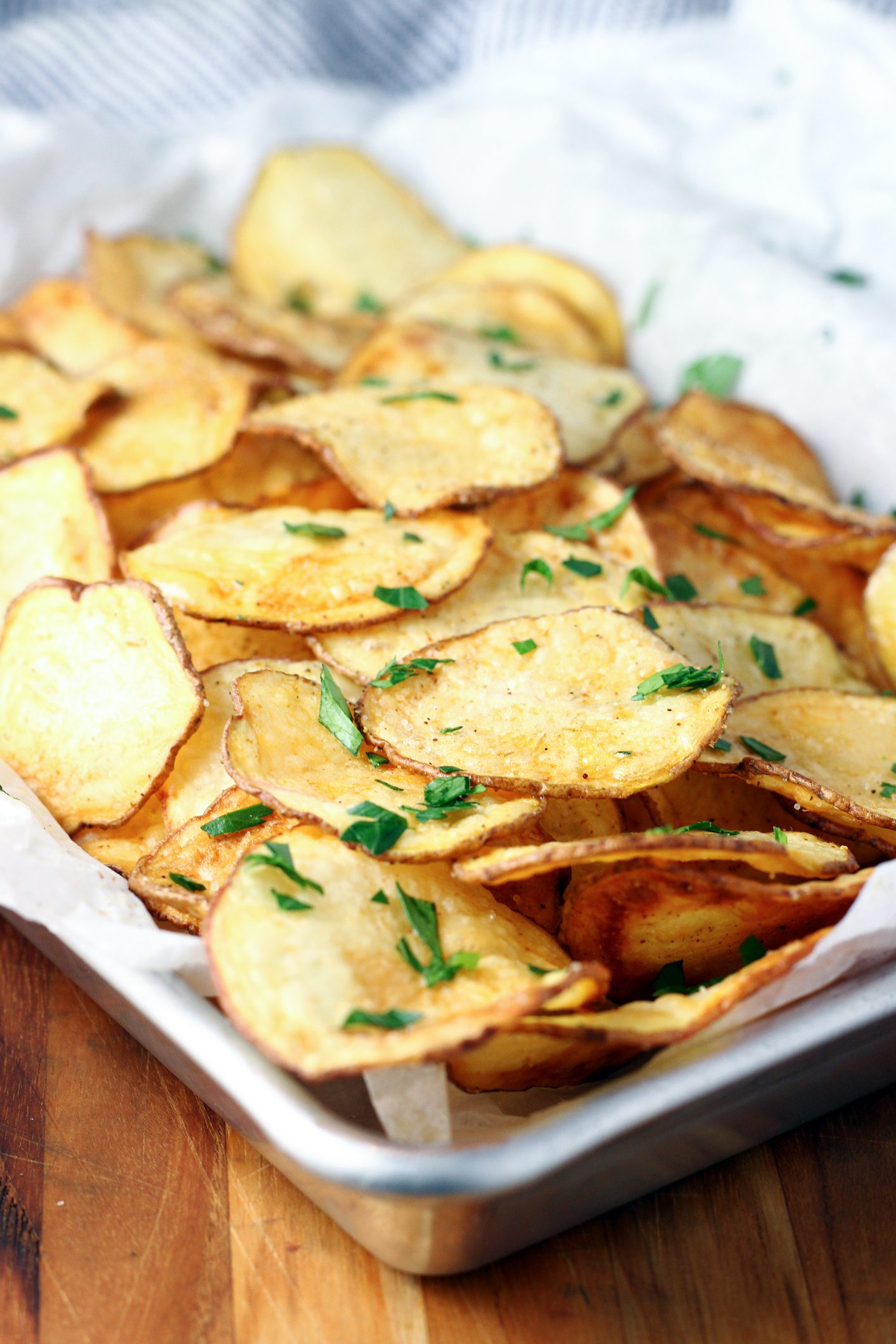
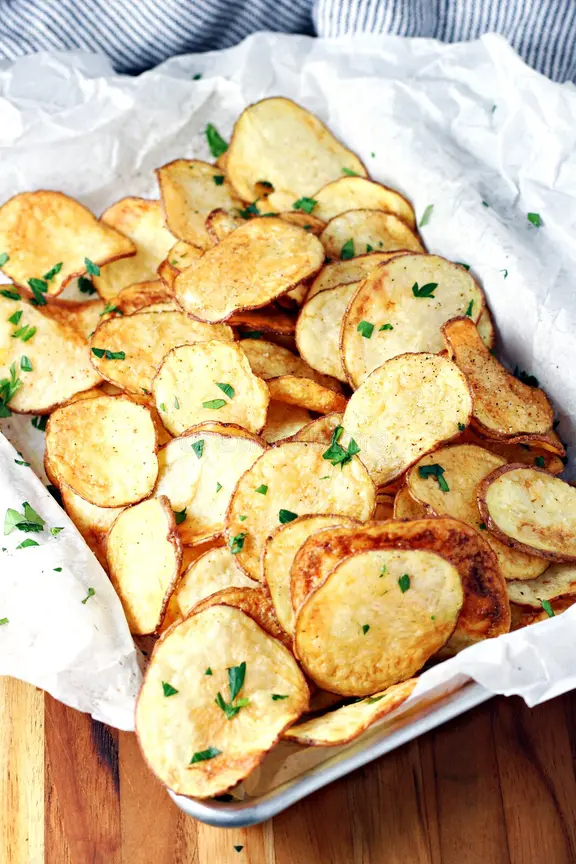
and then they cool on the paper towels for two minutes and turn this deep amber gold that looks intentional.
I thought about adding smoked paprika — actually no, I kept the regular kind, because smoked paprika with fleur de sel and Parmesan was too much going on in a single bite. The rosemary and thyme scattered across the platter are mostly decorative but they do release a little fragrance when the hot chips land on them, which is a nice touch.
About the herb situation.
Fresh sprigs only.
Dried rosemary goes sharp and scratchy on a thin chip — it’s not pleasant. The fresh sprigs aren’t really meant to be eaten straight; they sit underneath and around the chips on the platter and the heat pulls the oils out just enough. My neighbor Rosa asked me why I didn’t just toss dried herbs directly on them, and I told her to try it both ways and come back to me.
She came back.
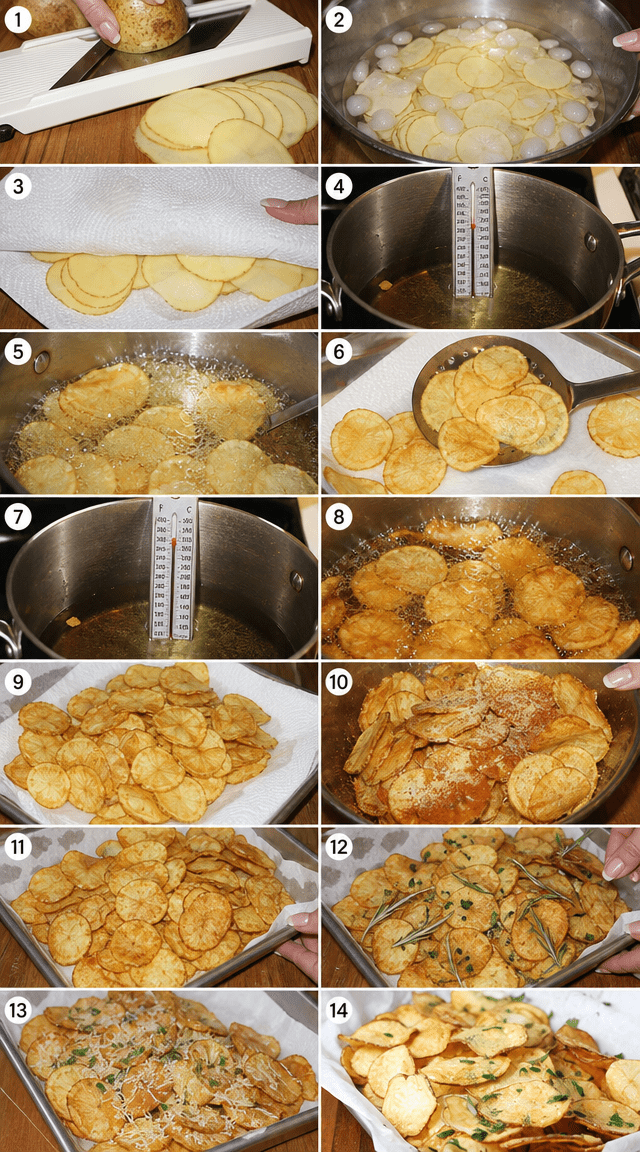
Step 1: Slice 2 lbs of russet potatoes as thinly as you can manage — a mandoline set to about 1/16 inch is the most consistent, but a sharp knife and patience work too. You want translucent, even slices. Thick spots fry unevenly and the thicker section stays soft while everything else crisps up.
Step 2: Submerge all the slices in a large bowl of ice-cold water and let them sit for 30 minutes. (Don’t skip this. I know it seems like extra work, but it’s the difference between chips that hold their crunch for an hour and chips that go soft before you’ve finished plating them.)
Step 3: Drain the slices and dry them — really dry them. Lay them out on a clean kitchen towel or several layers of paper towels and press firmly. I go through more paper towels than I’d like to admit doing this step. Wet potato hitting 325°F oil does not end well.
Step 4: Pour 2 cups of vegetable oil into a heavy pot — cast iron or a Dutch oven is best — and bring it to 325°F over medium heat. Use a thermometer. Guessing the temperature is how you end up with greasy chips or burned ones, and there’s not a lot of middle ground.
Step 5: Fry in small batches, 8 to 10 minutes per batch, until slices turn a pale, slightly matte gold. They will look underdone. They should. Transfer them to a paper towel-lined tray with a slotted spoon and don’t stack them while they’re hot.
Step 6: Raise the oil temperature to 350°F. This takes about 3 to 4 minutes between batches — don’t rush it by cranking the heat, or your next batch goes in too hot. Return the first-fried chips to the oil in small batches again, this time for just 2 to 3 minutes until they turn deeply golden and you can hear them crackling in the pot.
Step 7: Drain immediately on fresh paper towels. While still warm — this is the 90-second window I mentioned — toss the chips with 1 tsp sea salt, ½ tsp garlic powder, ½ tsp paprika, and ¼ tsp black pepper. Do you season before or after the second fry? I used to season before, and they just tasted burnt where the spices hit the oil — drop your method in the comments. Share below!
Step 8: Arrange on a serving platter with fresh rosemary and thyme sprigs scattered across and underneath. Finish with a pinch of fleur de sel and a generous handful of freshly grated Parmesan over the top while the chips are still warm enough to hold it.
Ways to Change It Up
Try this: Swap the Parmesan for aged Pecorino and add a crack of black pepper right at the end — it reads completely different, sharper and a little more aggressive, and works really well if you’re serving these with wine.
Try this: Skip the paprika and garlic powder entirely and go with a dusting of za’atar and a drizzle of lemon zest right before serving. It sounds like a lot but the chips can take it.
Try this: Add a very light drizzle of truffle oil — and I mean light, about ½ teaspoon across the whole batch — right before the Parmesan goes on. The heat from the chips is enough to bloom it.
Which would you go for? Drop it in the comments.
How to Serve It
These work well next to a cold glass of something sparkling — the salt and fat from the chips cut clean against carbonation. I’ve put them out with a small bowl of crème fraîche and chives on the side, and people treated it like a dip without being told to.
They also sit well on a cheese board in place of crackers — the Parmesan already on the chips means you don’t need a strong cheese next to them, so mild things like fresh mozzarella or burrata work better than sharp cheddar here.
Honestly, they’re fine on their own over a sink at 11pm. I’ve made worse choices.
What would you pair it with?
Storing It Without Ruining It
Room temperature in an airtight container — not the fridge. The fridge makes them soft within an hour, and I learned that the hard way after storing a full batch overnight and pulling out something closer to cooked potato slices than chips.
They’ll stay reasonably crisp for about 2 days at room temperature, though day two is noticeably less crunchy than day one. If you want to revive them, spread them on a baking sheet and put them in a 375°F oven for about 5 minutes — not longer, they go from crisp to burnt fast at that temp.
Freezing doesn’t work. The texture on thaw is genuinely bad and not worth attempting.
Have you ever saved leftovers like this? Tell me below!
Mistakes I Made So You Don’t Have To
I once crowded the pot with too many slices at once — not a few too many, I’m talking nearly the whole batch — and the oil temperature dropped to somewhere around 280°F, the chips clumped together, and I ended up with a soggy potato mass that I had to peel apart with tongs.
Skipping the paper towel press between the soak and the first fry. The oil spatters badly when wet potato hits it, and I caught a few drops on my forearm the first time I rushed this step. Dry the slices. Actually dry them.
Adding the fleur de sel before the second fry instead of after — the salt draws more moisture to the surface during frying and the chips came out slightly soft in the center despite looking done on the outside. Salt goes on after. Both times I made this mistake the chips looked fine and tasted off and I couldn’t figure out why for longer than I’d like to admit. Did something like this happen to you?
Questions I Actually Get Asked About These
Can I use a different type of potato? Russets work best here because of their high starch content — that starch is exactly what the ice water soak pulls out, and it’s what gives you a chip that shatters rather than bends. I tried Yukon Golds once and they came out more like thin fried potato rounds, still good, but a different texture entirely and they didn’t crisp up until about 4 minutes into the second fry.
Do I need a mandoline? No. But the slices need to be consistent — uneven slices mean half the batch burns before the other half is done. A sharp chef’s knife and slow, careful cuts get you there. It takes longer, maybe 15 extra minutes of prep. And if you already own a mandoline, use it.
How long do these stay crispy after serving? About 45 minutes to an hour before you notice them softening, especially if there’s humidity in the room. Add the Parmesan right before people eat, not right before people arrive. It’s a small difference but it matters.
Can I make these in an air fryer? It depends — if your air fryer basket fits single-layer slices without overlap, you can get a decent result at 375°F for about 12 minutes, flipping halfway. But the double-fry method builds a different kind of crunch than circulated hot air does. They’re not the same chip. Both are fine, but don’t expect identical results.
What oil works best? Vegetable oil is neutral and has a high enough smoke point to handle 350°F without issue. I tried avocado oil once and it worked fine, but it added about $4 to the batch cost for no noticeable flavor difference. Olive oil is too low a smoke point for this temperature. Don’t use it.
Can I prep these ahead of time? You can do the first fry up to 4 hours ahead and leave the pale chips at room temperature on a tray. Then do the second fry right before serving. That’s the best make-ahead window I’ve found — going longer than 4 hours between fries and the first-fried chips start to feel a little stale going into the second fry, and the final texture suffers for it.
Which answer helped you most?
Before you go make these.
The double fry is worth it. I know it sounds fussy and when I first read about it I thought it was the kind of thing food magazines invent to make recipes feel more impressive than they are.
It’s not.
The difference between a single-fried chip and a twice-fried one is audible — you can hear the crunch from across the table, and they hold it for nearly an hour after coming out of the oil. That’s not something I expected the first time I made them.
Fun fact: Russet potatoes contain about 80% water by weight — which is exactly why the ice water soak and the aggressive drying step matter so much. You’re removing surface starch while managing all that internal moisture before it hits the hot oil.
The fleur de sel at the end is not optional in my house. It’s coarser and flakier than regular sea salt and it sits on top of the chip rather than dissolving into it — you get a little hit of salt with each bite instead of a uniform saltiness all the way through. My youngest now calls these “the fancy chips” and asks for them specifically, which is high praise from someone who considers a plain pretzel a gourmet experience.
Will you make this soon? I hope so. And if your first batch comes out pale and limp, keep going — you’re halfway there already.
Happy cooking! —Marina Caldwell
Twice Fried Parmesan Herb Potato Chips Recipe
Ingredients
- 2 lbs russet potatoes
- 2 cups vegetable oil
- 1 tsp sea salt
- ½ tsp garlic powder
- ½ tsp paprika
- ¼ tsp black pepper
- Fresh rosemary sprigs
- Fresh thyme sprigs
- Fleur de sel
- Freshly grated Parmesan cheese
Instructions
- 1Using a mandoline or sharp knife, slice potatoes as thinly as possible
- 2Submerge slices in ice-cold water for 30 minutes to draw out excess starch
- 3Thoroughly dry each slice using paper towels, pressing firmly
- 4Pour oil into a heavy pot and bring to 325°F over medium heat
- 5Working in small batches, fry slices 8-10 minutes until pale golden
- 6Transfer chips to a paper towel-lined tray using a slotted spoon
- 7Raise oil temperature to 350°F
- 8Return chips to oil for a final 2-3 minute fry until deeply golden and shatteringly crisp
- 9Drain on fresh paper towels immediately
- 10While still warm, toss chips with sea salt, garlic powder, paprika, and black pepper
- 11Arrange on a serving platter and scatter rosemary and thyme sprigs throughout
- 12Finish with a pinch of fleur de sel and a generous shower of Parmesan
Notes
– Never skip the ice water soak — it guarantees maximum crunch by removing surface starch – Frying in two stages is the secret to chips that stay crispy longer without burning – Dry potatoes completely before frying to prevent dangerous oil splatter