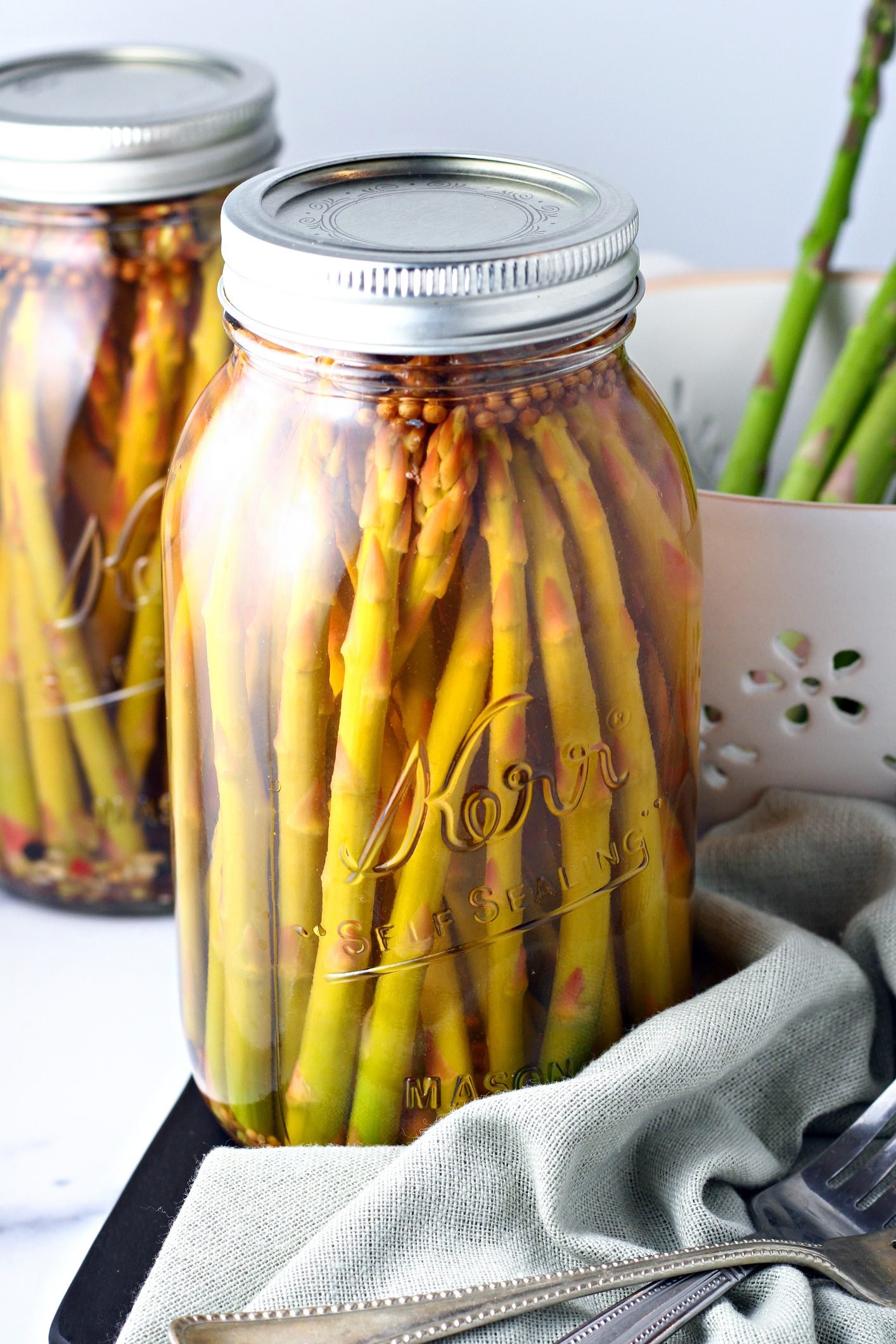
The jar was still warm when I put it in the fridge.
I packed those first jars at about 9 at night, and I didn’t wait long enough for them to cool before I refrigerated them — the lids made a weird condensation ring on the shelf and I was convinced I’d done something wrong.
I hadn’t done anything wrong. The asparagus was great. But I’ll always remember standing there in my kitchen socks on the tile, second-guessing myself over a jar of pickled vegetables.
Why asparagus, though?
My neighbor Rosa brought a jar of pickled green beans to a cookout three summers ago, and I kept thinking about how the crunch held up even after days in brine.
Asparagus does the same thing — maybe better, because the spears are long enough to stand upright in the jar and they look almost architectural when you stack them tight.
There’s something that happens around hour 36 where the brine pulls into the tips and the whole thing tastes more like itself, like asparagus but louder.
About the brine ratio.
Four cups of white vinegar to two cups of water is sharp — sharper than most refrigerator pickle brines I’ve used — and I thought about cutting it with more water the first time I made this.
I didn’t, and I’m glad, because that acidity is exactly what keeps the spears from going soft. The 4 tablespoons of sugar round it out just enough that it doesn’t feel like you’re eating straight vinegar.
Quick tip: Dissolve the salt and sugar completely before you pull the pot off the heat — undissolved sugar will make the brine cloudy and you’ll spend 10 minutes wondering if it went bad.
The spice situation, honestly.
One teaspoon of red pepper flakes per jar — I thought about adding paprika — actually no, I skipped it, because the dill and garlic are already doing a lot of work and I didn’t want to muddy it.
The heat from the flakes comes in at the back of your throat, not the front. It’s subtle enough that my husband didn’t even register it until the third spear.
Have you ever made a pickle brine and realized the aromatics were fighting each other? That’s what I was afraid of here, and it’s worth being conservative the first time you make it.
It looked wrong. It wasn’t.
After 24 hours in the fridge, the asparagus turns a duller green — kind of army-colored — and the brine goes slightly hazy from the garlic.
The first batch I made, I nearly tossed the whole thing at that point.
That haze is just the garlic and peppercorns doing what they do. Taste it before you decide anything.
What I’d tell you before you start.
Uniform thickness matters more than you’d think — I grabbed a bunch with mixed thin and fat spears once, and the thin ones were almost too soft by day three while the fat ones still needed another day.
Trim the spears so they sit about an inch below the rim,
and don’t skip that step, because spears poking up past the brine will dry out at the tips and taste like nothing.
Sterilize your jars. I know it’s an extra step. Do it anyway.
How to Make Bright Vinegar Asparagus Spears Chilled to Perfection
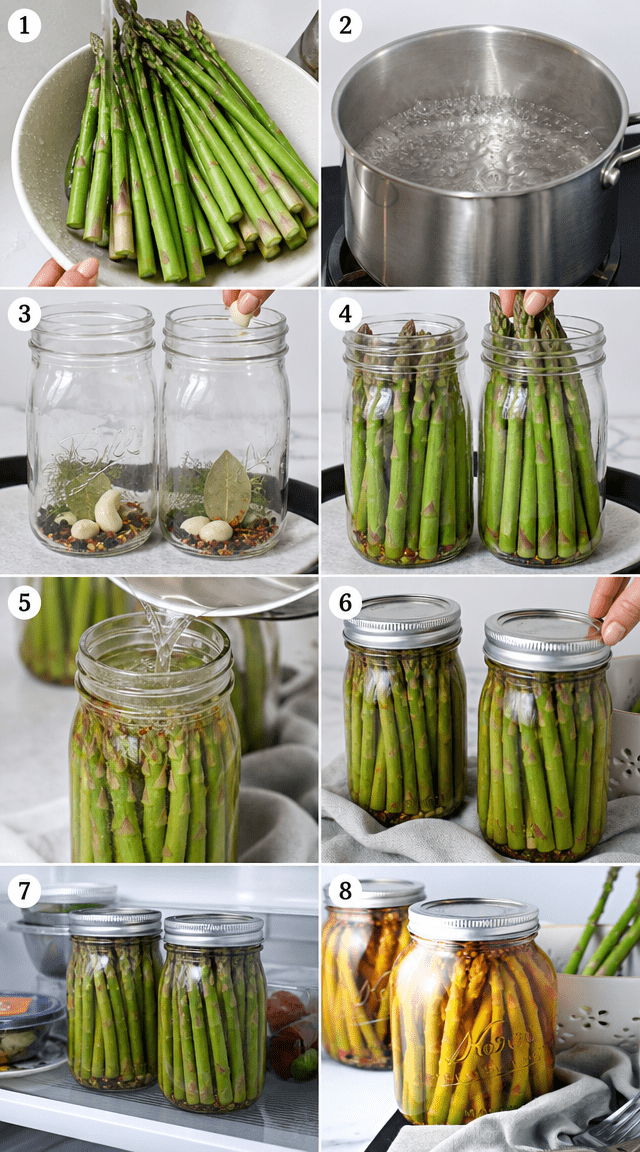
Step 1: Rinse your 2 lbs of asparagus under cold water and trim each spear so it sits roughly 1 inch below the rim of your quart jar. Hold one jar up and actually measure — don’t eyeball it — because spears that are too long will push the lid and break your headspace. I’ve done this more than once.
Step 2: Combine 4 cups white vinegar, 2 cups water, 4 tablespoons salt, and 4 tablespoons sugar in a large pot. Bring it to a rolling boil, stirring until every grain of salt and sugar is dissolved. (If you see any cloudiness while it’s hot, keep stirring — undissolved salt is the culprit almost every time.) The smell will be sharp and strong, and that’s fine.
Step 3: Layer the bottom of each sterilized quart jar with 2 peeled garlic cloves, 1 teaspoon red pepper flakes, 2 sprigs of fresh dill, 1 bay leaf, and 1 teaspoon of black peppercorns. I find it easier to do all four jars in an assembly line rather than finishing one at a time — it keeps everything even.
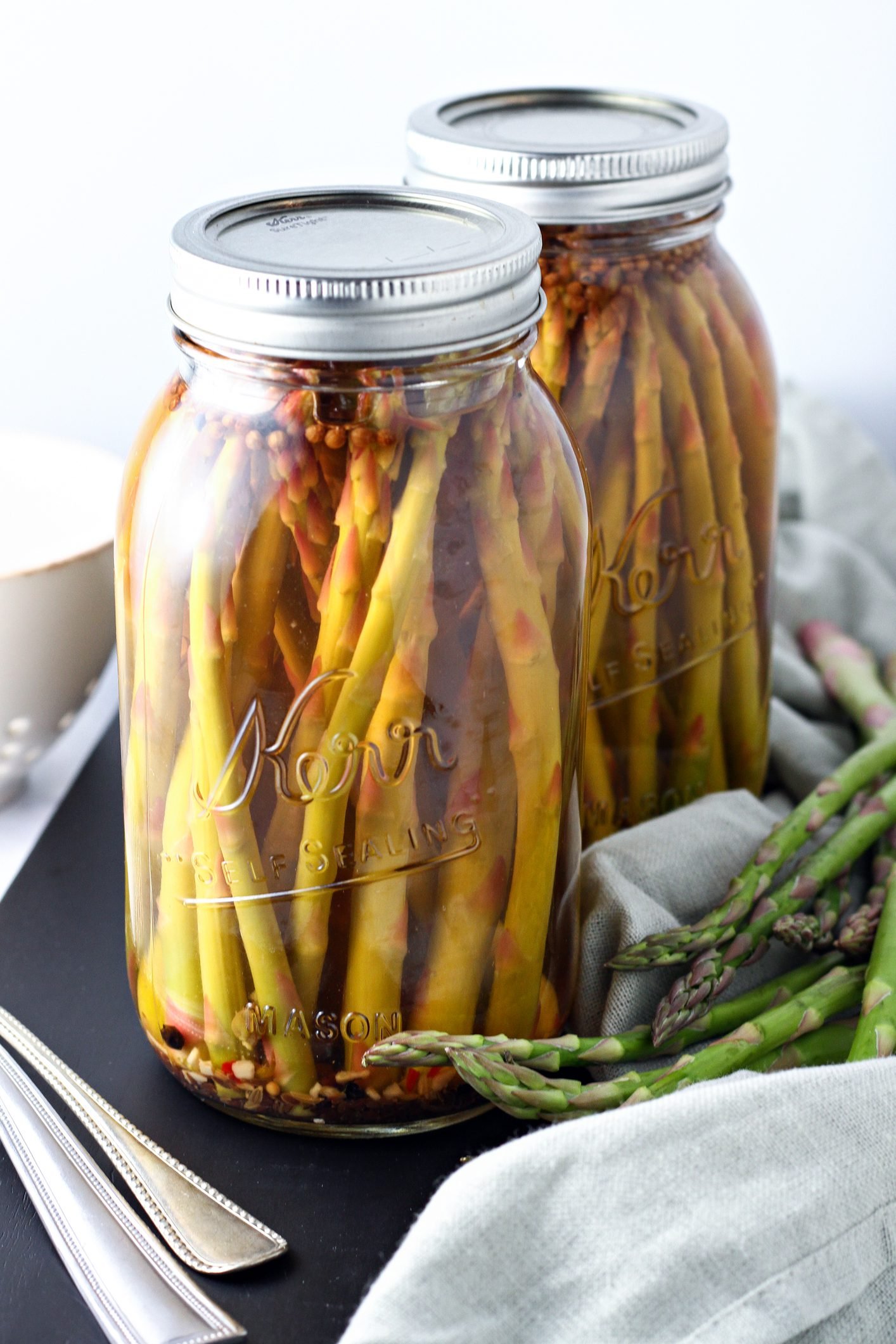
Step 4: Stand the asparagus spears upright in the jars, packing them in tightly. The tighter you pack them, the less they’ll float around when you pour the brine. Honestly, fitting them in is the most satisfying part of the whole process — it’s like a little green puzzle.
Step 5: Ladle the hot brine carefully over the asparagus, keeping that 1-inch headspace at the top. (Use a wide-mouth funnel if you have one — I didn’t the first time and poured vinegar brine across my entire counter.) Fill all four jars before the brine cools.
Step 6: Secure the lids firmly and set the jars on the counter to cool completely at room temperature — don’t rush this into the fridge. This takes about 2 hours depending on your kitchen temperature. The lids may flex a little as they cool, and that’s normal.
Step 7: Transfer to the refrigerator and leave them alone for a minimum of 24 hours. I know that’s hard. Wait at least 36 if you can, because the flavor at 36 hours is noticeably deeper than at 24. Consume within 2 months for best quality, though mine have never lasted anywhere near that long.
Did you pack your jars tight or leave them a little loose? Does it change the texture for you? Share below!
Ways to Change It Up
Try this: Swap the red pepper flakes for a sliced fresh jalapeño per jar — it gives a greener, grassier heat than the dried flakes and makes the brine look beautiful.
Try this: Add a strip of lemon zest to each jar along with the dill. My sister thought the original version needed more lemon, and she was right — the zest adds brightness without thinning the brine.
Try this: Replace half the white vinegar with apple cider vinegar for a softer, slightly fruity acidity. It changes the color of the brine but the crunch holds just as well.
Which would you go for? Drop it in the comments.
How to Serve It
Pull a spear straight from the jar and lay it alongside a cheese board — the acidity cuts right through anything creamy or aged, and the length of the spear looks good next to wedges of hard cheese.
Chop them into 2-inch pieces and toss them into a grain bowl with farro or barley. The brine acts like a built-in dressing and you don’t need to add much else.
Serve them whole in a tall glass next to a Bloody Mary. That’s it. That’s the suggestion. It works.
What would you pair it with?
Storing It Without Ruining It
These are refrigerator pickles — they don’t go through a water bath canning process, so they live in the fridge and nowhere else. Keep them sealed, and they’re good for up to 2 months.
Don’t freeze them. I tried it once out of curiosity and the spears came out genuinely mushy, like something had gone wrong at a cellular level.
If you’ve already opened a jar, just make sure the spears stay submerged under the brine. A fork nudging them back down every time you take one out is honestly all the maintenance this requires.
Reheating isn’t really a thing here — these are served cold, straight from the jar. That’s kind of the whole point.
Have you ever saved leftovers like this? Tell me below!
Mistakes I Made So You Don’t Have To
I once used asparagus that had been sitting in my fridge for almost a week, thinking the brine would revive it. It didn’t. The spears were soft by day two and the tips went almost mushy. Start with fresh asparagus, as fresh as you can get it.
The brine broke on my second batch — not chemically, but I poured it in too slowly and it cooled unevenly between jars. The last jar barely got hot brine at all. I served it anyway, and it was fine after four days, but the texture in that jar was softer than the others.
I skipped sterilizing the jars once because I was in a hurry and told myself it would be fine. One jar developed a slimy film on the inside after about 10 days and I had to throw the whole thing out. Not worth it. Sterilize the jars.
Did something like this happen to you?
Questions I Actually Get About This Recipe
Can I use a different vinegar? White vinegar is the sharpest and keeps the color of the asparagus most neutral, but apple cider vinegar works well too. I tried rice vinegar once and the brine tasted a little flat — it doesn’t have enough acidity on its own. And the asparagus went soft faster. Stick to white or ACV.
How long until they actually taste pickled? About 24 hours minimum, but 36 to 48 is where the flavor really settles in. The tips absorb brine faster than the stems, so if you taste one at 24 hours and the bottom is still bland, wait another half day. It depends on how thick your spears are.
Do I have to use fresh dill? I only have dried. Dried dill works, but use about half the amount — 1 teaspoon per jar instead of 2 sprigs. I tried this once and the flavor was a little more muted, less grassy, but still good. But fresh dill makes a visible difference.
Is 4 tablespoons of salt too much? It sounds like a lot. It’s not. That brine is covering 2 lbs of asparagus across 4 jars, so it dilutes considerably. If you reduce the salt, the spears will taste flat and won’t stay as crisp — I tried cutting it to 2 tablespoons once and the texture was noticeably softer by day five.
Can I reuse the brine for a second batch? It depends on how much brine you have left and whether it’s been contaminated by asparagus fiber. I’ve done it once with a batch where I had a full jar’s worth left over. It tasted fine but the second batch was slightly less acidic. I wouldn’t do it more than once.
What if I only have pint jars? Cut the spears shorter — about 3 inches — and pack them in horizontally if you need to. It’s not ideal. The spears tend to float a bit more and you get uneven pickling. Quart jars are genuinely worth finding for this recipe.
Which answer helped you most?
Go make a jar. Just one jar.
You don’t have to commit to four jars the first time you do this. Start with one, see how you feel at the 36-hour mark, and go from there.
The hardest part is waiting.
My kids ate an entire jar in one sitting the first time I made this — standing at the open fridge, pulling spears out one by one, and I called it a win.
You’ll learn things on the first batch that you can’t learn from reading about it — which jar packed tightest, how much your brine cools between the first and last jar, whether your fridge keeps them cold enough near the door.
Will you make this soon?
Fun fact: Asparagus contains a compound called asparagusic acid — it’s found almost nowhere else in nature and it breaks down during digestion into sulfur-containing molecules, which is why asparagus does that unmistakable thing to your urine. The pickling process doesn’t neutralize it.
Happy cooking! —Marina Caldwell
Bright Vinegar Asparagus Spears Chilled to Perfection
Ingredients
- 2 lbs fresh asparagus spears, trimmed
- 4 cups white vinegar
- 2 cups water
- 4 tablespoons salt
- 4 tablespoons sugar
- 8 cloves garlic, peeled
- 4 teaspoons red pepper flakes
- 8 sprigs fresh dill
- 4 bay leaves
- 1 teaspoon black peppercorns per jar
- 4 sterilized quart-sized glass jars with lids
Instructions
- 1Rinse asparagus under cold water, then trim spears to sit roughly 1 inch below each jar’s rim
- 2Combine vinegar, water, salt, and sugar in a large pot, bringing the mixture to a rolling boil until salt and sugar fully dissolve
- 3Layer the bottom of each jar with 2 garlic cloves, 1 teaspoon red pepper flakes, 2 dill sprigs, 1 bay leaf, and 1 teaspoon peppercorns
- 4Stand asparagus spears upright and tightly inside each prepared jar
- 5Carefully ladle the hot brine over the asparagus, preserving that 1-inch headspace at the top
- 6Firmly secure lids and allow jars to cool completely at room temperature
- 7Transfer to the refrigerator and allow flavors to develop for a minimum of 24 hours before enjoying
- 8Consume within 2 months for best quality
Notes
– Choose asparagus spears of uniform thickness so they pickle evenly and finish at the same rate – For a milder heat level, reduce red pepper flakes to ½ teaspoon per jar or omit entirely – Always ensure jars are properly sterilized before use to maximize shelf life and prevent contamination