This Is Not a Forgiving Cake
There are cakes that meet you halfway, and this isn’t one of them. The genoise doesn’t care how tired you are or how many times you’ve made a sponge before — fold it wrong, rush the eggs, and it will sink into itself like a quiet, dense little tragedy.
I made it four times before I got something I’d actually serve to anyone.
The third attempt was the worst. I thought the egg mixture was ready at the seven-minute mark because it looked pale enough. It wasn’t. The batter went flat the second I started folding in the flour, and I stood there watching it happen, unable to stop it, which is its own kind of cooking frustration.
Eight to ten minutes on the electric mixer. Not seven. Not eight if it looks close. The full time.
What surprised me the most — and you’d only know this if you’d made it — is how different the batter looks at the correct stage versus almost correct. When it’s right, it falls off the whisk in a thick, slow ribbon that holds its shape on the surface for a full two or three seconds before dissolving. When it’s not ready, it disappears immediately. That’s the marker. Not color, not volume alone. The ribbon.
My neighbor Claire watched me make the fourth batch and kept asking if it was supposed to look “that foamy.” I said yes and then immediately second-guessed myself, which I shouldn’t have, because it turned out fine. Quick tip: if your batter holds a visible figure-eight when you drizzle it from the whisk, you’re there.
The Lemon Cream Broke on Me.
The first time I made the lemon cream, it broke. Not slightly — completely. I whisked the butter in too fast when the curd was still too warm, and it went greasy and separated in about thirty seconds.
I served it anyway. Not proudly.
The fix I landed on after that: cool the curd until you can hold your hand near the bowl without feeling heat. Not cold, not room temperature — just no longer warm. Then add the butter one piece at a time, waiting until each cube has fully disappeared before adding the next. That’s roughly 100g of butter across eight or nine additions, which feels unnecessarily slow until you rush it once and learn why it matters.
Most recipes tell you to cool “slightly.” That’s vague enough to ruin you. Cool it more than you think you need to.
The finished cream — when it works — is pale yellow, slightly glossy, and thick enough to hold a spoon upright when chilled. It’s sharp and rich at the same time, which is the whole point of this cake. The whipped cream softens it. The berries cut through both.
About the Flour.
Three additions. Not two, not one big dump. Three.
Sift the flour and salt together before you start anything else. I used to skip the sifting because it felt fussy, and then I’d spend the next three minutes trying to work out lumps in the batter while also trying not to deflate it, which — you can’t do both at once.
Fold with a large spatula. Cut down through the center, sweep along the bottom, fold up the side. Don’t stir. Don’t use a whisk. Every unnecessary revolution of the spoon is air leaving the batter, and the genoise doesn’t have structure from fat or leavening to recover. What you put in is what you get out.
The butter goes in last — after the flour is almost but not quite fully incorporated — and it should be melted and cooled, not hot. I thought about adding a splash of almond extract once — actually no, I skipped it. This cake doesn’t need anything extra going on.
Stop folding the moment you can’t see streaks. That’s it. Doesn’t matter if it doesn’t look perfectly uniform. Overmixed is worse than undermixed here, and no one has ever eaten a slice and said “I detected a faint flour streak.” They haven’t.

I Left One Layer in Two Minutes Too Long.
On purpose, actually. I wanted to see what would happen if I pushed the bake to 27 minutes. The edges pulled away from the pan slightly more and the crust got just a bit chewier, which I didn’t love against the soft cream. Twenty to twenty-five minutes is the window, and in my oven it’s reliably done at 23.
The toothpick test works here, but I also press the center lightly with one finger. If it springs back immediately, it’s done. If it leaves a small dent, give it another two minutes.
Cool in the pans for ten minutes, then turn out onto wire racks. Don’t rush this. The layers are fragile when they’re hot, and a cracked genoise is annoying to assemble — not impossible, just annoying in a way that compounds every step after it.
Fully cool before you touch the cream. That’s a hard line. Warm cake plus lemon cream equals a sliding, leaning disaster that looks like something went wrong at a birthday party.
The Assembly Is Where It Gets Fussy.
Both creams need to be cold-ish but still spreadable. The lemon cream should have been chilling for at least 45 minutes. If it’s too firm, it’ll drag and tear the sponge. If it’s too loose, it slides off the sides.
Spreadable, not soft. Soft is wrong.
I spread the lemon cream first — about half of it — on the bottom layer, then the whipped cream on top of that. The whipped cream acts as a buffer between the tart curd and the berries, which would otherwise bleed into the lemon layer and make everything look grey-pink after a few hours. Layer order matters here in a way that only shows up later, not when you’re assembling.
Did yours hold together when you cut into it? Mine didn’t, the first time — everything just slid sideways on the plate.
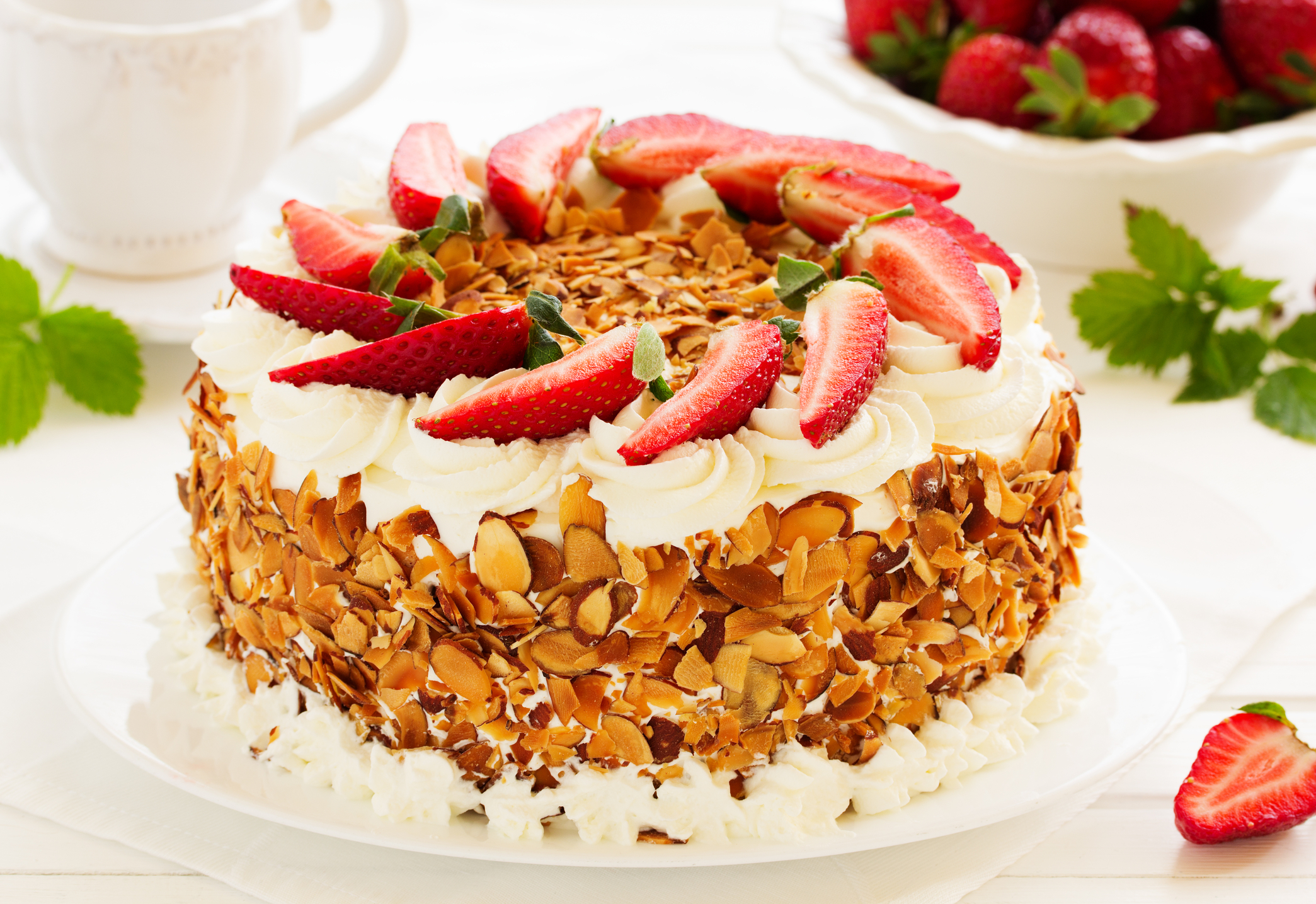
The berries on top don’t need to be arranged in any particular pattern. I’ve tried. It doesn’t make the cake taste better and it takes eight minutes I could be spending on other things. Scatter them. Let them land where they land. Finish with lemon zest, which does more for the visual than any careful berry placement ever did.
Chill the finished cake for at least 30 minutes before serving. Cutting into it at room temperature after assembly means the cream layers shift and the slices don’t hold. Chilled, it cuts cleanly — that satisfying clean edge where you can see the yellow cream and the white and the berries all in cross-section.

The Full Ingredient List
For the genoise: 4 large eggs, 120g granulated sugar, 120g all-purpose flour, 50g unsalted butter (melted), 2 tsp vanilla extract, 1/4 tsp salt.
For the lemon cream: 3 large egg yolks, 80g granulated sugar, zest and juice of 2 lemons, 100g unsalted butter (cubed), 1/4 tsp salt.
For the whipped cream and finish: 300ml heavy whipping cream, 30g powdered sugar, 300g fresh mixed berries (strawberries, blueberries, raspberries), fresh lemon zest for garnish.
Fun fact: Lemons produce more juice when they’re at room temperature — a cold lemon straight from the fridge can yield almost 30% less juice than one left out for an hour.
—Step 1: Preheat your oven to 350°F (175°C). Grease two 8-inch round cake pans and line the bottoms with parchment paper. Do both pans at once so the batter doesn’t sit waiting after it’s mixed.
Step 2: Combine the 4 eggs and 120g granulated sugar in a heatproof bowl set over a saucepan of simmering water. Whisk constantly — not aggressively, just steadily — until the mixture warms to around 43°C (110°F). It should feel just warm when you touch a drop of it to your wrist, not hot. (If you don’t have a thermometer, that wrist test is your best guide.)
Step 3: Remove the bowl from the heat and whisk with an electric mixer on high speed for 8 to 10 minutes until the mixture is pale, thick, and tripled in volume. This is where most people stop too early. It should look nearly white and fall from the beaters in a slow, thick ribbon. I almost always go the full 10 minutes.
Step 4: Sift the flour and salt together. Add it to the egg mixture in three separate additions, folding gently with a large rubber spatula each time. Cut down through the center, sweep along the bottom, fold over. Stop when you can barely see streaks — not when it looks perfectly smooth. (Overfolding is the most common way this cake fails. Stop sooner than you think you need to.)
Step 5: Add the melted, cooled butter and vanilla extract. Fold until no streaks of butter remain, which takes about 6 to 8 slow folds. The batter will deflate slightly here — that’s expected, not a sign that something went wrong.
Step 6: Divide the batter evenly between the two prepared pans. Bake for 20 to 25 minutes, until a toothpick inserted in the center comes out clean and the surface springs back when lightly pressed. Cool in pans for 10 minutes before turning out onto wire racks. Cool completely before assembling.
Step 7: For the lemon cream: whisk the 3 egg yolks and 80g granulated sugar in a heatproof bowl over simmering water until thick, pale, and warm — about 5 minutes. It should coat the back of a spoon. Remove from heat.
Step 8: Whisk in the lemon zest and juice. Let the mixture cool until it’s no longer warm to the touch — this is more important than it sounds. Add the 100g cubed butter one piece at a time, whisking each piece in fully before adding the next. Season with salt. Chill until the cream is spreadable but holds its shape — at least 45 minutes in the fridge.
Step 9: Beat the 300ml heavy whipping cream with the 30g powdered sugar until stiff peaks form. Don’t overbeat — stop the moment it holds peaks that stay upright without drooping.
Step 10: Place one genoise layer on your serving plate. Spread half the lemon cream over it, then half the whipped cream. Scatter half the berries across the top.
Step 11: Add the second genoise layer. Spread the remaining lemon cream, then the remaining whipped cream on top. Arrange the rest of the berries and finish with fresh lemon zest. Refrigerate for at least 30 minutes before slicing. How did your layers hold up? Share below!
Ways to Change It Up
Try this: Swap the lemon cream for a lime and ginger curd — same method, just use lime zest and juice plus 1 tsp of finely grated fresh ginger. It’s sharper and works particularly well with blueberries.
Try this: Soak each genoise layer with a tablespoon of elderflower syrup thinned with water before assembling. It adds moisture and a floral note without making the cake soggy if you don’t overdo it.
Try this: Skip the whipped cream entirely and use a thick mascarpone cream instead — 200g mascarpone beaten with 2 tbsp powdered sugar and a splash of vanilla. It holds much longer in the fridge and gives the slices cleaner edges.
Which would you go for? Drop it in the comments.
How to Serve It
Serve it cold, straight from the fridge. The lemon cream firms up nicely and the slices hold their shape — at room temperature for more than 30 minutes, the whole thing starts to soften in a way that doesn’t photograph well and doesn’t eat as cleanly.
Alongside a small cup of black coffee or an unsweetened tea is the pairing that works best for me. The cream and the berries are sweet enough that you don’t want more sweetness in the glass.
If you’re serving it at a table, slice it at the counter first rather than at the table. The layers are more cooperative when you’re not performing for an audience.
What would you pair it with?
—Storing It Without Ruining It
Keep the assembled cake covered in the fridge — loosely tented with plastic wrap or under a cake dome if you have one. It holds well for up to two days. After that the genoise starts absorbing moisture from the cream and gets a bit dense.
If you want to get ahead, bake the layers up to a day in advance and wrap them tightly in plastic once cooled. Make the lemon cream the same day you assemble — it keeps in the fridge for up to three days on its own, so you could technically make it a day ahead too.
Freezing the assembled cake isn’t something I’d do. The whipped cream doesn’t recover from a freeze-thaw cycle. The genoise layers freeze fine on their own — wrap them well and they’ll keep for up to a month.
Reheating isn’t a thing here. This is a cold cake. Eat it cold.
Have you ever saved leftovers like this? Tell me below!
Mistakes I Made So You Don’t Have To
I once folded in the butter while it was still warm enough to melt the egg foam. The batter went flat, the cake came out about half the height it should have been, and it was still edible but looked like I’d sat on it. Cool the butter fully. It should feel barely warm at most.
I skipped chilling the assembled cake before a dinner once because I ran out of time. When I cut into it at the table, both cream layers slid off the bottom genoise and pooled on the plate. The taste was fine. The presentation was not. Chill it. Thirty minutes minimum.
The lemon cream broke on the second attempt because I added three pieces of butter at once instead of one. Everything went greasy and grainy in under a minute. I pushed it through a sieve, which helped a little. Mostly it was just a bad batch and I started over. Did something like this happen to you?
Questions I Actually Get About This Cake
Can I use a stand mixer instead of a hand mixer for the eggs? Yes, and it works better, honestly. The bowl is more stable, you’re not holding anything, and you’re less likely to stop too early because your arm gets tired. Use the whisk attachment. Same timing — 8 to 10 minutes on high.
How do I know when the lemon cream is ready to use? It should hold a soft mound when spooned, not run. Chill it until a spoon dragged through it leaves a clean line that holds for a few seconds. It depends on your fridge temperature — mine takes about 50 minutes. But check it at 40.
Can I make this with only one cake layer? You can, but it reads more like a tart or a dessert plate than a layer cake. The ratio of cream to sponge tips too far. I tried it once and it wasn’t bad, just different — more cream-forward than the layered version. And you’d have leftover genoise, which isn’t a problem.
What if I can’t find fresh berries? Frozen works in the cream but not on top. Thawed frozen berries bleed and turn soft, which ruins the top layer visually and makes the surface wet. Keep the top layer fresh, or just skip it and use a dusting of lemon zest only.
Why did my genoise sink in the middle? It wasn’t done. The toothpick test is more reliable than timer-watching here because oven temperatures vary by 10 to 25 degrees in most home ovens. But — also check that you didn’t open the oven door before the 18-minute mark. Cold air in, collapsed cake out.
Can I make the whipped cream ahead? About 4 hours is the safe window in the fridge, covered. After that it starts to weep. I’ve tried stabilizing it with a teaspoon of cornstarch and it works, though the texture gets slightly stiffer. Whip it the same day if you can.
Which answer helped you most?
Where This One Landed for Me
I’ve made this cake enough times now that the genoise doesn’t stress me out the way it used to. But I also don’t think I’ve made a version yet where everything went exactly right. There’s always something — one layer slightly lower than the other, or the lemon cream a touch too firm, or the berries sliding off the edge before anyone photographs it.
That might just be what genoise is. A technically demanding cake that rewards patience and punishes shortcuts, and still manages to look imperfect on the plate most of the time.
It’s worth making anyway. Especially for the lemon cream, which I’d honestly eat from a spoon over the sink if no one was watching.
Claire asked me for the recipe after the fourth attempt. I told her it was easy and then immediately regretted it because it’s not easy. She’ll figure that out herself.
Will you make this soon?
The one thing I’d say going in: make the lemon cream first. Make it the day before if you can. Everything else builds around it, and if it breaks, you want time to start it over without the rest of the components sitting there waiting.
Happy cooking! —Marina Caldwell
Classic Genoise Cake with Berries and Lemon Cream
Ingredients
- 4 large eggs
- 120g granulated sugar
- 120g all-purpose flour
- 50g unsalted butter, melted
- 2 tsp vanilla extract
- 1/4 tsp salt
- 300ml heavy whipping cream
- 30g powdered sugar
- 300g fresh mixed berries (strawberries, blueberries, raspberries)
- 3 large egg yolks
- 80g granulated sugar
- Zest and juice of 2 lemons
- 100g unsalted butter, cubed
- 1/4 tsp salt
- Fresh lemon zest for garnish
Instructions
- 1Preheat oven to 350°F (175°C). Grease and line two 8-inch round cake pans with parchment paper.
- 2For genoise: Combine eggs and 120g sugar in a heatproof bowl over simmering water, whisking constantly until warm (about 43°C). Remove from heat.
- 3Whisk egg mixture until pale and tripled in volume, about 8-10 minutes using an electric mixer.
- 4Sift flour and salt together. Gently fold into egg mixture in three additions until just combined.
- 5Fold in melted butter and vanilla extract until no streaks remain.
- 6Divide batter between prepared pans. Bake for 20-25 minutes until a toothpick comes out clean. Cool in pans for 10 minutes, then turn out onto wire racks.
- 7For lemon cream: Whisk egg yolks and 80g sugar over simmering water until thick and pale, about 5 minutes.
- 8Remove from heat. Whisk in lemon zest and juice. Cool slightly.
- 9Whisk in cubed butter one piece at a time until smooth. Season with salt. Chill until spreadable.
- 10For whipped cream: Beat heavy cream with powdered sugar until stiff peaks form.
- 11Place one genoise layer on serving plate. Spread half the lemon cream, then half the whipped cream.
- 12Top with half the berries. Add second cake layer.
- 13Spread remaining lemon cream and whipped cream on top. Arrange remaining berries.
- 14Garnish with fresh lemon zest. Chill until serving.
Notes
See full recipe for nutritional information.