I Burned the First One Completely
Not golden-edged. Not slightly overdone. Burned.
I had the oven at 150°C and still managed to walk away for twenty minutes too long, and what came out looked like a cracked serving platter made of old chalk. My neighbor Diane, who has made pavlova more times than I can count, told me I probably had a hot spot in the back left corner of my oven. She was right. That one detail changed everything.
This is not a recipe that forgives you for not paying attention.
I came back to it three weekends later — curious, not confident — and decided to actually watch it the whole time instead of cleaning the kitchen around it. The meringue puffed slowly, turned a pale biscuit color around the edges, and stayed cream-white in the center. That’s what you want. That unevenness is correct.
What nobody told me before I started: the meringue will crack when it cools. Every time. It’s not a sign of failure, it’s just what happens when something that hot meets room temperature air. I spent my first attempt trying to transfer it before it cooled, which is how you end up with rubble. Leave it on the tray. Let it cool completely. Don’t touch it.
Quick tip: Slide a thin offset spatula under the base before you try to move it to a plate — run it slowly around the full edge first, then lift. Even then, handle it like you’re moving something that already has a crack in it, because it probably does.
About the Egg Whites.
Room temperature. Not cold. This matters more than most things in this recipe.
Cold egg whites take much longer to reach stiff peaks and the result is denser, less stable. I pulled mine from the fridge 45 minutes before I needed them — actually no, I thought about doing 30 minutes and then decided to wait a bit longer — and the difference in how they whipped was noticeable.
The bowl has to be spotless. Any trace of fat — even a water droplet — and the whites won’t peak properly. I wipe mine down with a paper towel and a bit of white vinegar before I start.
Most recipes tell you to add all the sugar at once after soft peaks. They’re wrong. You add it one tablespoon at a time, and you beat constantly between additions. It takes about eight minutes longer than you think it should. When the meringue is done, it should hold a sharp, stiff peak and feel smooth — not gritty — when you rub a small amount between two fingers. If it feels gritty, the sugar hasn’t fully dissolved and the meringue will weep during baking.
Weeping meringue. A puddle of syrup under the shell. I’ve been there.
The Cornstarch and Vinegar Aren’t Optional.
I skipped them once. On purpose, because I was curious what they actually did.
The meringue came out brittle all the way through — no soft, marshmallow center, just uniform crunch. Fine if you want a meringue cookie. Not fine if you want a pavlova. The cornstarch and vinegar are what give the inside that yielding, slightly chewy texture while the outside stays dry and crisp.
Fold them in with a spatula. Not a mixer. Once the meringue is stiff and glossy, the mixer is done.
Use a wide spatula and fold slowly — ten strokes, maybe twelve. You want the cornstarch and vinegar incorporated but you do not want to deflate what you just spent eight minutes building. There is a visible difference between folded-in and stirred-in. Folded meringue still has height. Stirred meringue collapses toward the bowl like it’s tired.
Tired meringue.
Shaping It on the Tray.
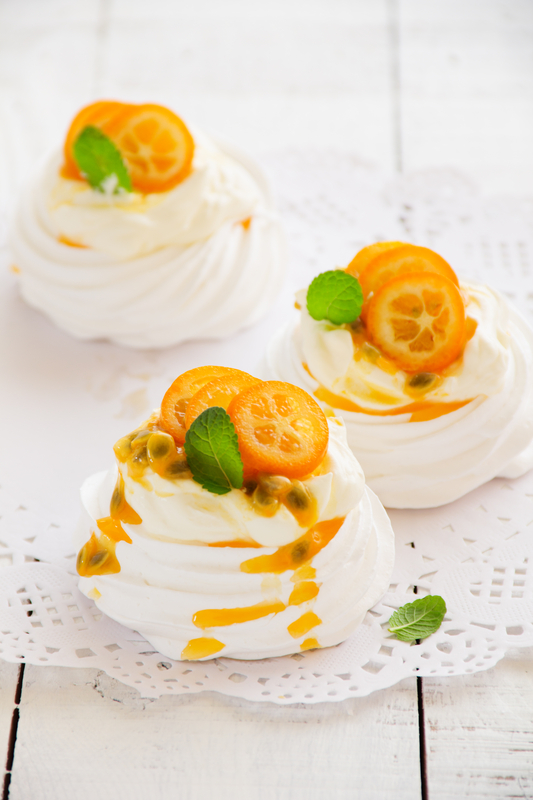
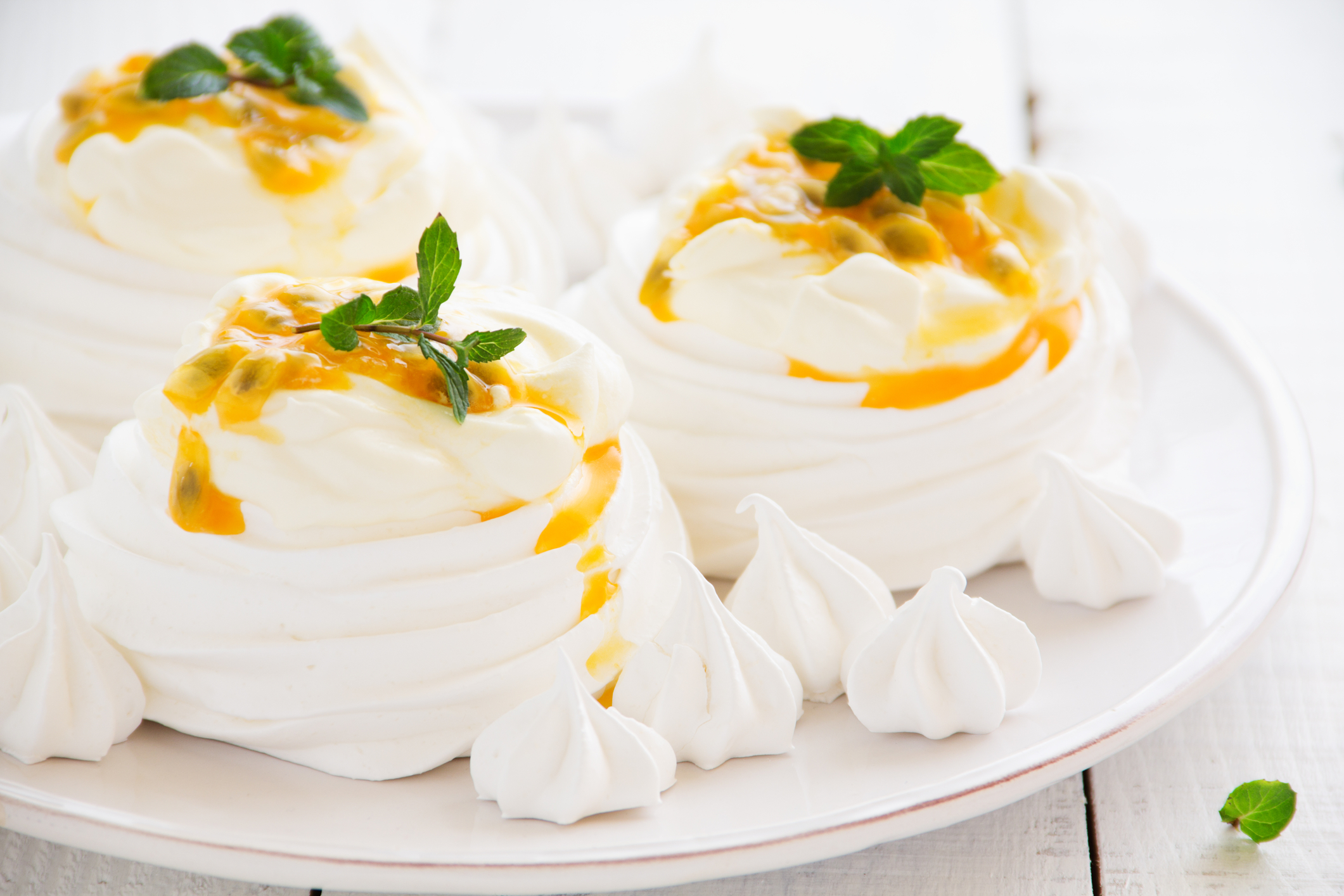
Spoon the meringue into the center of a parchment-lined tray. You’re aiming for an 8-inch round with the edges slightly built up — like a shallow nest — so the cream and passion fruit have somewhere to sit without sliding off immediately.
I use the back of a large spoon to push the edges upward, rotating the tray slowly. Don’t fuss over it. The more you work the surface, the more likely you are to deflate it or create weak spots that crack unevenly during baking.
Lumpy edges are fine. Rustic is fine. This is not a cake.
Slide it into the oven at 150°C and leave it alone for 1 hour 15 minutes. The outside should look pale, dry, and just slightly golden at the very base. If you tap the top gently it should sound hollow — not sticky or dull. When you pull it out, the center will feel slightly soft underfoot, which is what you want. It will firm up as it cools.
Then: do nothing. Leave it on the tray in the turned-off oven with the door slightly ajar if you have time, or just at room temperature. Do not rush this.
Honestly? It’s not that deep. But people treat the cooling phase like it’s optional and then wonder why the meringue implodes when they pick it up.
Passion Fruit Is Less Forgiving Than It Looks.
The pulp is tart. Genuinely tart, not just bright.
If the cream isn’t sweet enough, the whole thing tips sour and stays there. I whip 300ml of heavy cream with two tablespoons of icing sugar and a teaspoon of vanilla — soft peaks, not stiff, because stiff cream on a pavlova looks like frosting and behaves even worse when the juice from the passion fruit starts to bleed in.
Scoop the passion fruit pulp over the cream just before you serve it. Not an hour before. Not while people are still arriving. The juice soaks into the cream within about 20 minutes and turns it loose and wet. I learned this at the exact wrong moment, carrying it to the table to find the cream had gone concave where the juice had pooled.
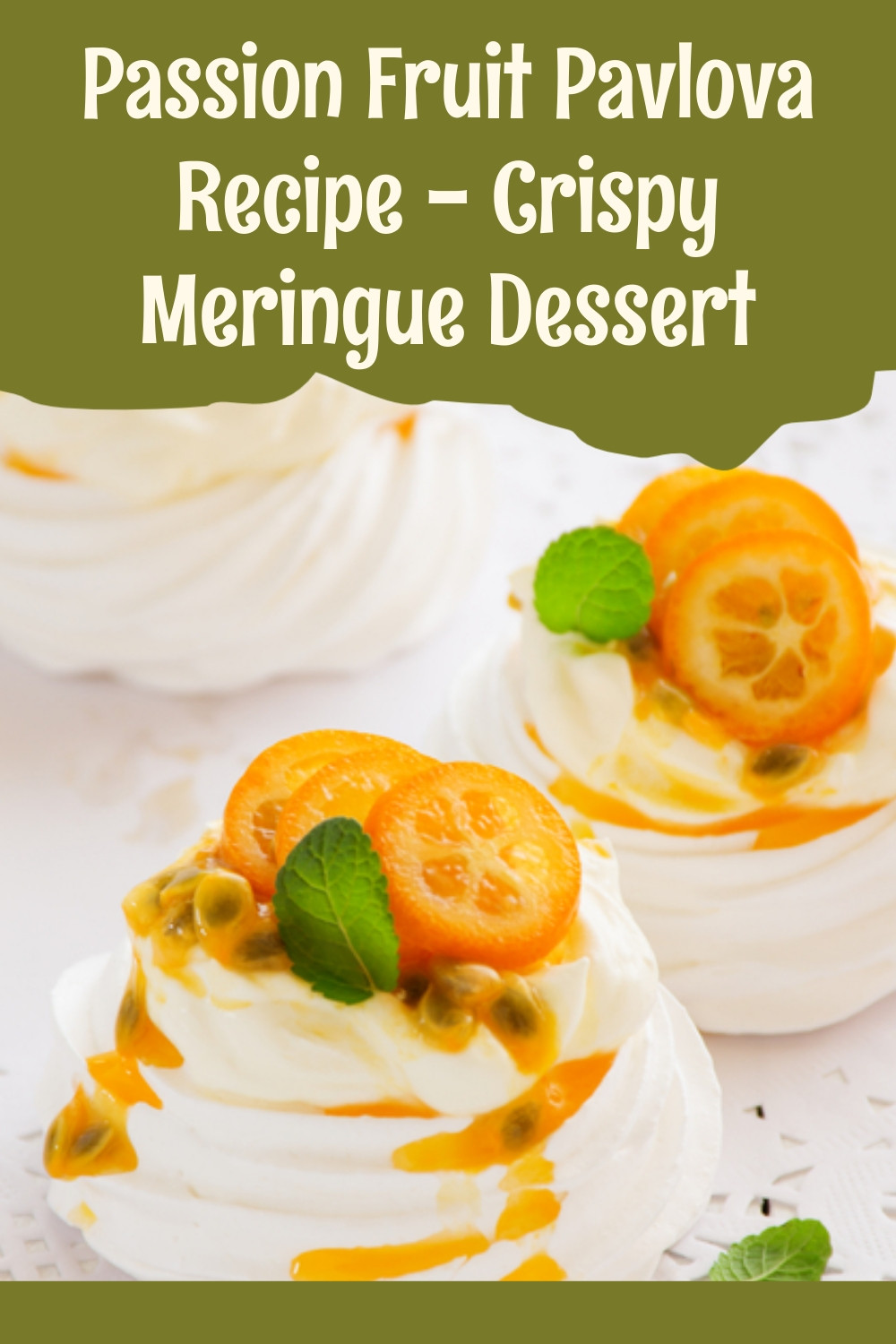
Six to eight fruits is the right range — that’s enough pulp to cover the cream without overwhelming it, and enough seeds to scatter over the top for garnish. Reserve a few teaspoons of pulp from the last fruit to drizzle right at the end, and add the mint just before you bring it out.
How to Make It, Step by Step
Step 1: Preheat your oven to 150°C (300°F) and line a baking tray with parchment paper. Trace an 8-inch circle on the back of the parchment if it helps you shape the meringue — I do this with a pencil and a small bowl as a guide.
Step 2: Make sure your mixing bowl and whisk are completely clean and dry. Wipe the bowl down with a paper towel dampened with white vinegar, then dry it. Any grease will prevent the whites from whipping. This is not a step you can skip and fix later.
Step 3: Beat 4 egg whites on medium speed until soft peaks form — they should look foamy and white, and the peak should fold over when you lift the beater. This takes about 3 minutes. (Don’t rush to high speed at the start; a slower build makes a more stable meringue.)
Step 4: Add 250g of caster sugar one tablespoon at a time, beating constantly on medium-high between each addition. This step takes about 8–10 minutes and should not be rushed. When done, the meringue should be stiff, glossy, and smooth — not gritty — when pinched between your fingers.
Step 5: Sift 1 tsp cornstarch over the meringue and add 1 tsp white vinegar. Fold gently with a wide spatula — about 10–12 slow strokes. The meringue will lose almost no volume if you’re patient here. I always hold my breath during this part, which I realize is ridiculous, but I do it anyway.
Step 6: Spoon the meringue onto the prepared tray and shape into an 8-inch round with slightly raised edges. Use the back of a spoon to create the nest shape, building up the sides without overworking the surface. Imperfect edges bake better than perfectly smoothed ones, in my experience.
Step 7: Bake for 1 hour 15 minutes at 150°C. The meringue should look pale and dry on the outside with just a hint of color at the base. Tap the top — it should sound hollow. Turn the oven off and leave the pavlova inside with the door slightly open for at least 30 minutes before moving it to room temperature.
Step 8: Once the meringue is fully cooled — and this means room temperature, not just not-hot — carefully slide a spatula under it and transfer to a serving plate. Cracks at the edges are expected. A crack through the center is more concerning but still usually holds.
Step 9: Whip 300ml heavy cream with 2 tbsp icing sugar and 1 tsp vanilla extract until soft peaks form. The cream should hold its shape but still look supple, not stiff. Spread it over the meringue base, leaving about half an inch from the edge.
Step 10: Halve 6–8 passion fruits and scoop the pulp directly over the cream. Reserve about 2 teaspoons from the last fruit to drizzle over the top. Did yours look as chaotically beautiful as it sounds? Share below! Scatter the remaining seeds and add fresh mint leaves right before serving.
Step 11: Serve immediately. This is a dessert that exists in a narrow window — best within the first hour, still fine at two. After that, the meringue absorbs moisture from the cream and begins to soften. Plan accordingly.
Ways to Change It Up
Try this: Swap passion fruit for a mix of mango puree and lime zest — spread the puree over the cream and scatter thin mango slices across the top. The lime cuts through the sweetness in a way passion fruit doesn’t need to.
Try this: Add 2 tablespoons of cocoa powder to the meringue at the folding stage for a chocolate pavlova base, then top with raspberries and a light dusting of extra cocoa. The meringue turns a pale brown and the inside stays fudgy.
Try this: Use coconut cream instead of heavy cream and top with fresh pineapple and toasted coconut flakes for a version that tastes like it came from somewhere significantly warmer than my kitchen.
Which would you go for? Drop it in the comments.
How to Serve It
Bring it to the table whole and slice it there — the cracks and the collapse are part of how it looks, and trying to slice it in the kitchen just moves the problem.
It pairs well after a meal that wasn’t too rich. A heavy main course makes the tartness of the passion fruit feel sharper than it should; after something light — grilled fish, a simple salad situation — the pavlova lands exactly right.
A small glass of something sparkling alongside it works. Prosecco, or even a good sparkling water with a wedge of lime if you want something non-alcoholic. The bubbles do something useful against the cream.
What would you pair it with?
ARTICLE 3Storing It Without Ruining It
The meringue base — untopped, unfilled — keeps at room temperature for up to two days. Cover it loosely with a clean tea towel, not plastic wrap. Plastic wrap traps moisture against the surface and the shell will soften overnight.
Once topped with cream and passion fruit, the clock is running. Eat it within two hours. I’m not exaggerating for effect — by hour three, the meringue has absorbed enough moisture from the cream to lose its crispness, and by the next day it’s a different texture entirely. Still edible, but not what you made.
You cannot freeze assembled pavlova. The cream weeps, the meringue softens, and the passion fruit seeds turn gray. I tried this exactly once. The result was something I would describe as a cold wet problem.
You can, however, freeze the plain meringue base. Wrap it carefully in two layers of plastic wrap — gently, because it will crack — and freeze for up to a month. Thaw at room temperature for a few hours before using, still wrapped, so the condensation forms on the plastic and not directly on the meringue.
Have you ever saved leftovers like this? Tell me below!
Mistakes I Made So You Don’t Have To
I once added the sugar too fast — about four tablespoons in one go because I was distracted — and the meringue never reached proper stiff peaks. It looked glossy enough but baked up flat and slightly chewy all the way through instead of having that dry, crisp shell. I served it anyway. Nobody said anything, which is its own kind of verdict.
Opening the oven door at the 40-minute mark “just to check.” The temperature drop caused the meringue to crack vertically, straight down the side, before it had set. It held together but the crack widened during cooling to about half an inch. Leave. The. Door. Closed.
Topping it too early and then trying to transport it. The cream slid toward one edge during the drive and the passion fruit pulp ran into the gap between the cream and the shell. What arrived at my sister’s house looked like something had already taken a serving spoon to it. Did something like this happen to you?
Questions I Actually Get Asked
Can I make the meringue the night before? Yes — bake it, cool it completely, and store it uncovered or loosely covered at room temperature overnight. Don’t refrigerate it. The fridge introduces humidity and the shell will go soft by morning.
Why did my meringue weep brown liquid at the base? The sugar wasn’t fully dissolved before baking. It draws moisture as it heats and the syrup leaks out. I tried this once with lightly underbeaten meringue and the puddle was about a tablespoon’s worth under the shell. Rub a bit between your fingers before you shape it — smooth means ready, gritty means keep beating.
My meringue cracked badly. Is it ruined? No. Pavlova cracks. That’s just what it does, and the cream covers most of it. But if it cracked at the base and collapsed inward, that’s usually from underbaking or moving it before it was fully cooled. Still fine to eat. Just serves differently.
Can I use frozen passion fruit pulp? It depends on what you’re using it for. For topping, yes — thaw it completely and drain off any excess liquid before spooning it over the cream. But it won’t look as fresh and the seeds sometimes look less vibrant after freezing. And fresh passion fruit is worth seeking out if you can find it.
How many servings does this actually make? Six to eight, realistically. The pavlova looks generous but an 8-inch base only goes so far. If you’re feeding more than eight people, make two smaller pavlovas instead of one large one — about 6 inches each. They bake more evenly and you’re not trying to slice one massive shell without it collapsing.
Do I have to use white vinegar, or can I use something else? White vinegar is what I use every time. Cream of tartar is a common substitution — about half a teaspoon in place of the vinegar — and it works, but the texture of the center is slightly different, a bit more uniformly chewy. I prefer the vinegar. And don’t use lemon juice; it adds flavor where you don’t need it and the acidity behaves differently in the meringue.
Which answer helped you most?
Before You Make It
Set aside more time than the recipe says you’ll need. Not because the steps are complicated, but because meringue doesn’t wait for you to be ready. The cooling phase alone takes an hour if you do it in the oven, and rushing it is how you end up with a broken shell at the worst possible moment.
Get the passion fruits the day before if you can. They should feel heavy and slightly wrinkled — smooth-skinned passion fruit is under-ripe and the pulp will be pale and thin instead of deep orange and intense. This is one of those details that changes whether the topping tastes worth it or not.
Will you make this soon?
The first time you make pavlova, something will probably go wrong. The meringue will crack in a way you didn’t expect, or the cream will soften faster than you planned, or the base will be slightly too soft in the center. That’s not a failure of the recipe. It’s just the first time.
My best one — the one where the shell was genuinely crisp all the way to the edge and the passion fruit was tart enough to make your jaw tighten slightly — was my fourth attempt. I still don’t know exactly what I did differently that time. I’ve been trying to figure it out since.
Fun fact: Passion fruit is one of the few fruits that actually becomes sweeter and more flavorful as the skin wrinkles and looks past its prime — what appears overripe at the store is usually at peak sweetness inside.
Happy cooking! —Marina Caldwell
Crispy Passion Fruit Pavlova Perfection
Ingredients
- 4 egg whites, room temperature
- 250g caster sugar
- 1 tsp cornstarch
- 1 tsp white vinegar
- 300ml heavy cream
- 2 tbsp icing sugar
- 1 tsp vanilla extract
- 6-8 passion fruits, halved
- Fresh mint leaves for garnish
Instructions
- 1Preheat oven to 150°C (300°F). Line baking tray with parchment paper.
- 2Beat egg whites in clean bowl until soft peaks form.
- 3Gradually add caster sugar, 1 tbsp at a time, beating constantly until stiff glossy peaks form.
- 4Fold in cornstarch and white vinegar gently with spatula.
- 5Spoon meringue onto prepared tray, creating a 8-inch round nest with slightly raised edges.
- 6Bake for 1 hour 15 minutes until pale and crisp. Center should be slightly soft.
- 7Cool completely on tray, then carefully transfer to serving plate.
- 8Whip heavy cream with icing sugar and vanilla until soft peaks form.
- 9Spread whipped cream over cooled meringue base.
- 10Scoop passion fruit pulp over cream, reserving some seeds for garnish.
- 11Garnish with fresh mint leaves and remaining passion fruit seeds.
- 12Serve immediately and enjoy within 2 hours for best texture.
Notes
See full recipe for nutritional information.