The butter was still cold. That was the whole problem.
My husband watched me scrape a lumpy, streaky mess off the first batch of rolls and said nothing, which honestly was worse than if he’d laughed.
What actually goes into this.
Five ingredients.
Butter, cream cheese, powdered sugar, vanilla, and salt — that’s it, and the salt is not optional no matter how much it feels like it should be.
I thought about adding a pinch of cinnamon to the glaze — actually no, I skipped it, because the rolls already have plenty going on and I didn’t want the frosting competing.
The part nobody warns you about.
Room temperature means actually room temperature — not “I left it out for eight minutes while I preheated the oven.”
Both the butter and cream cheese need to be genuinely soft, the kind where you press a finger in and it gives without resistance.
I rushed it once and the frosting looked fine in the bowl, then seized into greasy little clumps the second it hit the warm rolls. I served it anyway.
About the sugar.
Add the powdered sugar slowly — and I mean in small handfuls, not half the cup at once.
The first time I dumped it all in together, I got a cloud of white dust across the counter and somehow on my shirt, and the texture was gritty for a full extra minute of mixing.
Quick tip: Run your mixer on the lowest speed while adding sugar, and hold a kitchen towel loosely over the bowl — it catches the dust cloud and saves your ceiling.
It looked too thin. It wasn’t.
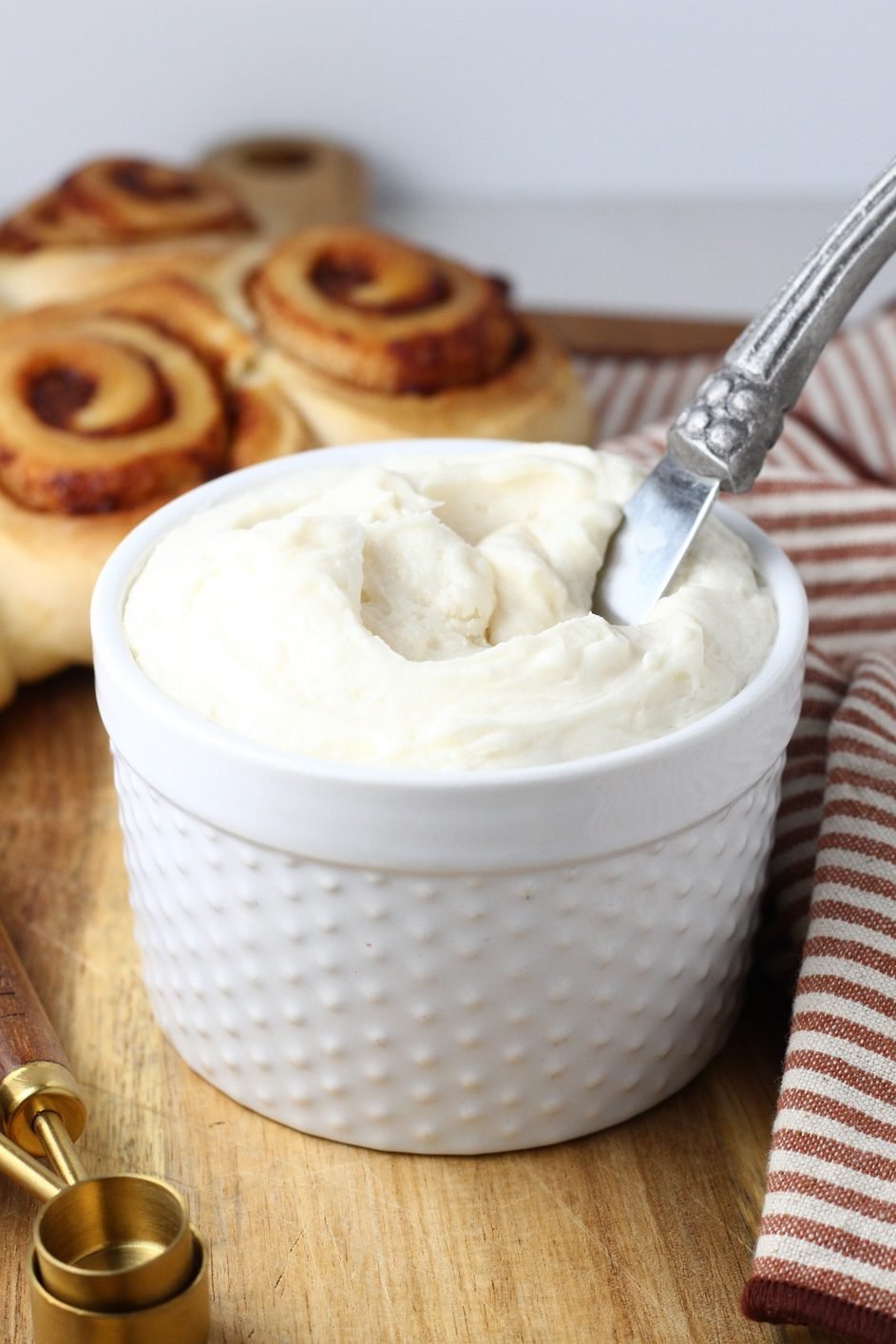
After the final whip — about 2 minutes at medium speed — the frosting looks almost too loose, almost like it won’t hold.
But that’s the point.
You want it to melt slightly — just slightly — into the warm swirls of the roll so it pools in the gaps and gets into every layer rather than sitting on top like a slab.
Do you go heavy or light on the frosting?
My sister goes light, barely a drizzle, and says anything more is “excessive,” and I genuinely do not understand her.
I go heavy.
The whole point of making a cream cheese glaze from scratch is that you can use as much as you want, so I slather it on while the rolls are still hot enough that the frosting visibly sinks into the swirls — you can watch it happen, which is the most satisfying 10 seconds of the whole process.
—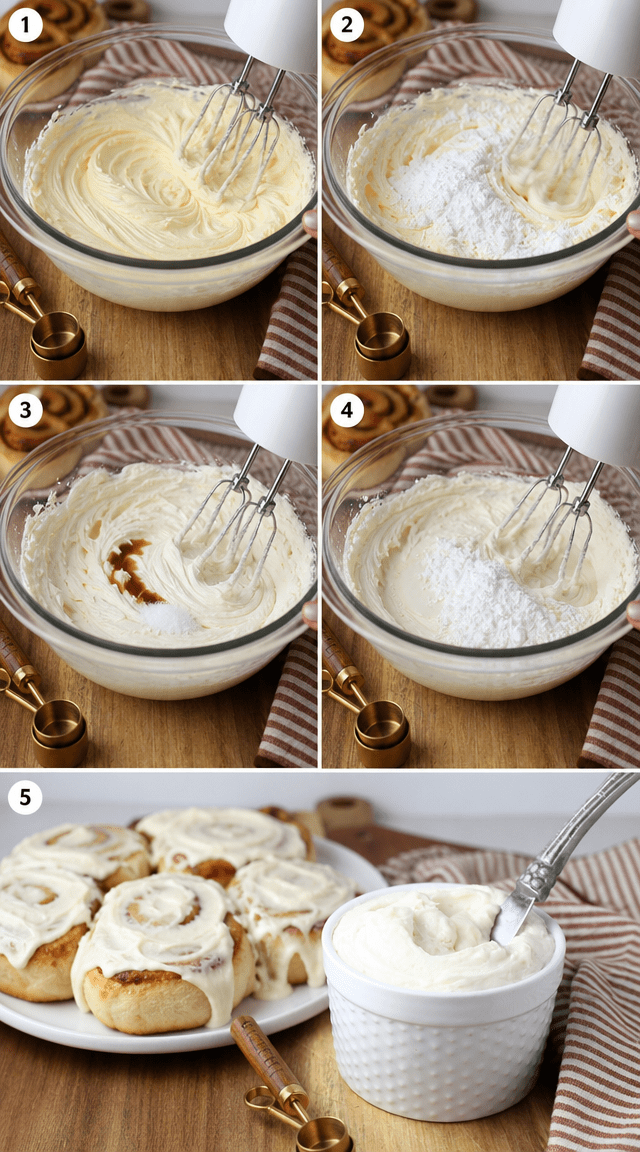
Step 1: Pull your butter and cream cheese out of the fridge at least an hour before you start — two hours is better if your kitchen runs cold. Press a finger into each one before you begin; they should give completely without any resistance. Cold spots in either will show up as lumps later, and no amount of extra mixing fully smooths them out.
Step 2: Add the butter and cream cheese to a mixing bowl and beat on medium speed for 2 to 3 minutes until the mixture is completely smooth and a little fluffy. I always stop the mixer and scrape the sides down once about halfway through — the cream cheese has a habit of climbing the bowl and avoiding the beater entirely. (Don’t rush this step; if it looks smooth after 60 seconds, keep going anyway.)
Step 3: Switch the mixer to low and add the powdered sugar in small amounts — I do about four or five additions from the 1½ cup total. Mix thoroughly after each addition before adding more. This is the step that feels the most tedious, and it’s the one that matters most for a smooth result.
Step 4: Add the vanilla and the salt, then bring the mixer up to medium and whip for another 1 to 2 minutes until the frosting turns slightly pale and looks airy. It will seem thin. That’s correct. Does your frosting ever turn out grainy? Tell us what happened — Share below!
Step 5: Check the texture. If it’s thicker than you’d like, a tiny splash of milk — and I mean maybe half a teaspoon — loosens it quickly. If it’s too loose, add powdered sugar a tablespoon at a time. (Don’t add more than 2 tablespoons of milk total or the texture changes in a way that’s hard to come back from.)
Step 6: Spoon it — generously — over rolls that just came out of the oven. Not cooled rolls. Not warm-ish rolls. Rolls that are hot enough that the frosting starts visibly melting at the edges within about 30 seconds of contact. That’s when you know it’s working.
Ways to Change It Up
Try this: For a tangier version, drop the powdered sugar down to 1 cup and add an extra ounce of cream cheese — the glaze gets a little sharper and a lot less sweet, which I actually prefer on a really heavily spiced roll.
Try this: Add 1 teaspoon of fresh lemon zest along with the vanilla. My sister thought it needed more lemon the first time I made it this way, but I think one teaspoon is exactly right — it cuts through the butter without tasting like a citrus dessert.
Try this: Swap the vanilla for maple extract, just ¼ teaspoon — it’s stronger than vanilla so you don’t need much, and it turns this into something that works over apple rolls or pecan sticky buns.
Which would you go for? Drop it in the comments.
How to Serve It
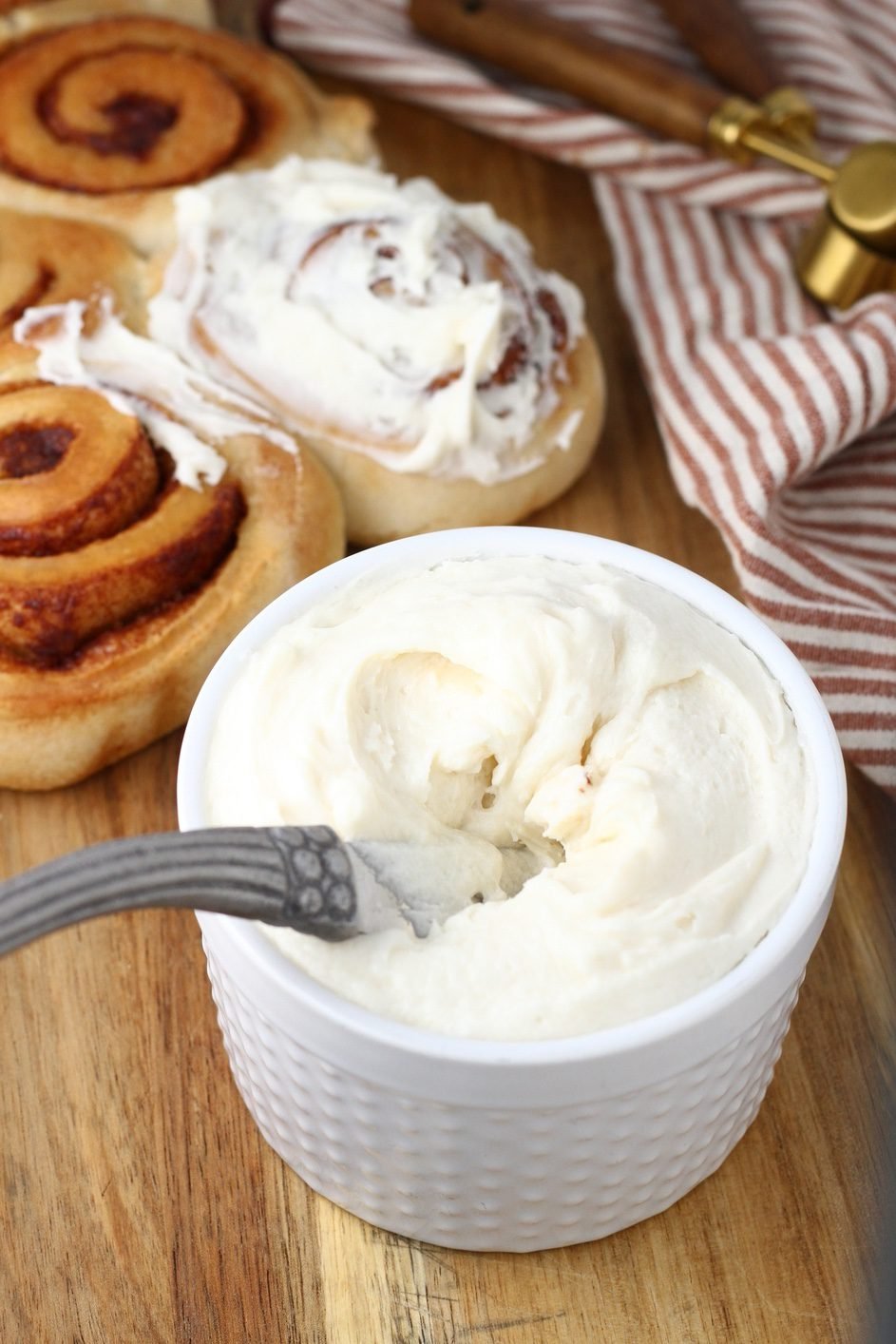
The most obvious move: straight over a pan of cinnamon rolls pulled directly from the oven, while steam is still coming off the top.
It also works spread cold — like a thick frosting — over rolls that have cooled to room temperature, if you want more of a bakery-style presentation where it holds its shape rather than melting in.
I’ve also used the leftovers as a spread on toasted brioche the next morning, and that’s not a bad way to start a Sunday.
What would you pair it with?
—
Storing It Without Ruining It
Leftover frosting goes into a jar or airtight container in the fridge, and it keeps well for about 5 days.
When you pull it out it’ll be stiff and almost solid — just let it sit at room temperature for 20 minutes, then give it a quick 30-second whip and it comes back close to where it was.
Freezing works technically but the texture after thawing is a little grainy even after re-whipping, so I’d only go that route if you made a truly significant amount and need it to last longer than a week.
Have you ever saved leftovers like this? Tell me below!
Mistakes I Made So You Don’t Have To
I once tried to speed up the softening process by microwaving the cream cheese for 15 seconds. The edges melted and the center was still cold, and when I mixed it in the frosting had soft greasy streaks running through it that never fully incorporated.
Adding too much milk at once — I’m talking a full teaspoon when I only needed a drop — made the frosting runny in a way that didn’t fix itself with more sugar. It went thin and kind of glossy instead of creamy, and I had to start a partial batch over from scratch.
Putting the frosting on rolls that had cooled for 20 minutes: it just sat there on top, didn’t sink in at all, and the whole thing tasted like frosting sitting on bread instead of part of the roll. Honestly? It’s not that deep, but timing really does matter here.
Did something like this happen to you?
Questions I Actually Get About This
Can I make this ahead of time? Yes, up to 5 days in the fridge in a sealed container. Take it out about 20 to 30 minutes before you need it, then re-whip for 30 seconds. But if your rolls are baking fresh, making the frosting while the rolls are in the oven puts everything at the right temperature at the right moment.
What if my frosting turns out lumpy? Lumps almost always mean cold butter or cold cream cheese — I tried fixing it once by mixing longer and it didn’t fully work. If the lumps won’t beat out after 4 or 5 minutes, the fastest fix is to set the bowl over a pot of barely simmering water for about 30 seconds, stir by hand, then beat again.
Can I use salted butter instead of unsalted? It depends on how salt-sensitive you are. I’ve done it. And the result was fine — slightly saltier, which actually I didn’t hate, but the ¼ teaspoon of added salt in the recipe will push it over for some people, so leave that out if you’re using salted.
How much does this recipe make? Enough to generously frost about 12 standard-sized cinnamon rolls — which for me means about 3 tablespoons per roll. If you like a lighter hand, it’ll cover closer to 16. Scale up easily; I’ve doubled it with no issues.
Can I use low-fat cream cheese? Technically yes. But the frosting will be thinner and slightly less creamy, and it won’t hold shape as well on cooled rolls. Full-fat gives you that thick, slow-melting drizzle that makes this what it is.
What’s the best way to get it into every swirl? Spoon it right in the center of each roll while they’re hot and let gravity do the work — the frosting follows the spiral down into the gaps on its own over about 60 seconds. Don’t spread it outward with a knife first or it loses that melted-in look. Which answer helped you most?
Go make the rolls.
This frosting comes together in under 10 minutes if your ingredients are properly softened.
Four tablespoons of butter and 4 ounces of cream cheese — that’s really the whole base of it, and everything else just adjusts the sweetness and the texture.
Fun fact: Cream cheese was first developed in the United States in 1872 by a New York dairyman trying to replicate a French soft cheese — it was an accident that became one of the most-used dairy products in American baking.
I’ve made this probably thirty times at this point and I still get a little impatient waiting for the butter to soften properly,
and every single time I rush it I regret it.
Will you make this soon? Tell me if you try the lemon zest version — I want to know if you agree with me or with my sister.
Happy cooking! —Marina Caldwell
Dreamy Cream Cheese Drizzle Over Warm Cinnamon Rolls
Ingredients
- 4 tablespoons unsalted butter, room temperature
- 4 oz cream cheese, room temperature
- 1½ cups powdered sugar
- ½ teaspoon pure vanilla extract
- ¼ teaspoon salt
Instructions
- 1Combine room temperature butter and cream cheese in a mixing bowl, whipping together until completely smooth and lump-free, roughly 2-3 minutes
- 2Slowly incorporate powdered sugar in small batches on low speed, mixing thoroughly between each addition
- 3Pour in vanilla extract and salt, then increase to medium speed and whip until the frosting turns pale and airy, about 1-2 minutes
- 4Check your texture — mix in extra powdered sugar to thicken or a tiny splash of milk to loosen as needed
- 5Slather generously over freshly baked, still-warm rolls so the frosting melts slightly into every swirl
Notes
– Both butter and cream cheese must be fully softened beforehand — cold ingredients will create an unpleasantly lumpy frosting – For a tangier, less sweet version, reduce powdered sugar to 1 cup and add an extra ounce of cream cheese – Leftover frosting keeps refrigerated for up to 5 days; simply re-whip briefly before using again