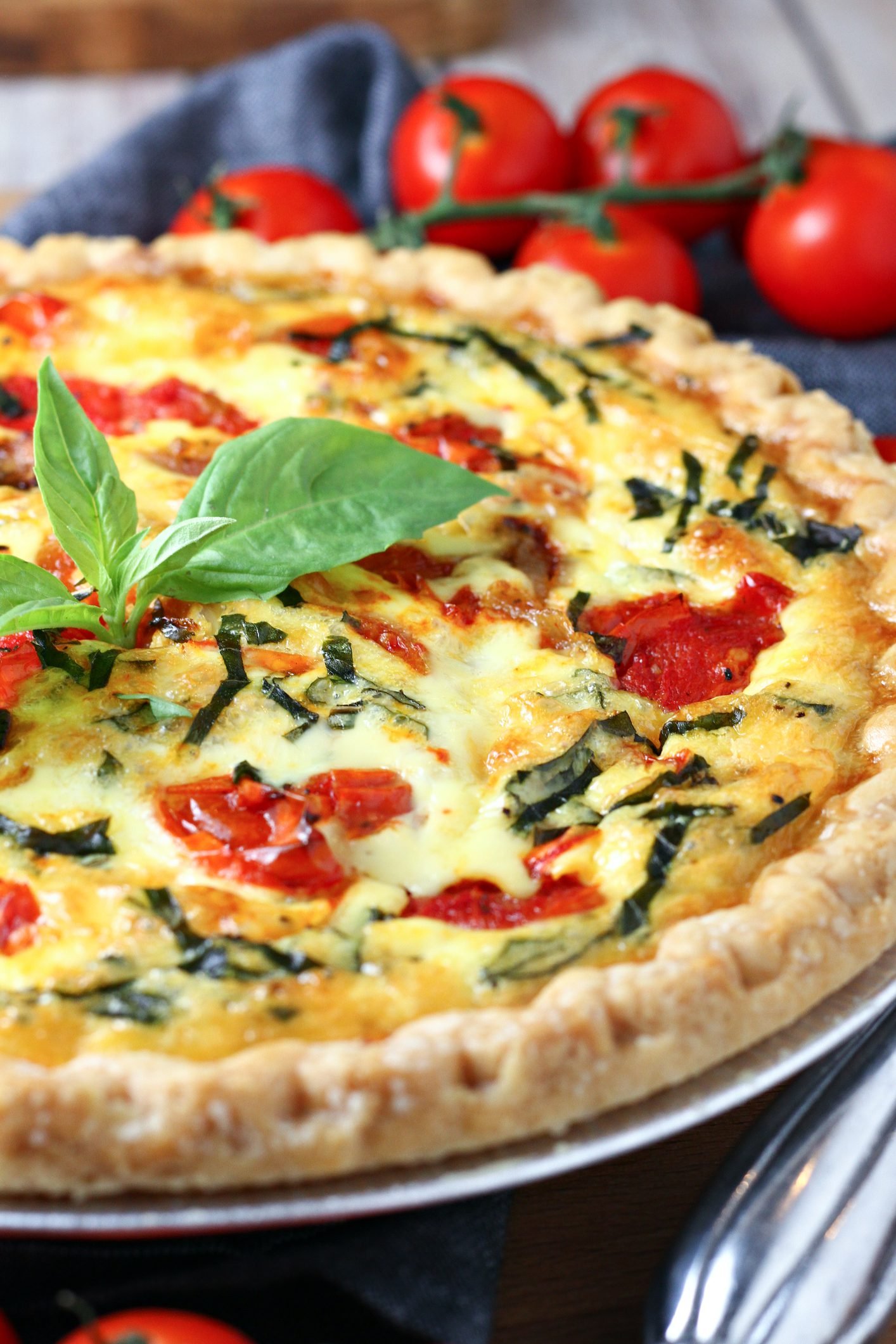
The quiche that made me question everything I thought about tomatoes.
My neighbor Rosa handed me six tomatoes over the fence and I had no plan, which is how this quiche got started. I made it wrong the first time — didn’t drain the tomatoes, didn’t blind bake the crust, and the bottom was like wet cardboard.
About that soggy crust situation.
Tomatoes have a lot of water in them. More than you think.
I salt the diced tomatoes, let them sit in a colander for about 10 minutes, then I cook them down in the pan for another 5 — and after all that, I still press them through a strainer before they go anywhere near the crust.
The first time I skipped all of that, honestly? The slice fell apart on the plate. I served it anyway because I wasn’t starting over at 6pm on a Tuesday.
Blind baking. Just do it.
Eight minutes at 375°F before any filling goes in — that’s all it takes to get a crust that actually holds up.
I thought about skipping it — actually no, I skipped it twice before I accepted that the crust genuinely needs that head start, especially with a wet filling like this one.
Quick tip: Line the crust with parchment and dry beans for those 8 minutes so it doesn’t puff up on you — I learned this after a very lumpy first attempt.
The basil and cheese layer — here’s what I noticed.
Mozzarella goes down first, directly on the crust, and it does something I didn’t expect: it acts like a seal between the custard and the pastry.
The Parmesan on top of that adds a sharpness that cuts through the cream, and without it the filling tastes a little flat. Have you ever made a quiche that looked right but tasted like it was missing something? That’s usually the Parmesan.
It looked wrong at the 30-minute mark. It wasn’t.
At 30 minutes the center still wobbled when I nudged the dish — like a lot, not just a little shimmy.
I almost pulled it early, which would have been a mistake. It needed the full 38 minutes in my oven, and then 5 minutes resting on the counter before I even touched it with a knife.
The custard keeps setting after you take it out. This is not a drill.
My husband’s one complaint.
My husband said it needed more basil, and he was right — I’d used about half a cup the first time and it was too subtle.
The full cup makes it actually taste like basil, not just hint at it. Fold it into the tomatoes after you pull them off the heat so it doesn’t go brown and bitter,
and the color stays bright green all the way through the bake.
How to Make It
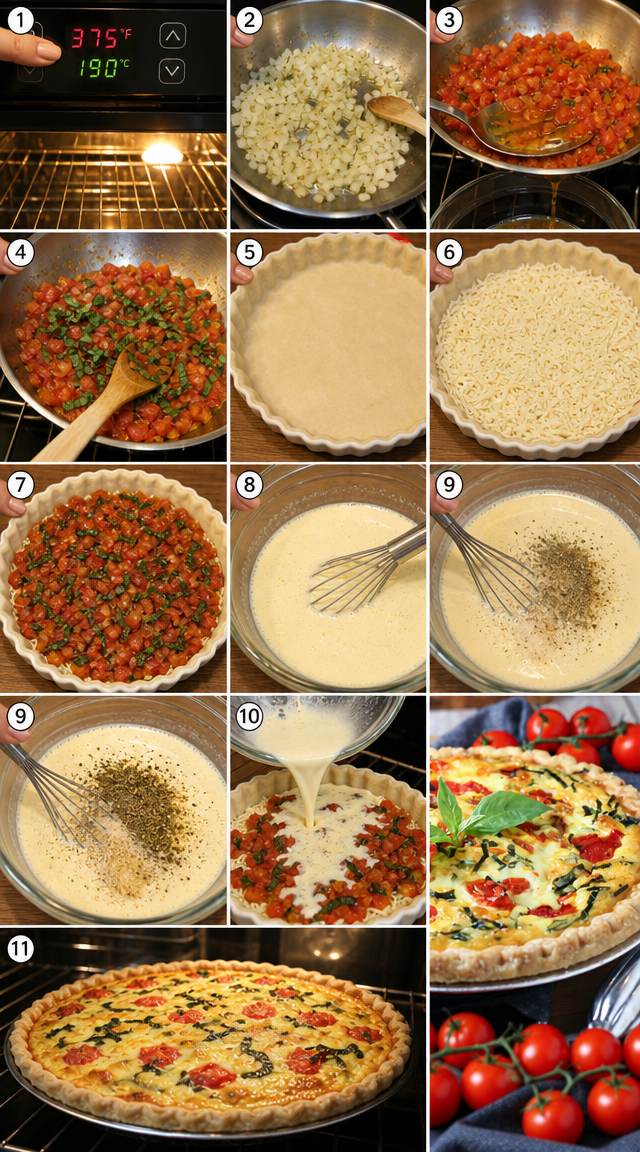
Step 1: Heat your oven to 375°F and set the rack in the center. While the oven heats, press your unbaked 9-inch pie crust into the quiche dish, getting it into the edges without tearing. Line it with parchment and dry beans, then blind bake for 8 minutes. (If you skip this, the bottom will be pale and soft — you’ve been warned.)
Step 2: Salt your diced tomatoes and let them sit in a strainer for 10 minutes while you dice the onion. Warm 2 tablespoons of olive oil over medium heat and cook the onion for about 3 minutes until it goes translucent. Add the tomatoes and cook another 5 minutes, then tip everything into a strainer and let the liquid drain off before you do anything else with them.
Step 3: Take the tomato mixture off the heat and fold in the chopped basil. Let this cool down — I mean actually cool, not just lukewarm — because if you put hot filling into the crust before adding the custard, the eggs start to cook unevenly and you get weird rubbery patches in the finished quiche. (I found this out the hard way. Give it 10 minutes minimum.)
Step 4: Layer the mozzarella across the bottom of the blind-baked crust, then the Parmesan on top of that. Spoon the cooled tomato-basil mixture over the cheese in an even layer. It doesn’t have to be pretty here — it redistributes as the custard settles. Do you do a cheese layer first or mix everything together? Share below!
Step 5: Whisk the 4 eggs, 1 cup heavy cream, and ½ cup whole milk together until smooth. Season with ½ teaspoon salt, ¼ teaspoon pepper, ¼ teaspoon garlic powder, and ¼ teaspoon dried oregano. Pour this slowly over the filling — go slow so it seeps down between the tomatoes and doesn’t just sit on top.
Step 6: Bake 35–40 minutes at 375°F until the surface is light golden and the center has only a slight wobble left. Mine hit the right point at 38 minutes. Rest it 5 minutes before cutting — the custard is still finishing up during that rest and clean slices depend on it.
Ways to Change It Up
Try this: Swap the mozzarella for Gruyère and add a handful of caramelized onions under the tomato layer — the result is deeper and a little more savory, especially if you’re serving it for dinner.
Try this: Skip the crust entirely and pour the filling straight into a buttered baking dish for a crustless version. It works, it’s lighter, and it cuts down the bake time by about 5 minutes.
Try this: Add ½ cup of crumbled cooked bacon or pancetta to the tomato-basil layer before pouring the custard. My sister made it this way and thought it didn’t even need the Parmesan anymore — she might be right.
Which would you go for? Drop it in the comments.
How to Serve It
Warm, straight from the dish with a simple green salad — arugula with lemon and olive oil works well because the bitterness cuts through the richness of the custard.
Cold the next morning with a cup of coffee. I know that sounds odd but it slices cleanly when chilled and the flavors are actually more settled after a night in the fridge.
For a proper lunch, serve a wedge alongside a bowl of tomato soup — yes, more tomatoes, it’s a good thing here.
What would you pair it with?
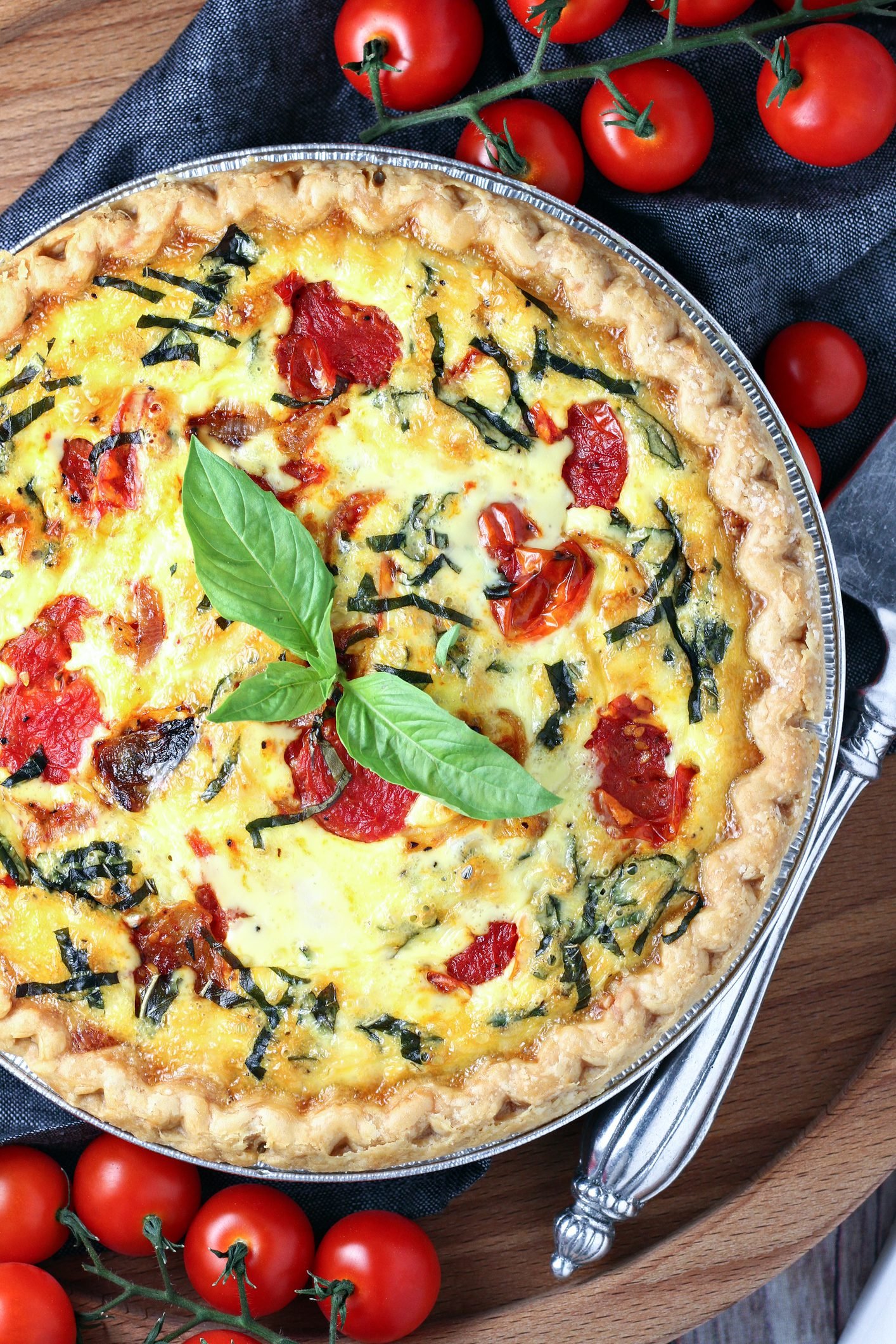
Storing It Without Ruining It
Cover the dish tightly with plastic wrap or move the slices into an airtight container — it keeps in the fridge for about 4 days.
To freeze it, cool it completely, wrap individual slices in plastic and then foil, and freeze for up to 2 months. Thaw overnight in the fridge before reheating.
Reheat at 325°F for about 15 minutes. The microwave works but the crust goes a little soft — the oven keeps it from turning sad.
Have you ever saved leftovers like this? Tell me below!
Mistakes I Made So You Don’t Have To
I once poured the custard in while the filling was still warm and the bottom third of the quiche set before the top half even went into the oven — the texture was completely off and there was nothing to do about it.
I skipped the strainer step after cooking the tomatoes and thought “it’ll be fine.” The crust turned into a wet sponge. I’ve made worse, but not by much.
I overbaked it by 8 minutes once because I walked away to answer the phone. The custard had pulled away from the edges and gone slightly rubbery in the center — edible, but not what you want. Did something like this happen to you?
Questions I Actually Get About This Quiche
Can I use a store-bought crust? Yes, and I do it half the time. The texture is slightly different — a little more tender, a little less flaky — but it still blind bakes well and holds the filling without trouble.
Do I have to use heavy cream or can I use something lighter? It depends on what you want the texture to be. I tried half-and-half once and the custard set but was noticeably less creamy — still good, just thinner. And with whole milk only, it gets closer to a frittata than a quiche.
Can I make this the night before? Absolutely. Bake it fully, cool it, refrigerate overnight, and reheat at 325°F for about 15 minutes. It actually slices cleaner cold. But don’t assemble it unbaked and refrigerate — the crust absorbs moisture overnight and gets soft before it even hits the oven.
How do I know it’s done? The edges should be set and the center should give just a small wobble — not a wave, just a tiny jiggle. About 38 minutes was right in my oven, but ovens vary. I tried using a thermometer once and the custard reads done around 170°F internally.
Can I add more vegetables to this? You can, but keep the total filling volume the same. Spinach works well — squeeze it out really hard first. Zucchini works too but it needs the same treatment as the tomatoes: salt, rest, drain, or it releases water into the custard.
What if I don’t have fresh basil? Dried basil doesn’t really cut it here — the flavor goes dusty, not fresh. I’d rather use a different herb. Fresh thyme works. So does flat-leaf parsley, though it’s a different profile entirely.
Which answer helped you most?
Okay, go make it.
This quiche has been on my table more times than I can count at this point.
It’s not complicated. It just has a few steps that matter — the draining, the blind bake, the cooling — and once you’ve done it once you’ll do them automatically.
Fun fact: Basil is a member of the mint family, and its volatile oils — the stuff that gives it that sharp, sweet smell — start breaking down the moment you apply heat, which is why folding it in off the heat keeps the flavor so much brighter.
The tomatoes from Rosa’s garden were what started this, but I’ve made it with grocery store tomatoes in the middle of January and it still worked.
Will you make this soon? Let me know how it goes — and if you made any swaps, I genuinely want to hear about them.
Happy cooking! —Marina Caldwell
Savory Summer Quiche Featuring Tomatoes Basil and Butter
Ingredients
- 1 unbaked 9-inch pie crust
- 2 cups fresh tomatoes, diced and drained
- 1 cup fresh basil leaves, chopped
- 1 cup shredded mozzarella cheese
- 1/2 cup grated Parmesan cheese
- 4 large eggs
- 1 cup heavy cream
- 1/2 cup whole milk
- 1/2 teaspoon salt
- 1/4 teaspoon black pepper
- 1/4 teaspoon garlic powder
- 1/4 teaspoon dried oregano
- 2 tablespoons olive oil
- 1/2 onion, finely diced
Instructions
- 1Heat your oven to 375°F (190°C) and position rack in center.
- 2Warm olive oil in a skillet over medium heat, then cook diced onion for 3 minutes until translucent and tender.
- 3Toss in diced tomatoes and cook down for 5 minutes, then transfer to a strainer to remove excess liquid.
- 4Fold chopped basil into the tomato mixture and allow everything to cool.
- 5Lay pie crust into a 9-inch quiche dish, pressing gently into edges.
- 6Layer mozzarella and Parmesan evenly across the bottom of the crust.
- 7Spoon cooled tomato-basil mixture evenly over the cheese layer.
- 8Whisk eggs, heavy cream, and milk together in a large bowl until smooth and fully blended.
- 9Season custard mixture with salt, pepper, garlic powder, and oregano, stirring to combine.
- 10Slowly pour custard over the filling, allowing it to settle naturally between layers.
- 11Bake 35-40 minutes until custard is firmly set and surface turns light golden brown.
- 12Rest quiche for 5 minutes before cutting into wedges and serving warm.
Notes
– Salt diced tomatoes beforehand and let sit 10 minutes to draw out excess moisture, preventing a soggy crust. – Blind bake the pie crust for 8 minutes before adding fillings to ensure a crispier, sturdier base. – Quiche slices cleanly when fully chilled, making it ideal for preparing a day ahead and reheating at 325°F.