The Broth Looked Wrong for About Two Hours
The pot sat on the stove looking absolutely murky and I convinced myself I had ruined it before the meat had even softened. That foam that rises in the first thirty minutes — I kept skimming it, kept thinking there was something wrong with my pork knuckles, and then around hour two it cleared on its own and smelled exactly the way my grandmother’s kitchen smelled on the first Sunday in December.
I’ve made holodets probably six or seven times now. The first batch never set.
Not loosely set. Not soft-set. Completely liquid, even after twelve hours in the fridge. I had used mostly chicken and not enough of the collagen-heavy cuts, which is a mistake you only make once because the result is humiliating — you’re pouring what is essentially meat soup over people’s plates.
Pork knuckles and beef bones. That’s what makes it set without gelatin.
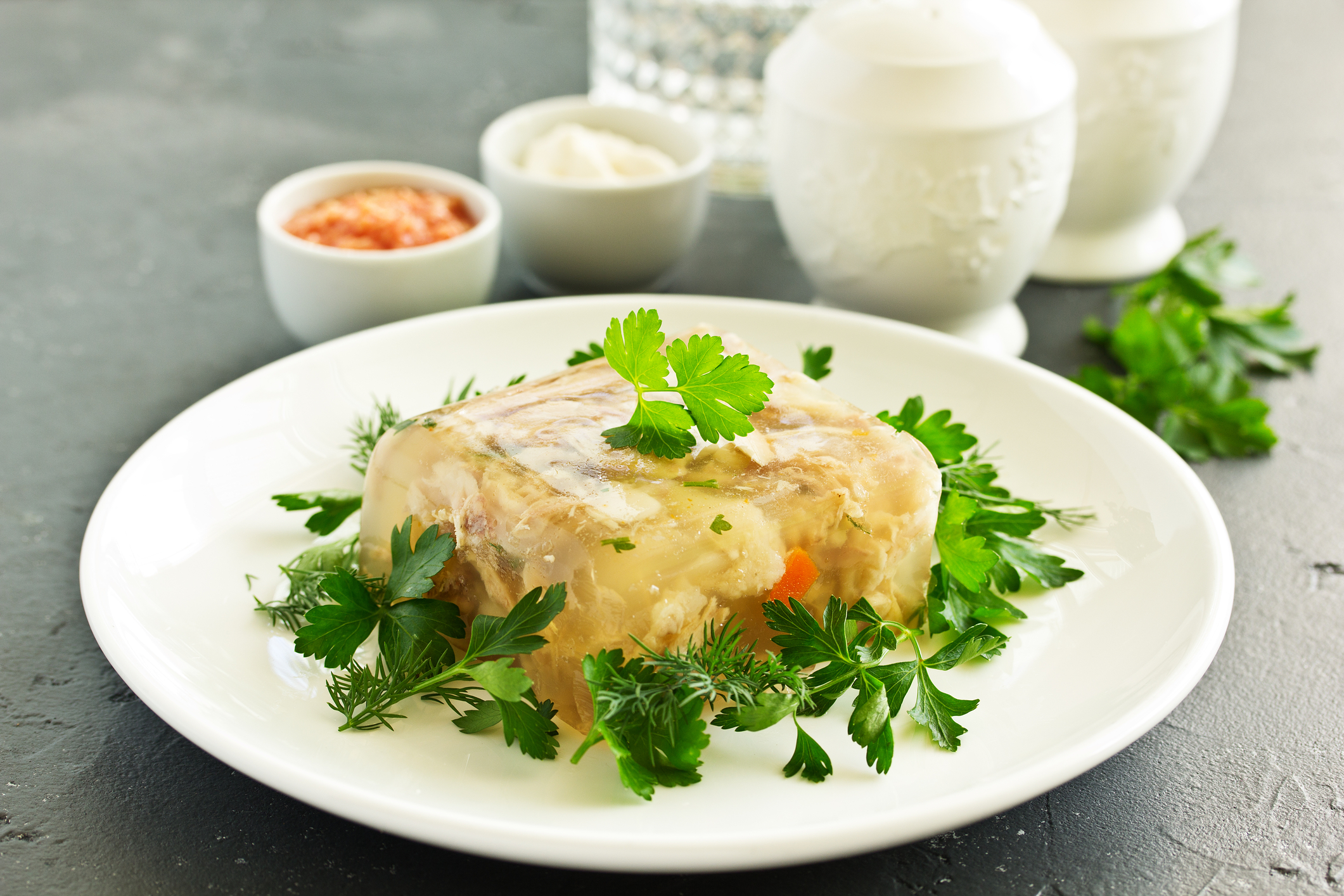
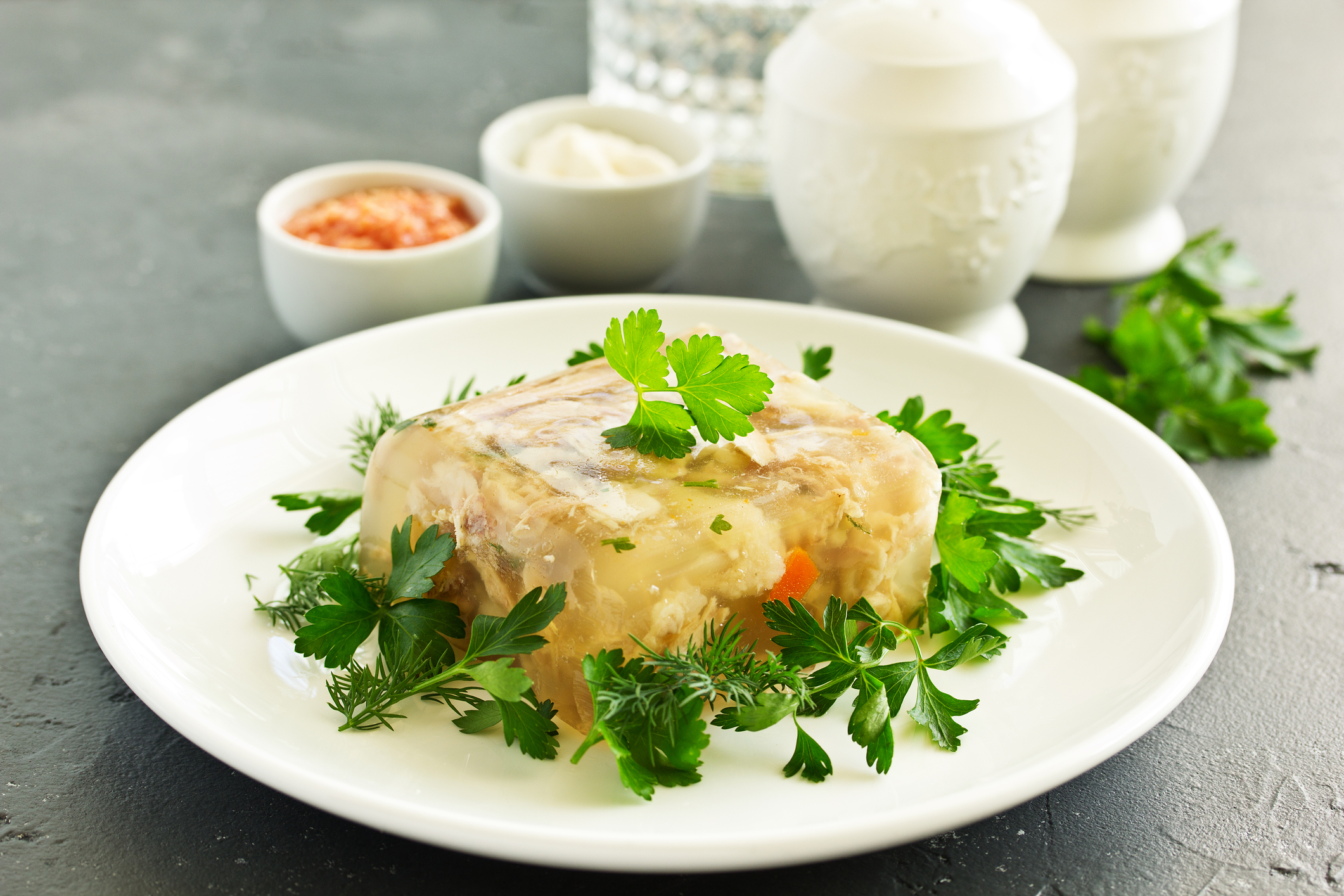
I thought about adding the tablespoon of gelatin anyway — actually no, I skipped it this time and it held cleanly, sliced without crumbling, sat on the plate in a neat rectangle with the egg layer visible through the sides. Three and a half hours of simmering, not three. That extra thirty minutes matters more than any additive.
Holodets is not a recipe you make when you’re tired or distracted. It’s patient, repetitive work — skimming, watching, waiting. The reward is something that looks almost architectural on a plate.
About the Bones
Most recipes tell you to skip the blanching step. They’re wrong.
Blanching the bones in boiling water for two to three minutes, then draining and rinsing everything under cold water, removes the gray scum and blood that would otherwise cloud your broth for the entire cook. You can skim continuously and still not recover a broth that started dirty. Do the blanch. It costs you four minutes.
The pork knuckles need a real scrub under cold water before that — not a rinse, a scrub. Use your hands.
Beef bones go in alongside the pork and chicken wings because each contributes something different to the texture of the final jelly. The pork knuckles carry most of the collagen. The beef bones deepen the flavor without overwhelming it. The chicken wings soften quickly and give the meat something lighter to chew through when the whole thing is sliced cold.
Honestly? Three types of meat is not excessive. It’s the point.
Quick tip: Pull the chicken wings out at the two-hour mark — they’ll be fully cooked and the meat will stay tender instead of going stringy from the extra hour in the pot.
The Vegetables Go in Late. Not Early.
Thirty minutes into simmering — not at the start.
I added the carrots and onions right at the beginning the first few times and they disintegrated completely, leaving the broth slightly sweet and murky in a way I couldn’t fix. They need time to give flavor but not so much time that they fall apart. Halved carrots and quartered onions go in after that initial thirty-minute simmer and foam-skimming phase, and then they cook for the remaining three hours alongside the meat.
The parsley and dill go in at the same time. They will look completely wrecked by the end. That’s fine — they’re going through a sieve anyway.
Bay leaves, peppercorns — four of the first, eight of the second. I’ve tried more peppercorns. The broth gets aggressive and sharp in a way that fights the garlic at the end. Eight is enough.
The garlic is different. Garlic goes in raw and minced, stirred into the pulled meat after the broth has been strained and the bones discarded. Not cooked into the broth. Added at the end, so it stays present — sharp and specific — rather than fading into the background the way it would after three and a half hours on the heat.
I Strained It Twice
The first strain got the bones and vegetables out. The second got everything else.
Line your sieve with a piece of cheesecloth or even a clean kitchen towel for the second pass — the broth that comes through will be noticeably clearer, and once it sets, the jelly will be more translucent rather than cloudy. This matters if you’re putting eggs on the bottom of the mold, because part of the appeal of holodets is seeing those egg slices through the side of the jelly once it’s unmolded.
Let the strained broth cool for about twenty minutes before you pour it over the meat, or the garlic cooks slightly and loses its edge.
The egg arrangement is fussier than it sounds. Lay the slices flat on the bottom of the loaf pan, slightly overlapping, before you pour anything in. Once you pour the broth and meat mixture over them, they’ll shift — slightly, inevitably. I’ve made peace with imperfect egg placement. The slice still looks good.
Overnight in the fridge. Not four hours. Not six. Overnight.
I once tried to rush it with six hours and the center was still loose when I unmolded it, and the whole thing — the eggs, the meat, all of it — collapsed sideways on the plate. My neighbor Daria, who taught me this recipe, said nothing. She just handed me a spoon.
Cold. Only Cold.
Holodets is served cold and that is not a preference.
Run a thin knife around the edges of the pan before unmolding — all four sides, slow and deliberate. Place your serving plate face-down over the pan, then flip the whole thing at once. Tap the bottom a few times if it resists. It will release. Give it thirty seconds of patience before you start worrying.
Slice it with a sharp knife. Not a serrated one. A sharp, straight blade cuts cleanly through the jelly without dragging.
Mustard is traditional — the sharp, grainy kind, not yellow ballpark mustard. Horseradish, if you have it. A splash of vinegar on the side. These aren’t optional garnishes, they’re the whole point of the cold richness of the dish: something sharp against something fatty and gelatinous.
Has anyone ever served you holodets warm? I’d genuinely like to know what that was like.
What the Second Attempt Tasted Like
Better than the first. Still not as good as Daria’s.
I think her knuckles came from a different butcher — something about the collagen content, the way her broth gelled without any extra gelatin and held so firmly you could almost stand a fork in it. Mine is softer. It slices cleanly but there’s more give to it, which I’ve come to think of as the home-cook version: a little less precise, a little more forgiving on the plate.
I’ve made worse. This one I’d put in front of people.
The salt gets added during cooking — two tablespoons into the simmering broth — but taste it again after straining, before you pour it over the meat. Broth concentrates as it cooks and what tasted right at the ninety-minute mark might need adjusting at the end. The one time I forgot to re-taste, the finished holodets was under-salted and flat in a way that no amount of mustard could fix at the table.
Worth making again. Worth making carefully.
Step-by-Step Instructions
Step 1: Scrub the pork knuckles under cold running water — use your hands to work along any creases. Place knuckles, beef bones, and chicken wings into a large pot, cover with boiling water, and blanch for 2–3 minutes. Drain completely, then rinse everything under cold water. (Don’t skip this. The broth will be murky for the entire cook if you do.)
Step 2: Return all the meat and bones to a clean pot. Add 12 cups of fresh cold water. Bring to a boil over medium-high heat, then reduce to a steady simmer. For the first 30 minutes, skim the foam from the surface every 5 or 6 minutes — there will be more of it than you expect.
Step 3: Add the halved carrots, quartered onions, bay leaves, peppercorns, parsley sprigs, dill sprigs, and 2 tablespoons of salt. Stir once and leave it alone. Simmer uncovered for 3 to 3.5 hours, until the meat is very tender and pulling away from the bones. Pull the chicken wings out at the 2-hour mark and set them aside.
Step 4: Remove the pot from heat and let it cool for 15 minutes. Strain the entire broth through a fine sieve — then strain it a second time through cheesecloth for clarity. Taste the strained broth and adjust salt now, before it goes anywhere near the meat. This is the step I always forget and always regret skipping.
Step 5: Pull all the meat from the bones — pork, beef, and chicken. Discard the bones. Chop the meat into small, rough pieces; nothing needs to be uniform. In a large bowl, combine the chopped meat with 4 cloves of minced garlic and stir to distribute evenly. (Add the garlic at this stage, not earlier — it stays sharper and doesn’t disappear into the broth.)
Step 6: Let the strained broth cool for about 20 minutes until warm but not hot. Pour it over the meat and garlic, stirring to combine. If you’re using the optional tablespoon of gelatin, dissolve it in a few tablespoons of warm broth first and stir that into the full batch now.
Step 7: Arrange sliced hard-boiled eggs in a single slightly overlapping layer across the bottom of a loaf pan or mold. Carefully ladle the meat and broth mixture over the eggs, filling the pan to about three-quarters full. Cover with plastic wrap and refrigerate overnight — at minimum 8 hours. Have you tried making holodets before? Tell me how it went — Share below!
Step 8: To unmold, run a thin knife along all four edges of the pan. Place a serving plate face-down over the pan and flip in one confident motion. Tap the bottom of the pan firmly if it holds. It will release. Slice cold with a sharp straight-bladed knife and serve immediately with mustard, horseradish, or a splash of vinegar.
Ways to Change It Up
Try this: Skip the beef bones entirely and use only pork knuckles and feet for a denser, more gelatinous set. The flavor is more one-note but the texture is firmer and slices even more cleanly.
Try this: Add a layer of thinly sliced cooked beets between the egg layer and the meat mixture before refrigerating. It looks startling when sliced — deep purple cutting through the pale jelly — and the earthiness works well against the garlic.
Try this: Substitute the dill and parsley with a small bunch of fresh thyme and two celery stalks during the simmer. The broth comes out with a slightly different character — less Ukrainian grandmother, more something you might find at a French charcuterie counter, if that appeals to you.
Which would you go for? Drop it in the comments.
How to Serve It
Slice it cold, directly from the fridge, onto individual plates. Each slice should be about 2 centimeters thick — thin enough to see the layers, thick enough to hold its shape on the plate without sliding.
Serve with a sharp grain mustard on the side, a small dish of freshly grated horseradish if you have it, and black rye bread. The bread is not optional texture — it absorbs the cold juices as you eat and turns into something worth finishing.
Holodets works as a cold appetizer before a heavier meal, or as the centerpiece of a spread alongside pickled vegetables — cucumbers, cabbage, beets. Don’t serve it on a warm plate. The surface starts to melt at the edges within minutes and the whole thing looks sad by the time anyone takes seconds.
What would you pair it with?
Storing It Without Ruining It
In the fridge, holodets keeps well for up to 4 days covered tightly with plastic wrap or in an airtight container. After 4 days the texture starts to weep slightly — a thin layer of liquid pools around the edges. Still technically edible, but not at its best.
You can freeze it, but you should know what you’re getting into. The jelly texture changes after freezing — it becomes slightly grainy and less smooth when it sets again after thawing. It still tastes right. It just doesn’t look as clean.
To freeze: wrap the unmolded loaf tightly in plastic wrap, then in foil. Freeze for up to 2 months. Thaw in the refrigerator overnight — never at room temperature, which turns the surface to liquid before the interior is ready.
Do not reheat holodets. There is nothing to reheat it into. It becomes soup again, and not very good soup — the collagen has already done its work and won’t reconstitute the same way twice.
Have you ever saved leftovers like this? Tell me below!
Mistakes I Made So You Don’t Have To
I once made this with all chicken — wings, thighs, backs — because I didn’t feel like dealing with pork knuckles. The broth never set. Twelve hours in the refrigerator and it was still fully liquid. I served it in bowls as broth with meat in it and told no one what it was supposed to be.
I forgot to blanch the bones one time and decided it was probably fine. The broth was gray and foamy no matter how much I skimmed — not dramatically bad, but dull-looking, with a slightly flat flavor. The whole cook felt like I was fighting the pot instead of just letting it work.
I over-seasoned the broth at the ninety-minute mark and didn’t taste it again after straining. The finished holodets was noticeably salty — not inedible, but every bite reminded you of the mistake. There’s no fixing it once it’s set. Did something like this happen to you?
Questions About Holodets, Answered Honestly
Does it always need the gelatin? No — if you use pork knuckles and beef bones, the natural collagen from those cuts sets the broth without any additions. I tried it once with only chicken wings and had to add two tablespoons of gelatin just to get a loose set. Stick to the collagen-heavy cuts and the gelatin is purely optional insurance.
How long does it actually take to set? About 8 hours minimum, but overnight is better — closer to 10 to 12 hours in the refrigerator. At the 6-hour mark the center is usually still soft. Not set enough. And if you try to unmold it early, the middle collapses.
Can I make this in a slow cooker? It depends on your slow cooker and how well it maintains a low, steady temperature. I tried it once on low for 8 hours and the meat was tender, but the broth didn’t reduce the way it does on the stovetop, so the flavor was thin. You’d need to simmer it uncovered on high for the last hour to concentrate it.
What if my holodets doesn’t unmold cleanly? Run the knife more slowly around the edges and give it more time. But honestly — if it breaks coming out, serve it in slices directly from the pan with a spoon. Not ideal. Still edible. Some things just don’t unmold.
Can I use powdered gelatin instead of sheet gelatin? Yes. One tablespoon of powdered gelatin dissolved in a few tablespoons of warm broth is equivalent to about 3 gelatin sheets. Bloom the powder in cold water first for about 5 minutes, then dissolve in warm broth before stirring into the batch. And the bloom step matters — skip it and the gelatin clumps.
Is the egg layer just decorative? Mostly. But the eggs add a specific, mild richness that cuts through the garlic when you get a bite with both. Remove them and the dish still works — it’s just less interesting visually and slightly less balanced flavor-wise. I wouldn’t skip them.
Which answer helped you most?
A Few Last Things
Holodets is one of those dishes that tests your patience in the first hour and rewards it in the last. Not metaphorically — literally. The broth looks wrong, smells slightly animal, and takes up your whole afternoon. Then it sets overnight into something that looks considered and deliberate.
The collagen-rich cuts matter more than any other variable. I’ve experimented with seasoning adjustments, different herb combinations, more garlic and less garlic — none of it changes the outcome as fundamentally as getting the right bones in the pot from the start.
Will you make this soon?
The version I made last week set more firmly than any previous batch — something about the pork knuckles from the butcher on Hartley Street, which Daria recommended after I complained about my softer results. I don’t know if I’ll get the same result next time with a different source.
That’s the thing about holodets. The recipe is consistent. The ingredients never quite are.
Fun fact: Pork knuckles contain some of the highest concentrations of natural collagen of any cut — the same collagen that turns into gelatin when simmered low and slow for hours, which is exactly what makes holodets set without any additives when the right cuts are used.
Happy cooking! —Marina Caldwell
Traditional Ukrainian Meat Jelly Holodets Recipe
Ingredients
- 2 lbs pork knuckles or feet
- 5 lbs beef bones
- 1 lb chicken wings
- 2 carrots, halved
- 2 onions, quartered
- 4 bay leaves
- 8 black peppercorns
- 3 sprigs fresh parsley
- 2 sprigs fresh dill
- 2 tablespoons salt
- 12 cups water
- 4 cloves garlic, minced
- 3 hard-boiled eggs, sliced
- 1 tablespoon gelatin (optional, for extra setting)
Instructions
- 1Clean the pork knuckles and beef bones under cold water thoroughly
- 2Blanch bones and pork in boiling water for 2-3 minutes, drain, and rinse
- 3Add cleaned bones, pork, and chicken to a large pot with 12 cups fresh water
- 4Bring to a boil, then reduce heat and simmer for 30 minutes, skimming foam
- 5Add carrots, onions, bay leaves, peppercorns, parsley, and dill
- 6Simmer for 3-3.5 hours until meat is very tender and falls off bones
- 7Remove from heat and cool slightly, then strain broth through fine sieve
- 8Remove meat from bones, chop into small pieces, and discard bones
- 9Combine chopped meat with minced garlic in a large bowl
- 10Pour strained broth over meat, stirring well
- 11Arrange sliced hard-boiled eggs on the bottom of a loaf pan or mold
- 12Pour meat and broth mixture over eggs carefully
- 13Refrigerate overnight until fully set and jelled
- 14Run a knife around edges and unmold onto a serving plate
- 15Slice and serve cold with mustard, horseradish, or vinegar
Notes
See full recipe for nutritional information.