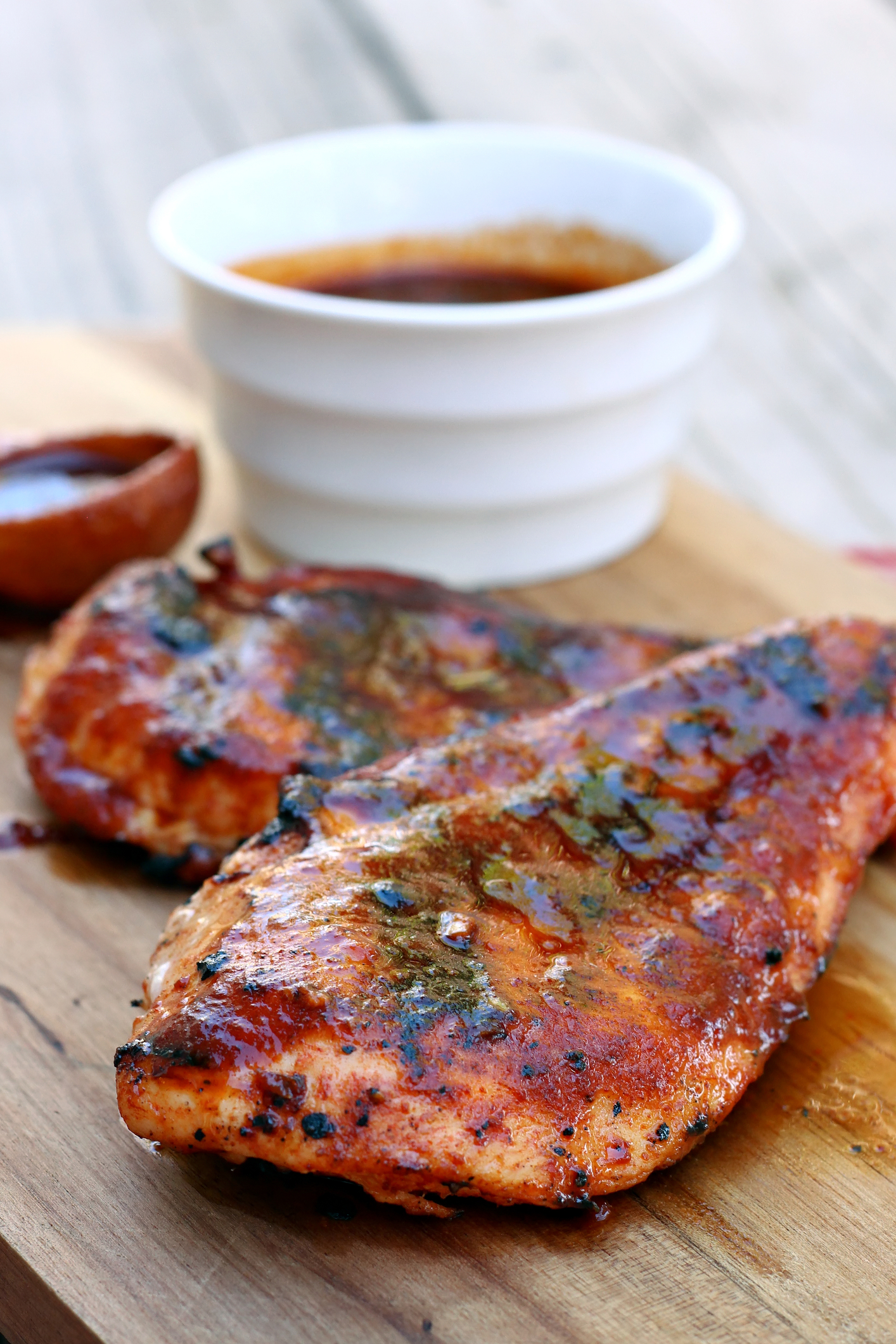
My husband took one bite and asked if I’d bought it somewhere.
I hadn’t. But I’d also made it three times before getting it to that point.
The first two attempts were edible. Fine. Nothing that would make anyone ask questions. The glaze was there, the char was there, but something about the balance was off — too sweet without enough smoke pulling it back, or too much cayenne making it sharp before you even got to the honey.
Third time I slowed down and actually measured. Wrote things down. Paid attention to when the sauce went on instead of just guessing.
That’s the version here.
About the spice rub — it matters more than the glaze.
Most recipes lead with the barbecue sauce. They treat it like the main event and let the rub be an afterthought. They’re wrong.
The rub is what builds the char. The glaze sits on top of it — it doesn’t replace it. If your rub is bland, your glaze is just sticky sauce on pale chicken, and no amount of honey is going to fix that.
Paprika, garlic powder, onion powder, salt, black pepper, cayenne. Nothing exotic. But the paprika does real work here — it’s what goes dark and slightly smoky under the grill grates, and that bitter edge is exactly what the honey needs to land against.
I thought about adding cumin — actually no, I skipped it. It pulled the flavor somewhere I didn’t want to go.
Quick tip: Pat the chicken genuinely dry before the oil and rub go on. Not a quick blot. Actually dry. If there’s moisture on the surface, the rub steams instead of searing, and you lose the whole point of it.
Six minutes without touching it.
This is the part I kept getting wrong in my head even when I knew better.
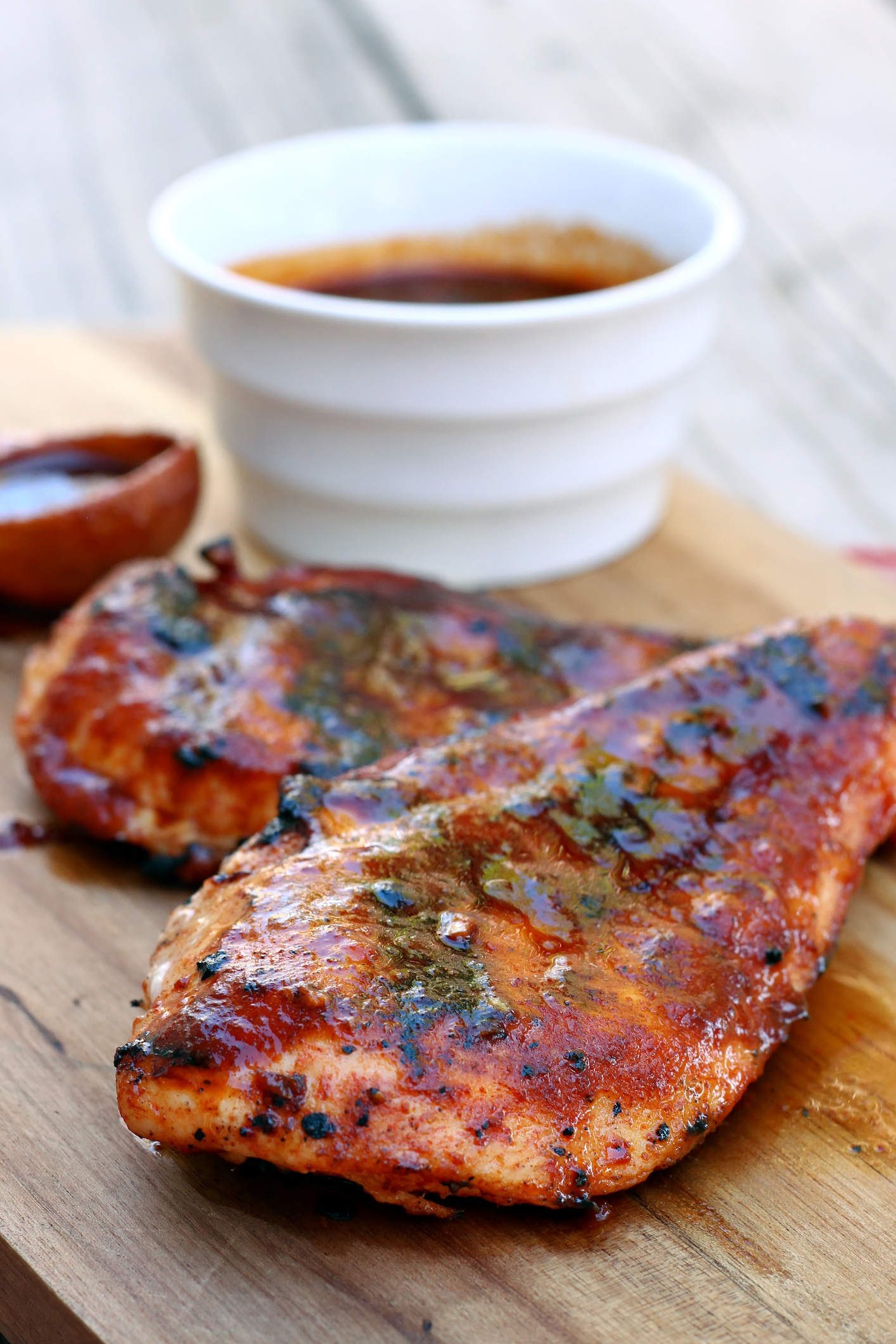
Six to seven minutes per side, grill at medium-high, and you do not move the chicken. Not to check it. Not to peek at the underside. Not because you’re nervous it’s burning. The grates need to do their job, and that requires contact and time — interrupted contact gives you grill marks but not the crust you’re actually after.
The first time I let it go the full seven minutes without lifting it, I was genuinely convinced I’d overdone it. I hadn’t. It released cleanly from the grates, which is how you know it’s ready to flip anyway.
If it sticks when you try to flip, it’s not done. That’s not a rule I read somewhere — it’s just what the chicken will tell you if you pay attention.
Honest admission: the second batch I made for this post, I pulled one breast at six minutes because I got impatient. It stuck slightly, tore a little at the edge, and the crust on that side was patchy. I served it to myself and gave the better pieces to my daughter Lena, who didn’t notice either way and ate three bites before running back outside.
The glaze goes on late. Much later than you think.
Not at the start. Not in the middle. The glaze — barbecue sauce, honey, apple cider vinegar — goes on after the chicken has already cooked through most of the way on both sides.
Honey burns. It burns fast, and it burns in a way that tastes acrid rather than caramelized. Three to four minutes per side with the glaze on is plenty. Any longer and you’re fighting the sugar instead of using it.
The apple cider vinegar in the glaze is the part people skip or halve because it sounds like too much. Don’t. It cuts through the sweetness just enough that the glaze doesn’t coat your mouth like candy. One tablespoon. Whisk it in properly so it doesn’t just pool at the bottom of your bowl.
Brush on both sides. Not a drizzle. A real layer. Then let it sit on the heat long enough to tack up slightly — you’ll see it go from shiny-wet to slightly matte at the edges, and that’s when it’s done.
Step 1:
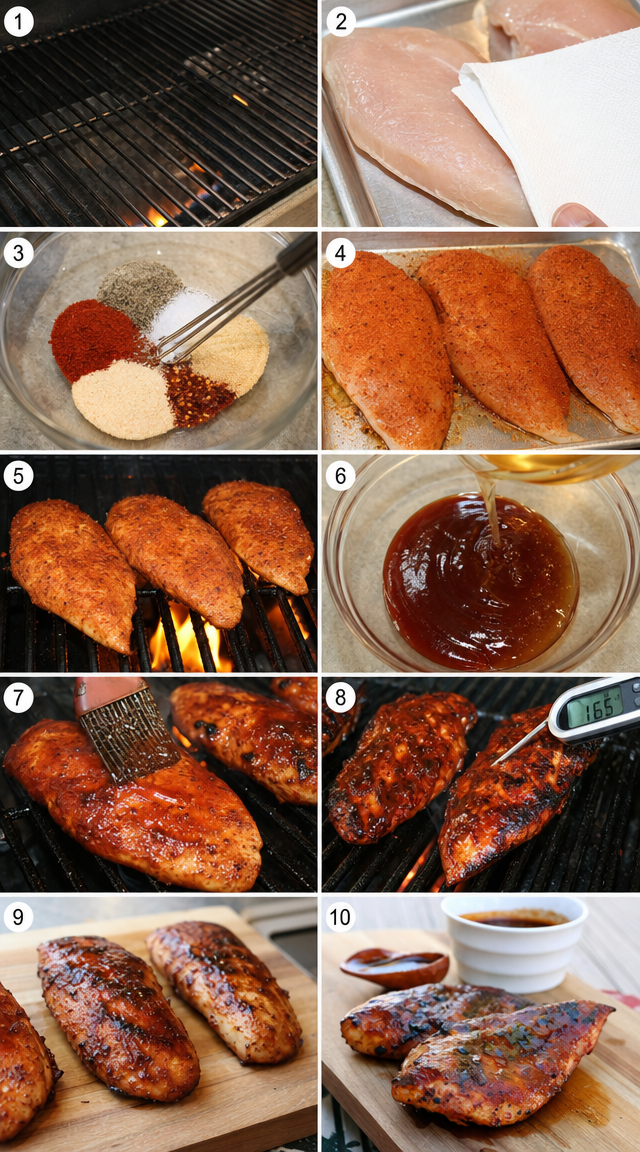
Step 1: Heat your grill to medium-high, which lands around 375–400°F. Give it a full 10 minutes to get there. A grill that isn’t fully preheated means the chicken sits on lukewarm metal and steams instead of searing, and you’ll never recover that texture from a slow start.
Step 2: Pat the chicken dry with paper towels — every surface, including the underside. Then coat each breast in olive oil. You want a thin, even layer, not pooling at the edges. (I once skipped the oil and went straight to the rub because I was in a rush. The spices didn’t adhere properly and about half of them fell onto the grates. Don’t do that.)
Step 3: In a small bowl, mix the paprika, garlic powder, onion powder, salt, black pepper, and cayenne until combined. Coat each breast evenly, pressing the rub in rather than just sprinkling it on. Every part of the surface should be covered — the edges and the underside included.
Step 4: Place the chicken on oiled grill grates and leave it. Six to seven minutes per side, no moving, no checking, no adjusting. Set a timer if you need to. The grill should be hot enough that you hear a real sizzle when the chicken goes on — if it’s quiet, your grill isn’t ready. Did yours sizzle right away when it hit the grates? Share below!
Step 5: While the chicken grills, whisk together 1 cup barbecue sauce, 2 tablespoons honey, and 1 tablespoon apple cider vinegar in a bowl. Whisk it properly — don’t just stir. The vinegar needs to fully incorporate or you’ll get uneven spots of sharp and sweet when it hits the heat.
Step 6: After the initial cook, brush the glaze onto the top side, then flip. Brush the other side. Cook 3–4 minutes, flip once more, brush again, and cook another 3–4 minutes. Internal temperature should reach 165°F. I felt genuinely relieved the first time I pulled a breast at exactly 165°F — after two over-cooked test runs, getting it right felt like something.
Step 7: Remove from the grill and let rest 5 minutes before cutting. This is not optional. The juices are still moving inside the meat at this point, and if you cut immediately, they run straight out onto the cutting board. Five minutes. Then serve with extra sauce on the side.
Ways to Change It Up
Try this: Swap the honey for maple syrup and reduce the cayenne to 1/4 teaspoon. The maple reads a little earthier and pairs well with thighs instead of breasts if you want more fat in the cut.
Try this: Add 1 teaspoon of smoked paprika on top of the regular paprika in the rub. It deepens the smoke note significantly, especially if you’re working with a gas grill that doesn’t give you much natural smokiness from the grates.
Try this: Use this exact glaze on bone-in skin-on thighs instead. Increase the total grill time — about 10–12 minutes per side before the glaze goes on, then the same 3–4 minutes glazed per side. The skin chars in a way that the boneless breasts can’t match.
Which would you go for? Drop it in the comments.
How to Serve It
Sliced against the grain over a pile of buttered corn and something acidic — pickled red onions, a quick slaw with apple cider vinegar, anything that cuts through the sweetness of the glaze without competing with it.
On a roll with a smear of mayo and a few slices of dill pickle. The pickle brine does exactly what the vinegar does in the glaze, just with more crunch.
Straight off the cutting board, standing at the counter, with extra sauce for dipping. Honestly? It’s not that deep. Sometimes that’s the best version.
What would you pair it with?
Storing It Without Ruining It
Refrigerator: wrap the chicken tightly or store in an airtight container. It keeps about 4 days. The glaze firms up when cold and the texture changes slightly — the outside gets a little tacky — but the flavor holds.
Freezer: yes, but freeze before glazing if you can. The glaze doesn’t freeze badly, exactly, but it separates slightly when thawed and the surface gets a little weepy. Still edible. Just not as clean.
Reheating: low and slow in a covered skillet with a splash of water, or wrapped in foil in a 300°F oven for about 15 minutes. Microwave works in a pinch but dries out the edges fast — 90 seconds max, covered.
Have you ever saved leftovers like this? Tell me below!
Mistakes I Made So You Don’t Have To
I once brushed the glaze on at the very start — before any of the initial cook time — because I wanted the color to build gradually. The outside went dark and slightly burnt within four minutes while the inside was still raw. Pulled it, scraped the glaze off, finished cooking it plain. Served it with extra sauce on the side and told no one.
I used a cheap thin barbecue sauce once and the glaze slid right off the chicken instead of sticking. The honey ratio wasn’t enough to give it body. Thicker sauce, or add an extra half tablespoon of honey — it makes a real difference in how the glaze behaves on the grill.
Skipping the rest. I know I keep saying it. I skipped it once on a night I was starving and just wanted to eat, and the cutting board had a genuine puddle on it by the time I was done slicing. The chicken wasn’t dry, but it was drier than it should have been. Five minutes is not a long time. Did something like this happen to you?
Questions I Actually Get Asked
Can I use chicken thighs instead of breasts? Yes, and in some ways they’re better for this. Thighs have more fat, which means more margin for error — you can go a minute or two over on a thigh and it stays juicy where a breast won’t. Bone-in adds about 8–10 minutes to the total grill time. And internal temp still needs to hit 165°F regardless of cut.
What if I don’t have a grill? Cast iron grill pan on the stove, medium-high heat, same timing. It won’t taste exactly the same — you lose the airflow and the open flame — but the char is real and the glaze behaves identically. I tried this once on a rainy night and it was genuinely close. But the smoke from the honey browning will set off your kitchen alarm, so open a window first.
Can the chicken sit in the rub overnight? It depends on how much time you have. Up to 12 hours in the fridge is fine and actually helps. Beyond that, the salt starts drawing moisture out and you get a slightly different texture on the outside — not bad, just different. I wouldn’t go past 24 hours.
My glaze keeps burning. What am I doing wrong? Grill is too hot, or the glaze went on too early. Honey burns above 350°F if it has too much direct contact time. Medium-high is the ceiling — if your grill runs hot, pull it back slightly before the glaze goes on. And 3–4 minutes per side with the glaze on is the maximum. Not a suggestion.
Do I need a meat thermometer? Yes. About 90% of overcooked grilled chicken comes from guessing instead of measuring. A basic instant-read costs under $15 and removes all the uncertainty. I’ve made this without one. It’s worse every time.
Can I make the glaze ahead of time? Up to 3 days in the fridge, covered. Whisk it again before using — the honey settles to the bottom as it sits. It takes about 20 seconds. Don’t skip it or the first few brush strokes will be thin and the last ones will be cloyingly sweet.
Which answer helped you most?
Where I landed with this one.
It took three tries to get right, and the third time I was tired and not in the mood to be cooking at all. That version turned out the best. I don’t know what to do with that information.
The balance between the rub and the glaze is the thing that took the most attention. Not the grilling time, not the temperature — just whether the base layer underneath the sauce had enough character to hold its own once the sweetness landed on top of it.
Will you make this soon?
My daughter Lena has asked for it twice since that first good batch. I’ve made it once since then, for just the two of us on a Thursday, and I pulled one breast a minute early again out of habit. It was fine. The other three were better.
Fun fact: Honey never spoils. Archaeologists have found 3,000-year-old honey in Egyptian tombs that was still edible — its low moisture content and natural acidity prevent bacterial growth entirely.
I’m still not entirely sure about the cayenne level. Half a teaspoon is where I landed, but I’ve wondered since whether three-quarters would push it somewhere more interesting or just make it too sharp for the honey to balance. I haven’t tested it yet.
Happy cooking! —Marina Caldwell
Smoky Honey Glaze Makes Grilled Chicken Shine
Ingredients
Instructions
Notes
See full recipe for nutritional information.