The night I almost didn’t make this.
My husband pulled the cast iron out of the cabinet and set it on the stove without me asking, which is how I knew he was hoping I’d make something good that night.
The first time I made this, the chicken came out dry at the edges and the gravy was thin — not broken, just unconvincing, like it hadn’t committed to being a gravy yet.
About the spice blend situation.
Three tablespoons of sweet paprika sounds like a lot.
It is a lot, actually, and that’s the whole point — it’s what gives the crust that deep brick-red color before the gravy even touches it.
I thought about adding a pinch of cayenne — actually no, I skipped it. The smoked paprika already carries a quiet heat and I didn’t want to muddy that.
The sear. Don’t rush it.
Six minutes, undisturbed.
I know you want to lift the edge and check. The first time I did that — actually, I did it twice — and pulled up the crust before it had released from the pan, so I had half a sear and half a mess.
Quick tip: Pat the chicken completely dry before the spice rub goes on. I mean really dry, paper towel pressed and held for a few seconds. Moisture is what turns your sear into a steam.
It looked wrong. It wasn’t.
When you dust the flour over the onions and garlic, the whole pan looks kind of pasty and pale for about 30 seconds, like something went wrong.
Keep stirring. That roux needs the full minute — honestly, go a little longer if you want a deeper color in the finished gravy — and then the broth goes in and everything pulls together fast.
What I noticed that surprised me.
The Dijon mustard at the end. You don’t taste mustard.
You just taste a gravy that has more depth than it should for how few ingredients went into it, and I didn’t figure out that was the mustard until I left it out once to test.
Have you ever done that — left something out just to see what it actually contributes? It’s a strange little experiment and sometimes the answer genuinely surprises you.
Okay, the cream timing.
Add the butter, cream, and Dijon after you’ve pulled the chicken out, not before.
I added the cream while the chicken was still in the pan the second time I made this,
and it reduced too fast around the edges and left a slightly grainy ring on the inside of the skillet before I could pull it back. The gravy was still fine. But I noticed.
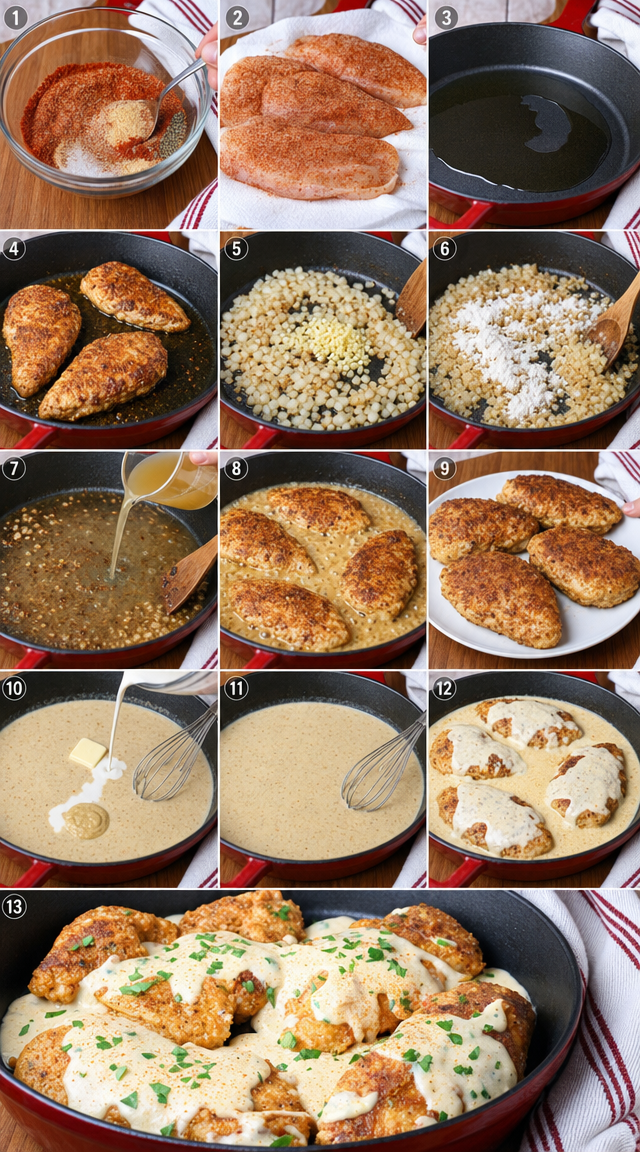
Step 1: Mix the 3 tablespoons sweet paprika, 1 teaspoon smoked paprika, garlic powder, onion powder, salt, and pepper together in a small bowl until combined. This is your whole flavor foundation, so don’t eyeball it — measure the paprika properly. (I once used a heaping pour instead of a measured spoon and the coating was uneven in a way I could taste in every other bite.)
Step 2: Pat all four chicken breasts completely dry with paper towels, pressing down and holding for a few seconds on each side. Then coat every surface with the spice blend — top, bottom, and the edges. Don’t leave bare patches.
Step 3: Heat your cast iron skillet over medium-high and add the 2 tablespoons of olive oil. Wait until it’s shimmering before the chicken goes in — this takes about 2 minutes, and putting the chicken in too early is how you get a pale crust instead of a real one.
Step 4: Lay the chicken in and do not touch it for 5 to 6 minutes. Flip once, and sear the other side for another 5 to 6 minutes until deeply golden. Transfer to a plate — the chicken isn’t cooked through yet, and that’s fine, it finishes in the gravy.
Step 5: Add the diced onion directly to the same skillet, all those browned bits still in there. Cook for 3 minutes, stirring occasionally, until the onion goes soft and translucent, then add the minced garlic and stir for one more minute. The smell at this point is genuinely distracting — I had to stop myself from just eating the onion situation straight from the pan.
Step 6: Dust the 2 tablespoons of flour over the onion and garlic mixture. Stir continuously for a full minute to cook out the raw flour taste and build your roux base. (If you want a darker, richer gravy, go 90 seconds here — just watch the heat so nothing scorches.)
Step 7: Pour in the 1 cup of chicken broth in a slow stream while scraping the bottom of the pan with a wooden spoon. Every caramelized bit that comes up off that cast iron goes into your gravy and adds flavor. Don’t skip the scraping.
Step 8: Nestle the chicken back into the skillet, lower heat to medium, and simmer uncovered for 15 to 18 minutes until the internal temperature hits 165°F. Use a thermometer — guessing by color alone doesn’t work with this much paprika because everything looks very done very fast. Do you use a meat thermometer every time, or do you go by feel? Share below!
Step 9: Move the chicken to a warm plate and leave it there while you finish the gravy in the skillet.
Step 10: Add the 2 tablespoons of butter, ½ cup of heavy cream, and ½ teaspoon of Dijon mustard to the skillet. Whisk everything together until the butter is melted and the gravy is smooth. Let it simmer for 2 to 3 minutes until it coats the back of a spoon. Taste it. Adjust salt if it needs it.
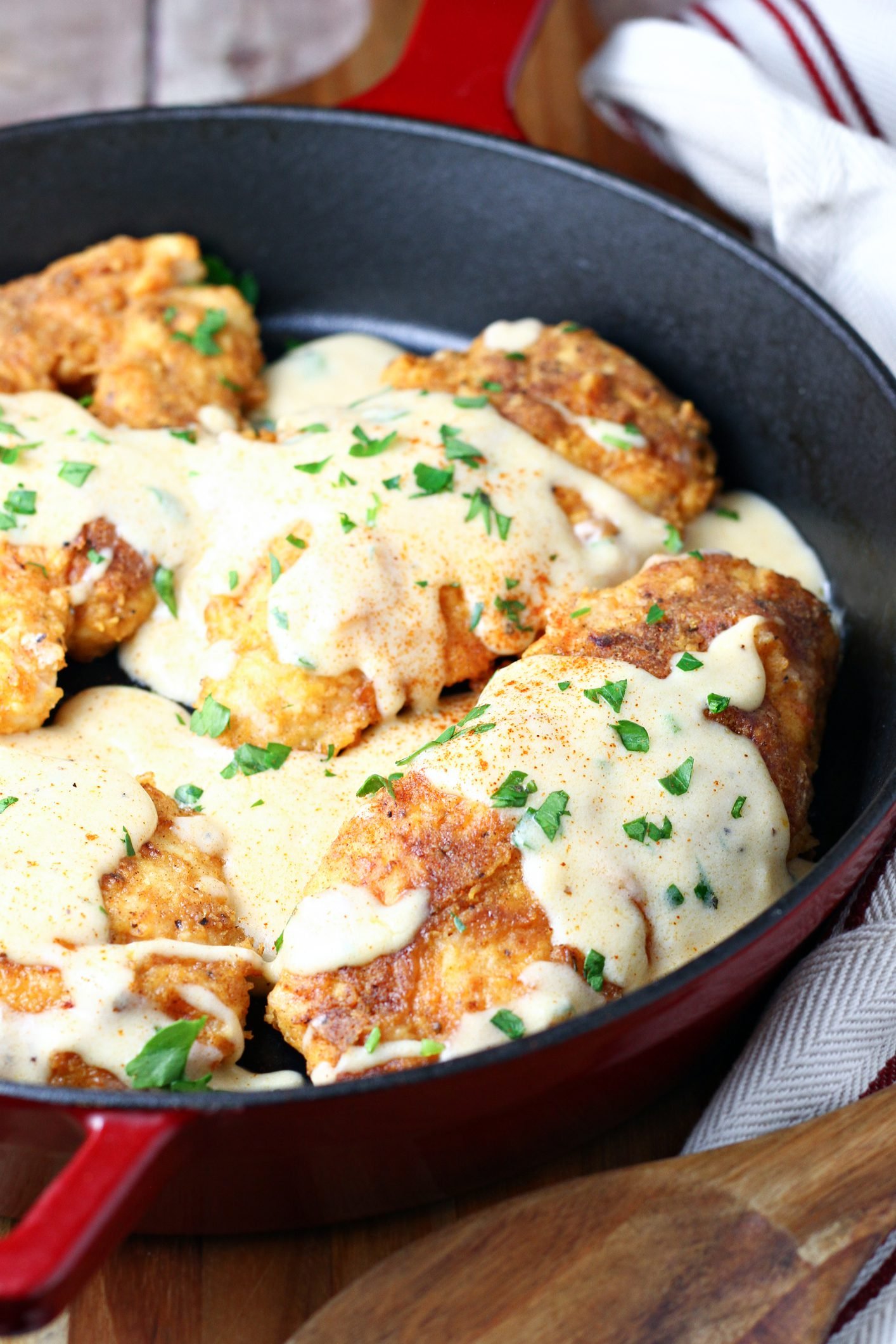
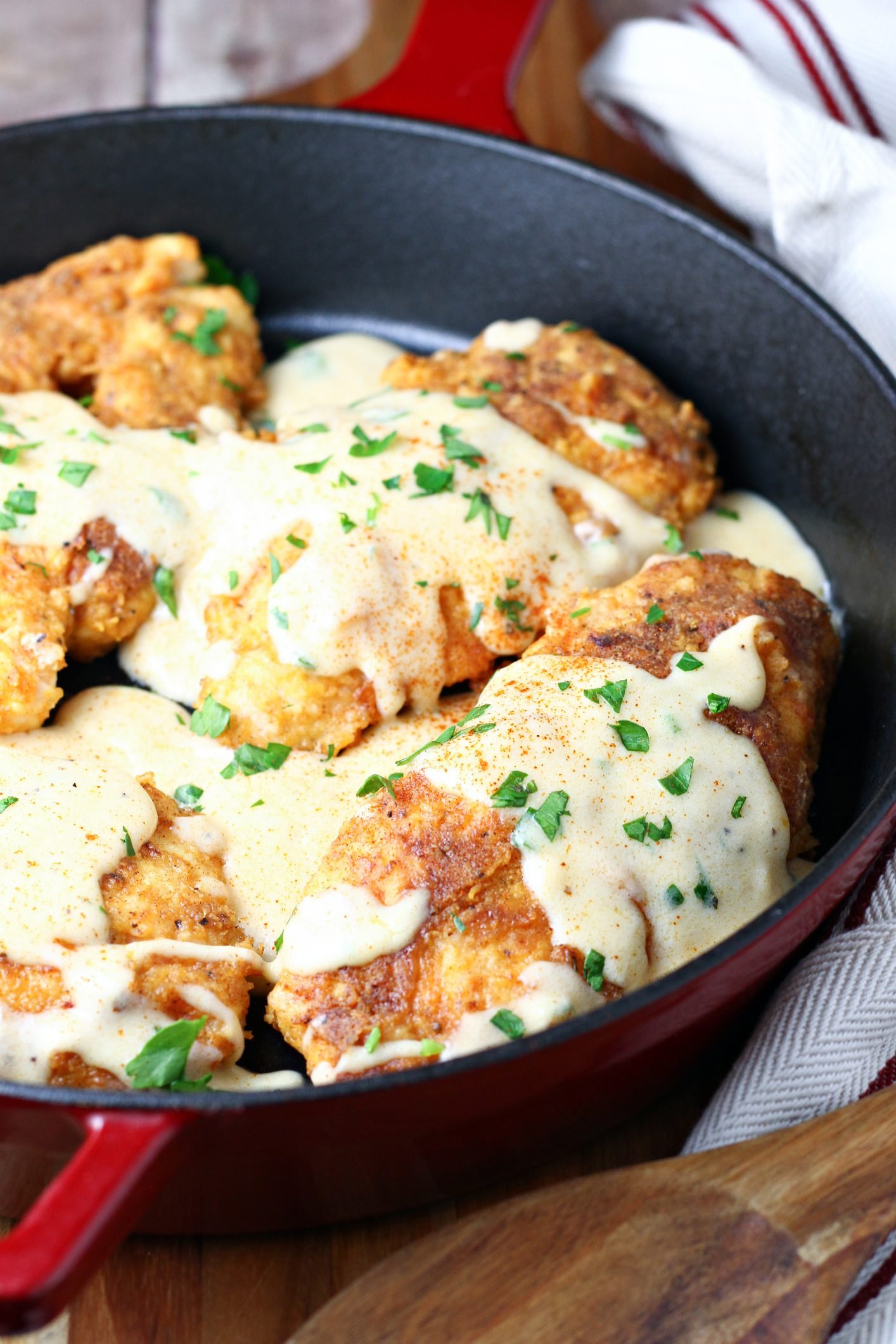
Step 11: Spoon the gravy over the plated chicken — generously. Scatter parsley over the top and serve immediately while the gravy is still glossy and loose.
Ways to Change It Up
Try this: Swap the heavy cream for full-fat coconut milk if you want a dairy-free version. The gravy takes on a slightly sweeter, more mellow quality and it still coats well.
Try this: Use bone-in, skin-on thighs instead of breasts. Increase the sear time to 7 minutes per side and add about 5 minutes to the simmer. The fat that renders out of the thighs makes the gravy even thicker without adding extra flour.
Try this: Add a handful of sliced mushrooms when you cook the onions. They soak up the paprika and broth and give the whole dish a slightly earthier, meatier quality that my sister-in-law specifically requested I keep in her version.
Which would you go for? Drop it in the comments.
How to Serve It
Mashed potatoes are the obvious call, and I mean that as a compliment — the gravy pools into them and the whole plate becomes one cohesive thing.
Egg noodles are a close second. Wide ones, tossed with just a little butter first so the gravy clings instead of sliding off.
Crusty bread alongside works if you want something lighter — a thick slice to drag through whatever gravy is left on the plate after the chicken is gone.
What would you pair it with?
Storing It Without Ruining It
In the fridge, this keeps for up to 3 days in a sealed container with the chicken and gravy stored together — the chicken stays moister that way.
To reheat, go low and slow on the stovetop. Maybe 10 minutes on a low burner with a splash of broth or water to loosen the gravy back up. The microwave works in a pinch but the cream-based gravy can go grainy if it overheats, which I found out the hard way on day-two leftovers.
Freezing. Honestly, the gravy doesn’t love it — the cream separates a bit on thaw, and while you can whisk it back together over heat, it’s not quite the same texture. I’d freeze the chicken and make a fresh batch of gravy if you’re planning ahead.
Have you ever saved leftovers like this? Tell me below!
Mistakes I Made So You Don’t Have To
I once skipped patting the chicken dry because I was impatient and had already seasoned it. The moisture under the spice rub turned the whole surface to a kind of paste, and the sear took almost 9 minutes to develop anything and still came out uneven.
I added the garlic at the same time as the onion — thinking it wouldn’t matter much, honestly I wasn’t paying close attention — and by the time the onion was done, the garlic had gone past golden into something slightly bitter that I could taste in every bite of the gravy.
I also tried rushing the flour roux once and added the broth after about 20 seconds instead of a full minute. The gravy tasted like raw flour at the center of every spoonful. I served it anyway. My husband didn’t say anything but he used a lot of bread.
Did something like this happen to you?
A few questions people actually ask.
Can I use chicken thighs instead of breasts? Yes, and bone-in skin-on thighs are genuinely better here if you have the time — the extra fat enriches the gravy without adding anything else. Add about 5 minutes to the simmer and check for 165°F. It depends on thickness, so the thermometer matters more with thighs.
My gravy came out too thin. What happened? It probably needed another 2 to 3 minutes of simmering after the cream went in. But it also depends on whether your roux cooked long enough before the broth was added — under a minute and the flour doesn’t fully hydrate. I tried thickening thin gravy with a cornstarch slurry once and it worked fine, though the texture is slightly different.
Can I make this without a cast iron skillet? A heavy stainless skillet works. Don’t use nonstick — the fond that builds up on the bottom is what makes the gravy taste like something, and nonstick doesn’t build fond the same way. And the sear won’t be as deep.
How much does this actually keep in the fridge? About 4 days if the container is properly sealed. By day 3 the gravy has thickened considerably in the cold, so reheat it with a few tablespoons of broth. Day 4 is fine but the chicken texture starts to soften.
Can I make the gravy ahead of time? I tried this once and stored the gravy separately from the chicken overnight. It reheated well over low heat with a little whisking. But you lose the fond from the chicken sear if you’re making gravy on a separate day — it depends on whether that depth matters to you or not.
Is 3 tablespoons of paprika really right? That seems like a lot. It is a lot. That’s on purpose. Spread across 4 large chicken breasts it’s about ¾ tablespoon per breast, and most of it forms the crust rather than staying loose. The flavor is present but not overpowering. Cut it to 2 tablespoons if you’re cautious — the result is milder and the crust is less dramatic.
Which answer helped you most?
Make it, eat it, tell me what happened.
This is a weeknight dinner that takes about 45 minutes start to finish and requires one pan.
The cast iron does a lot of the work — holds heat evenly, builds a proper sear, keeps the simmer steady without hot spots. Worth getting one out of the back of the cabinet if you’ve been avoiding it.
Sweet paprika has been used in Hungarian cooking for centuries and was only introduced to the region in the 16th century via trade routes from the Americas — meaning one of Europe’s most iconic spice traditions is actually newer than people assume.
My husband now asks for this specifically when he gets the cast iron out. That’s become its own kind of shorthand in our house.
Will you make this soon? Drop a comment and tell me how it went — especially if you made any swaps.
Happy cooking! —Marina Caldwell
Smoky Paprika Chicken Drowning in Silky Gravy
Ingredients
- 4 boneless, skinless chicken breasts (6 oz each)
- 3 tablespoons sweet paprika
- 1 teaspoon smoked paprika
- 1 teaspoon garlic powder
- 1 teaspoon onion powder
- 1 teaspoon salt
- ½ teaspoon black pepper
- 2 tablespoons olive oil
- 1 medium onion, diced
- 3 cloves garlic, minced
- 1 cup chicken broth
- ½ cup heavy cream
- 2 tablespoons butter
- 2 tablespoons all-purpose flour
- 1 tablespoon dried parsley flakes (or 2 tablespoons fresh)
- ½ teaspoon Dijon mustard
Instructions
- 1Combine both paprikas, garlic powder, onion powder, salt, and pepper in a bowl to create your spice blend.
- 2Thoroughly pat chicken dry, then coat every surface generously with the spice mixture.
- 3Place a cast iron skillet over medium-high heat and warm the olive oil until shimmering.
- 4Lay chicken breasts into the hot skillet and sear undisturbed for 5-6 minutes per side until a deep golden crust forms. Transfer to a plate.
- 5Add diced onion to the same skillet and cook for 3 minutes until translucent, then stir in minced garlic for one additional minute.
- 6Dust flour over the onion mixture and stir continuously for 1 minute, building a light roux as your gravy base.
- 7Stream in the chicken broth while scraping all the caramelized bits from the pan bottom into the liquid.
- 8Nestle the chicken back into the skillet, lower heat to medium, and simmer uncovered 15-18 minutes until the internal temperature reads 165°F.
- 9Transfer chicken to a warm plate while you finish the gravy.
- 10Add butter, heavy cream, and Dijon mustard to the skillet, whisking everything together until completely smooth.
- 11Allow gravy to simmer 2-3 minutes until it coats the back of a spoon, then taste and adjust seasoning.
- 12Spoon the finished gravy liberally over the plated chicken.
- 13Finish with a bright scatter of parsley and serve immediately.
Notes
– Drying the chicken thoroughly before seasoning is essential for achieving a proper sear rather than steaming the meat. – For a deeper, richer gravy color, allow your roux to cook a full minute longer before adding the broth. – Leftovers store well refrigerated for up to 3 days; reheat gently over low heat to prevent the cream-based gravy from breaking.