I Left It in the Pan Too Long. On Purpose.
Fifteen minutes is what every recipe says. I waited twenty-two.
There’s something that happens to banana bread when it sits in a warm pan just past the point you’re supposed to pull it — the sides firm up, the bottom gets this faint crust, and when you finally tip it out, it holds its shape instead of sagging in the middle like it’s embarrassed.
I didn’t plan that discovery. I got distracted by my neighbor Renata showing up at the door with a question about my rosemary plant, and by the time I got back to the kitchen, the loaf had been sitting there for longer than intended. No drama. It was better.
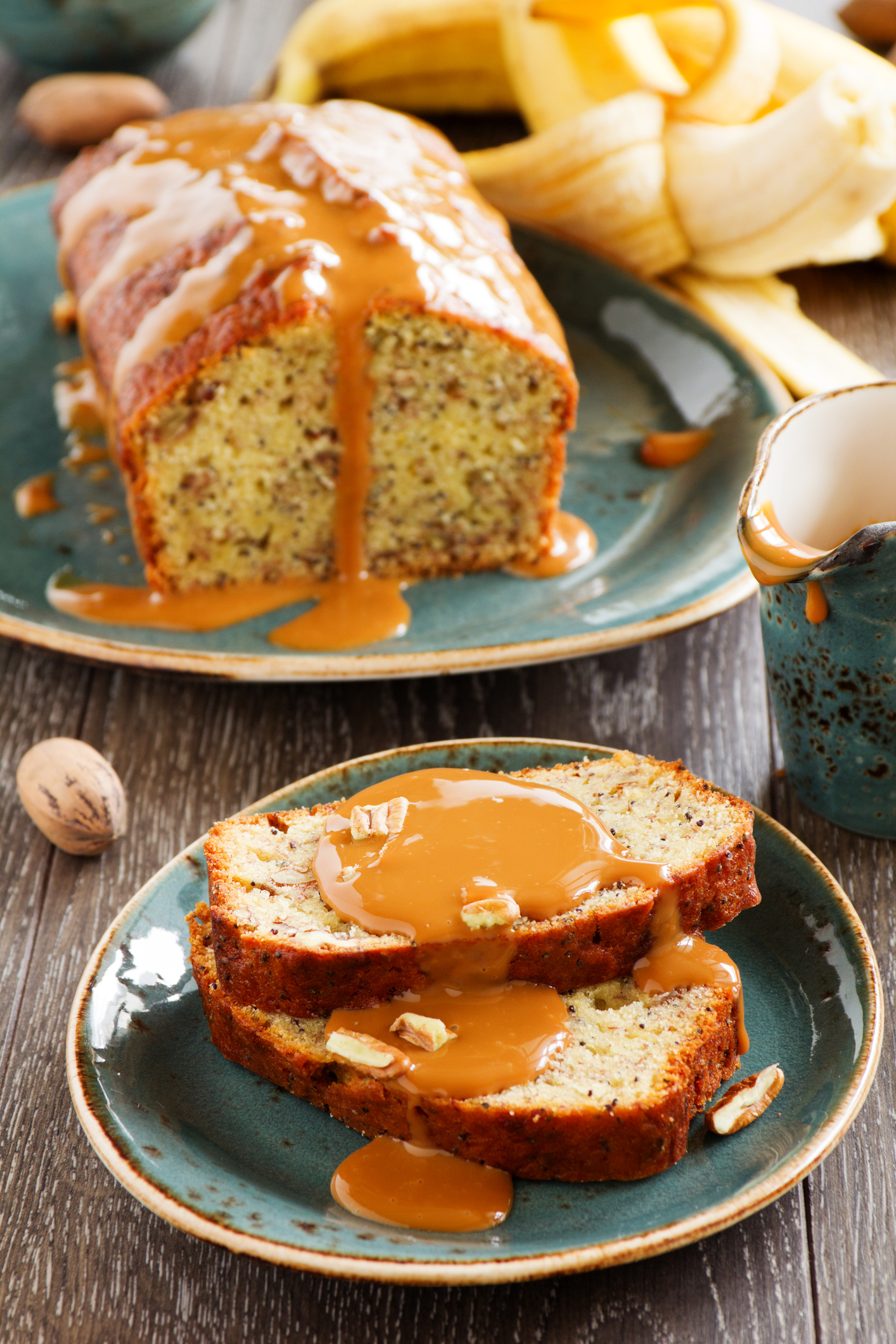
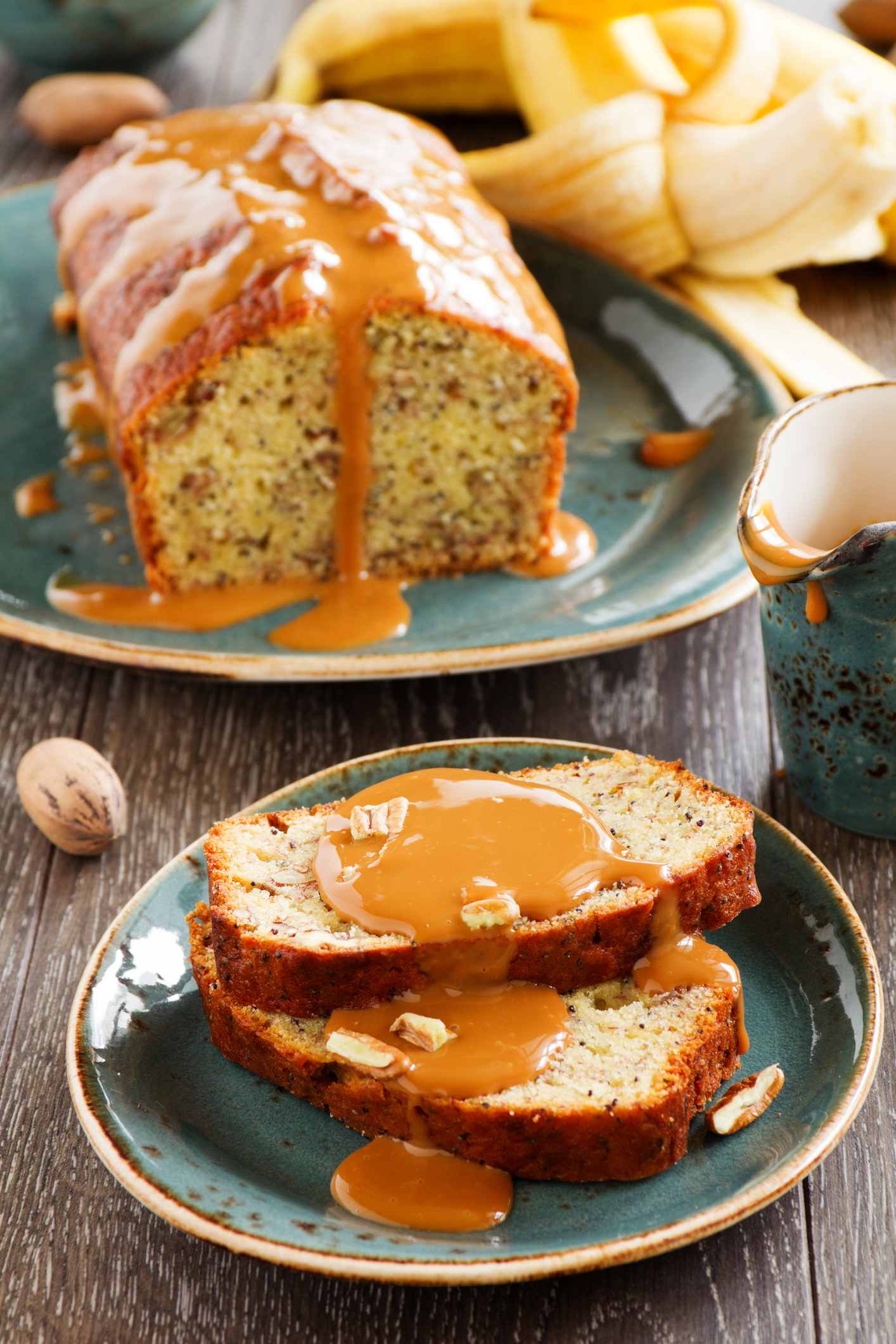
This particular loaf — the one with caramel drizzled over the top and chopped pecans folded into the batter — has been on my counter more times than I can honestly track. It started as a way to use three bananas that had gone fully black on the counter, the kind where the peel slips off before you even try.
Those are the ones you want.
The caramel came later. The first version had no topping at all, and it was fine — genuinely fine, just not interesting. Adding caramel felt almost too obvious, but obvious sometimes lands exactly right.
About the Bananas. And the Sour Cream.
Most recipes tell you ripe bananas are fine. They’re not wrong, but they’re not being specific enough.
You want bananas where the peel is more black than yellow. The flesh inside should be soft enough to mash with just a fork, no pressure needed — almost liquid in spots. That stage of ripeness gives you natural sugar that no amount of added granulated sugar can replicate. The batter will smell almost fermented, which is correct.
The sour cream is not optional.
I know some people swap in plain yogurt. I tried that once and the crumb was noticeably tighter — not bad, just different in a way I didn’t prefer. The sour cream keeps things tender without making the loaf gummy, which is the failure mode nobody talks about.
Gummy banana bread. The real enemy.
It usually happens when you overmix after the flour goes in, or when the bananas weren’t ripe enough and released too much water during baking. Both things happened to me at different points. The overmixing version looked fine on the outside and then collapsed slightly in the center about ten minutes after it came out. I still don’t fully understand why that happens at the structural level, but I’ve stopped overmixing and it stopped happening.
Quick tip: Fold the flour in with a spatula, not a mixer. Stop the moment you don’t see dry streaks. The batter should look slightly lumpy — that’s correct.
The Pecans Go In. The Walnuts Don’t.
I thought about adding walnuts — actually no, I stayed with pecans.
Walnuts are fine in banana bread but they have a slight bitterness that fights with the caramel on top. Pecans are sweeter, softer, and they get a little toasty during the 55 minutes in the oven without going hard. You don’t need to toast them beforehand. The bake does that work for you.
Use a full cup. Some recipes call for half a cup and you can tell — you get a bite here and there instead of nuts in every slice.
Chop them yourself if you can. Pre-chopped pecans from the bag tend to be dusty and uneven, and the smaller pieces burn before the loaf is done.
The Bake Itself.
350°F. 9×5 loaf pan, greased.
Bake time is 55 to 60 minutes. My oven runs slightly hot so I pull it at 53 and check with a toothpick inserted in the thickest part — not the center crack on top, but about an inch to the side of it. The crack is always done before the middle is. If you test the crack, you’ll think it’s ready. It isn’t.
The toothpick should come out with no wet batter attached. A few moist crumbs are fine.
If the top is going too dark before the inside is done — which happens sometimes depending on the pan color and your oven — tent it loosely with foil around the 40-minute mark. I use a dark pan and have had to do this more than once.
Then: wait.
Twenty minutes in the pan minimum. I know I said twenty-two before. That wasn’t me being careless. After the first time, I started leaving it intentionally. Then turn it out onto a wire rack and let it cool completely before the caramel goes on. Hot bread plus caramel sauce means the caramel soaks in and disappears. Which sounds good in theory and is actually fine,
but you lose the texture on top — the slight pull of the set caramel against the crust, which is the point of doing this at all.
The Caramel Doesn’t Need to Be Complicated.
Warm the caramel sauce with two tablespoons of butter in a small saucepan over low heat. Stir until the butter is fully incorporated — about 3 minutes. That’s it.
You’re not making caramel from scratch. I’ve done that version. It’s not better, it’s just harder, and the results were nearly identical once cooled.
Drizzle it over the cooled loaf in whatever pattern you want. I use a spoon rather than a squeeze bottle because I don’t own a squeeze bottle and I’m not going to buy one for this.
Sea salt goes on immediately after — before the caramel sets. If you wait too long, the salt sits on top of a hardened surface and doesn’t bond. About 30 seconds after drizzling is right. Then leave the whole thing alone for 5 minutes before you cut it.
Honestly? Don’t skip the sea salt. It’s doing more than it looks like.
What I Still Haven’t Figured Out.
The loaf slices cleanly on day one. Day two it gets stickier on the cut end — not from the caramel but from the banana itself. I haven’t found a way around that besides cutting just before serving, which I don’t always do.
I’ve also never nailed a version with chocolate chips that I liked better than this one. The chocolate competed with the caramel in a way that felt crowded. Something to keep trying, I guess.
Does the caramel drizzle ever stay completely perfect-looking by the next morning? No. It settles and gets tacky. Still tastes the same. But if you’re making it for someone and presentation matters, make it the same day.
—How to Make Banana Bread with Caramel Pecans
Step 1: Preheat your oven to 350°F and grease a 9×5 inch loaf pan thoroughly — sides and bottom. I use butter and then a light dust of flour, which gives the crust a slightly more defined edge than spray alone. (If you skip the flour, the sides can stick in a way that tears the loaf when you tip it out.)
Step 2: In a large bowl, cream together 1/2 cup softened butter and 3/4 cup granulated sugar. You want it genuinely light and a little fluffy — about 3 minutes with a hand mixer on medium. Under-creaming here makes the final loaf denser than it should be.
Step 3: Beat in 2 large eggs, one at a time. Each egg should be fully incorporated before you add the next. Then add 1 teaspoon vanilla extract. The batter will look slightly curdled after the second egg — that’s normal, keep going.
Step 4: Fold in 3 mashed bananas. The riper they are, the faster they incorporate. I mash them in a separate bowl first with a fork and leave a few small lumps — it doesn’t hurt anything and saves the effort of getting them perfectly smooth.
Step 5: In a separate bowl, whisk together 1 3/4 cups all-purpose flour, 1 teaspoon baking soda, and 1/2 teaspoon salt. Whisking the dry ingredients together matters — it distributes the baking soda so you don’t get pockets of it in the finished loaf. I skipped this once and got a faint metallic taste in one slice near the bottom.
Step 6: Alternate adding the flour mixture and 1/2 cup sour cream to the banana mixture, beginning and ending with flour. Three additions of flour, two of sour cream. Use a spatula, not a mixer. Stop folding as soon as the dry streaks disappear. Did your batter look thicker than you expected at this point? That’s normal — share below!
Step 7: Fold in 1 cup of chopped pecans gently. Two or three folds maximum — you’re just distributing them, not mixing. Pour the batter into the prepared loaf pan and smooth the top.
Step 8: Bake for 55 to 60 minutes. Test with a toothpick inserted to the side of the center crack, not inside it. Cool in the pan for at least 20 minutes before turning out onto a wire rack. Let the loaf cool completely before adding the caramel — this takes about an hour at room temperature.
Step 9: In a small saucepan over low heat, warm 1/2 cup caramel sauce with 2 tablespoons butter, stirring until smooth, about 3 minutes. Drizzle over the cooled loaf. Immediately sprinkle with 1/4 teaspoon sea salt. Wait 5 minutes before slicing.
Ways to Change It Up
Try this: Swap the pecans for toasted coconut flakes. Fold in 3/4 cup and reduce pecans to 1/4 cup if you want both — full coconut alone makes the texture noticeably different, almost chewier near the edges.
Try this: Use brown butter instead of softened butter. Melt 1/2 cup butter in a saucepan until it smells nutty and turns amber — about 6 minutes — then cool it until solid before creaming. It adds a layer to the flavor that works well against the caramel.
Try this: Skip the caramel drizzle entirely and add 1/3 cup of good-quality dark chocolate chunks to the batter instead of on top. Not my preference, but it works.
Which would you go for? Drop it in the comments.
How to Serve It
Slice it thick — at least 3/4 of an inch — and serve it at room temperature. Cold banana bread is tighter and less fragrant.
A thin spread of salted butter on a warm slice is the version I eat most often. The butter melts slightly into the crumb and it doesn’t need anything else.
If you’re serving it to guests, a small scoop of vanilla ice cream alongside a warm slice works — reheat individual slices in a 300°F oven for about 8 minutes rather than the microwave, which makes the caramel topping soft and the crumb dense.
What would you pair it with?
—Storing It Without Ruining It
Room temperature, wrapped tightly in plastic wrap or in an airtight container, it holds for 2 days. After that the caramel topping gets progressively tackier and the crumb tightens.
In the fridge it lasts up to 5 days. Wrap it well — banana bread picks up other smells faster than you’d expect, and a loaf that sat near leftover onion soup is not something I want to describe in detail.
To freeze: slice the whole loaf first, wrap individual slices in plastic wrap, then seal in a zip-top bag. Frozen up to 3 months. Thaw at room temperature for about 45 minutes or in a low oven.
The caramel topping does not freeze cleanly. It gets sticky and pulls off when you unwrap the slices. If you know you’re going to freeze most of the loaf, add the caramel drizzle only to the slices you’ll eat fresh.
Have you ever saved leftovers like this? Tell me below!
Mistakes I Made So You Don’t Have To
I once added the sour cream all at once instead of alternating it with the flour. The batter went soupy, baked unevenly, and the center sank. I served it anyway with extra caramel on top to hide the dip. It tasted fine. The texture was wrong.
Using bananas that weren’t ripe enough. I was impatient — the bananas had some yellow left, and I thought close enough. The loaf was less sweet, yes, but also strangely dry, like the moisture hadn’t fully distributed. It needed another three days on the counter.
Pouring the caramel on while the bread was still warm. It soaked in completely within two minutes and the top looked bare. Technically not a disaster — the caramel flavor was in every bite. But the whole visual reason for the drizzle was gone. Did something like this happen to you?
Questions I Get Asked About This One
Can I use frozen bananas? Yes, but thaw them completely and drain the liquid that collects. I tried skipping the draining once and the batter was too wet — the loaf took an extra 12 minutes and still came out slightly underdone in one spot. And the texture was gummier than usual.
Can I make this without pecans? Leave them out entirely and the loaf bakes fine — it’ll be done closer to 53 minutes since there’s less mass. But it’s noticeably plainer. I’d at least add something, even just a handful of whatever nut you have.
Can I use a different size pan? It depends on what you have. An 8×4 pan will give you a taller loaf that needs about 65 minutes. A muffin tin works at 350°F for about 22 to 25 minutes per batch. Check at 20 minutes.
What if I don’t have sour cream? Full-fat plain yogurt is the closest substitute — about 4 days into testing this recipe I ran out of sour cream and used yogurt once. The crumb was slightly tighter, not terrible. But sour cream is worth buying for this specifically.
Does the type of caramel sauce matter? Somewhat. A thin, runny sauce won’t set properly on top — it just slides off the loaf. Use one that’s thick enough to coat a spoon. Homemade or store-bought both work. I’ve used both at different times with similar results.
Can I make this ahead for an event? Bake the day before, store wrapped at room temperature, and add the caramel drizzle the morning of. About 2 hours before serving is ideal — enough time for it to set but not so long that it gets completely sticky. But honestly? It always looks slightly less perfect than it did fresh.
Which answer helped you most?
Where I Am With This Recipe
I’ve made this loaf enough times now that I stop second-guessing the bake time. Fifty-five minutes in my oven, toothpick to the side, twenty-two minutes in the pan. That part is settled.
The caramel ratio I’m less sure about. Half a cup feels right but some batches taste like it needs more, and I can’t figure out if that’s the bananas being slightly less sweet or the caramel brand varying. I haven’t landed on a consistent answer.
Fun fact: Pecans are native to North America and were a primary food source for Indigenous communities long before they showed up in any baked good — they’re one of the few commercially significant nut crops that originated in the U.S.
The loaf is genuinely good. I’m not saying that to sell you on it — I’m saying it because the caramel-salt-pecan combination on top of banana bread is one of those pairings that works better than you expect it to on paper.
Will you make this soon?
There’s still a version of this I want to try with a cream cheese swirl through the center. I’ve started it twice and pulled back both times because I didn’t want to mess with something that was already working. Maybe next time. Maybe not.
Happy cooking! —Marina Caldwell
The Ultimate Banana Bread with Caramel Pecans
Ingredients
- 3 ripe bananas, mashed
- 1/2 cup butter, softened
- 3/4 cup granulated sugar
- 2 large eggs
- 1 teaspoon vanilla extract
- 1 3/4 cups all-purpose flour
- 1 teaspoon baking soda
- 1/2 teaspoon salt
- 1/2 cup sour cream
- 1 cup pecans, chopped
- 1/2 cup caramel sauce
- 2 tablespoons butter for caramel topping
- 1/4 teaspoon sea salt for garnish
Instructions
- 1Preheat oven to 350°F. Grease a 9×5 inch loaf pan.
- 2In a large bowl, cream together softened butter and sugar until light and fluffy.
- 3Beat in eggs one at a time, then add vanilla extract.
- 4Fold in mashed bananas until combined.
- 5In a separate bowl, whisk together flour, baking soda, and salt.
- 6Alternate adding flour mixture and sour cream to the banana mixture, beginning and ending with flour.
- 7Gently fold in chopped pecans.
- 8Pour batter into prepared loaf pan.
- 9Bake for 55-60 minutes until a toothpick inserted in the center comes out clean.
- 10Cool in pan for 15 minutes, then turn out onto a wire rack.
- 11Warm caramel sauce with 2 tablespoons butter in a small saucepan.
- 12Drizzle caramel sauce over cooled banana bread and sprinkle with sea salt.
- 13Let caramel set for 5 minutes before serving.
Notes
See full recipe for nutritional information.