The first time I made this, the beef was tough.
My husband asked for seconds anyway, which I thought was sweet but also a little alarming. I had only braised it for 55 minutes, pulled it early because I was impatient, and the chunks resisted the fork in that specific way that tells you the collagen hasn’t given up yet.
The second time I went the full 90 minutes. Different dish entirely.
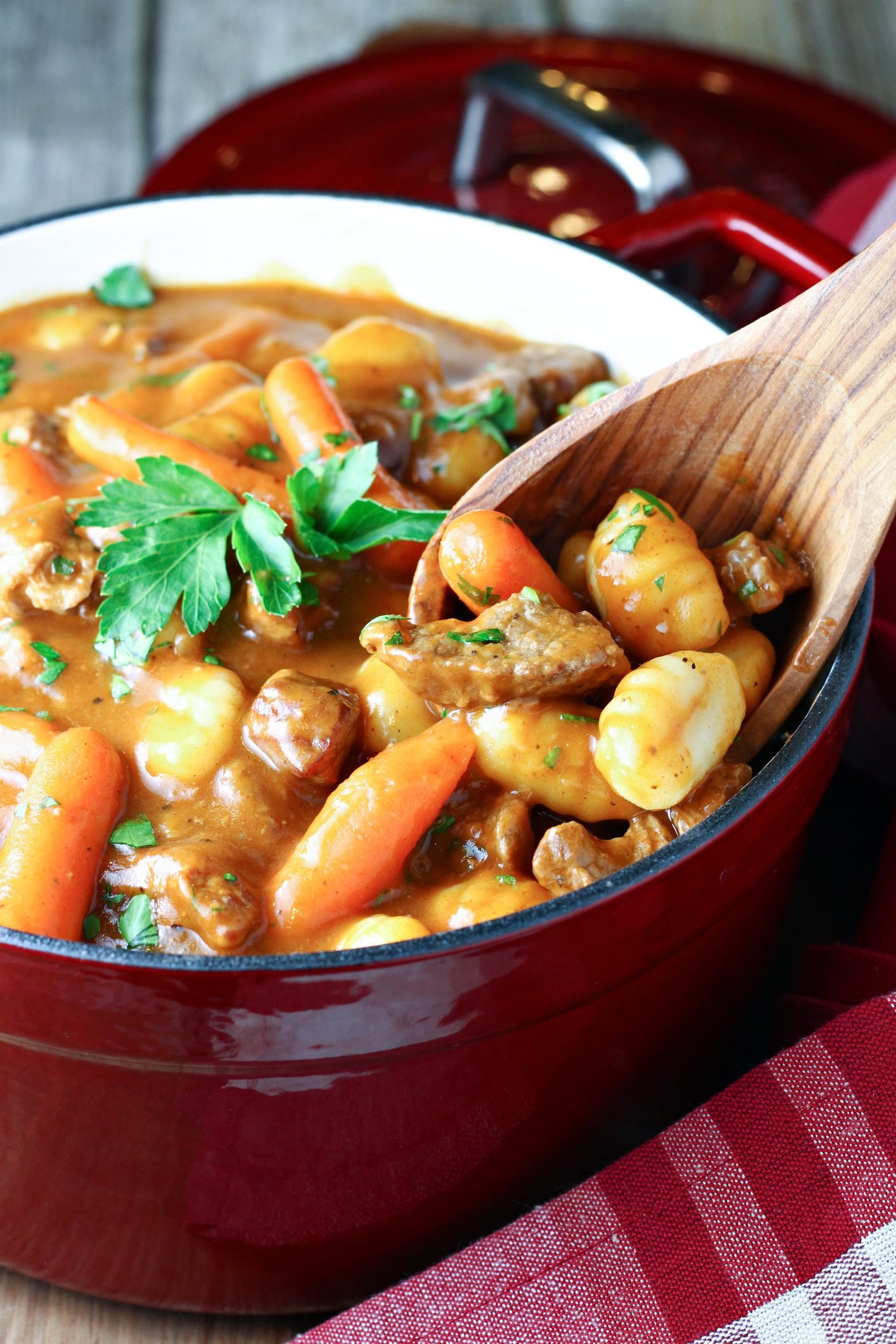
This is a slow braise — chuck beef, red wine, a handful of aromatics — with gnocchi folded in right at the end so they soak up whatever the pot has become by that point. It’s not elegant. It is extremely good.
About the beef. Specifically.
Chuck is the right cut here and I won’t pretend otherwise. It has enough fat running through it that after 90 minutes of low heat, the pieces almost fall apart when you look at them too hard.
I thought about adding paprika to the seasoning — actually no, I skipped it. Salt and pepper only on the meat before searing, and then the wine and tomato paste do everything else.
Quick tip: Pat your beef completely dry before it goes anywhere near the pan. Damp beef steams instead of sears, and you lose the crust that carries flavor through the whole dish.
It looked wrong. It wasn’t.
When the red wine goes in, the whole pot turns an unsettling deep purple-brown. Looks like something went wrong. It hasn’t.
Give it five minutes and it starts to smell like the thing it’s trying to become — something low and warm, vaguely sweet from the carrots, with that back-of-the-throat thing that red wine does when it cooks down.
Worth noting: the tomato paste goes in before the wine and gets cooked in the center of the pot for a full two minutes until it darkens a shade. That step is doing more than it looks like it’s doing.
Okay, the gnocchi situation.
Store-bought is what I used. Every time.
They go in cooked and drained — boiled separately until they float, then two minutes more — and then folded into the stew at the very end, gently, because they will fall apart if you’re rough with them. I learned this the hard way in round three: I stirred aggressively and ended up with potato paste clouding the broth. The stew was still edible, but the gnocchi were gone as a texture.
Have you ever tried adding them raw directly to the braise? I haven’t, and I’m genuinely not sure if it would work. My instinct says no — the broth would get starchy in a bad way — but I’d be curious to hear if anyone’s tried it.
Something only a person who’s made this would know.
The braise smells best around the 70-minute mark — something about that window where the beef is almost done but still has 20 minutes left. The whole kitchen settles into it. My neighbor Rosa knocked on the door once at exactly that moment and stood in the entryway for about 30 seconds just breathing.
Also: if you make the stew base a day ahead and refrigerate it overnight, the fat solidifies on top and lifts off cleanly, and the flavor — there’s just more of it. I can’t explain the chemistry but I’ve done it both ways enough times to be sure.
One honest thing before the recipe.
The first time I added the cornstarch slurry, I poured it in all at once instead of slowly while stirring, and it seized into little gel lumps at the bottom of the pot.
I served it anyway.
Nobody mentioned the lumps, but I knew they were there. Go slow with the slurry. Stir constantly. Five more minutes of simmering after that and the broth goes glossy and thick in a way that makes you feel like you did something right.
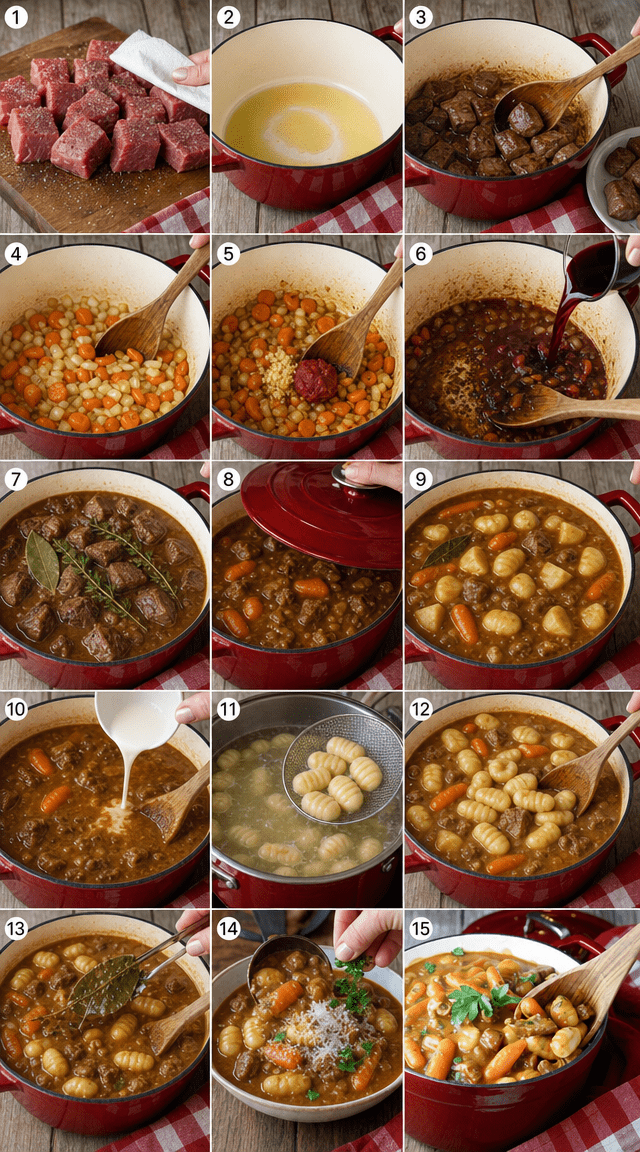
How to Make Slow Braised Chuck Beef With Pillowy Potato Gnocchi
Step 1: Pull your beef out of the fridge about 20 minutes before you start. Press it firmly between paper towels until the surface is genuinely dry, not just dabbed. Season all sides generously with 1 teaspoon salt and ½ teaspoon black pepper.
Step 2: Set your Dutch oven over medium-high heat and add 3 tablespoons of olive oil. Wait until it shimmers — not smokes, shimmers — before any beef goes in. This took me about 2 minutes on my stove.
Step 3: Sear the beef in small batches, 3–4 minutes per side, until each piece is deeply browned on at least two sides. Do not crowd the pan. (Crowding drops the temperature and you get grey, sad beef instead of a real crust — ask me how I know.) Transfer each batch to a plate and leave it alone.
Step 4: Drop in the diced onion and carrot chunks. Cook for 5 minutes, stirring occasionally, until the edges of the onion start to go soft and translucent. The bottom of the pot should have a lot of brown bits by now. Good.
Step 5: Push the vegetables to the side and add the 4 minced garlic cloves and 2 tablespoons of tomato paste directly to the center of the pot. Cook that mixture for 2 full minutes — it should darken and smell almost roasted. This is my favorite step, honestly, because the kitchen shifts.
Step 6: Pour in 1 cup of red wine and use a wooden spoon to scrape every caramelized bit off the bottom of the pot. Don’t rush this. Those bits are flavor. Let the wine bubble for about 3 minutes before moving on.
Step 7: Nestle the seared beef back into the pot. Pour in 2 cups of beef broth, then tuck in 2 bay leaves and 3 sprigs of fresh thyme. The liquid should come about halfway up the beef — not fully submerge it.
Step 8: Raise the heat to bring everything to a boil, then drop it to a low simmer, cover the pot, and walk away for 90 minutes. Set a timer. Go do something else. (Lifting the lid every 15 minutes will not make it cook faster; it will make you anxious for no reason.)
Step 9: After 90 minutes, add the potato chunks and leave the pot uncovered. Simmer for another 45 minutes until both the beef and potatoes give easily when pressed with a fork.
Step 10: Stir together 2 tablespoons cornstarch and 3 tablespoons water in a small bowl. Pour this slurry slowly into the braise while stirring constantly. Simmer for 5 more minutes until the broth thickens and looks glossy. Do you prefer a thicker stew or a thinner brothy base? Share below!
Step 11: Meanwhile, boil a separate pot of well-salted water. Cook 1 lb of store-bought gnocchi until they float, then give them 2 minutes more. Drain them well.
Step 12: Fold the drained gnocchi into the stew using a wide spoon and a gentle hand. Two or three slow folds. Then stop. Fish out and discard the bay leaves and thyme sprigs. Taste. Adjust salt if needed.
Step 13: Ladle into deep bowls and finish with fresh chopped parsley and a generous amount of grated Parmesan over the top. Serve immediately while the gnocchi are still holding their shape.
Ways to Change It Up
Try this: Swap the red wine for a dark beer — something like a stout or a porter. The braise gets a slightly bitter, malty edge that works well with the beef and cuts through the richness.
Try this: Add a handful of frozen peas in the last 10 minutes of braising. They stay bright green and give you a bit of sweetness against all that savory depth.
Try this: Skip the gnocchi and serve the braise over creamy polenta instead. The broth soaks into polenta differently — slower, heavier — and it becomes a completely different meal with the same pot of meat.
Which would you go for? Drop it in the comments.
How to Serve It
Deep bowls are non-negotiable. This is a brothy, chunky stew and a shallow plate will just make a mess before you get through half of it.
A thick slice of crusty bread on the side for soaking up whatever broth is left at the bottom of the bowl — sourdough works, a plain country loaf works, even a day-old baguette that’s gone a little chewy is fine here.
A simple green salad with a sharp vinaigrette balances the weight of the stew without competing with it. Nothing creamy, nothing sweet. Just something acidic to cut through.
What would you pair it with?
Storing It Without Ruining It
The stew base — beef, broth, vegetables, everything except the gnocchi — keeps in the fridge for up to 4 days in a covered container. Store the gnocchi separately if you can, or make a fresh batch when you reheat. Gnocchi that sit in the broth overnight go soft and start to dissolve, and not in a good way.
To freeze, leave the gnocchi out entirely. The braise itself freezes well for up to 3 months. Let it thaw overnight in the fridge and reheat low and slow on the stovetop, adding a splash of broth if it’s tightened up too much.
Reheating on the stovetop over medium-low heat takes about 15 minutes. Microwave works in a pinch — cover it loosely, go in 90-second intervals, stir between each. Don’t blast it on high or the beef gets stringy.
Have you ever saved leftovers like this? Tell me below!
Mistakes I Made So You Don’t Have To
I once skipped the searing step entirely because I was running late for something and thought it wouldn’t matter that much. The braise came out pale and flat, like the beef had just been boiled. The sear isn’t optional. It sets the flavor baseline for everything that follows.
I added the garlic too early once, honestly I wasn’t paying attention,
and it burned against the bottom of the pot before the onion had even softened. Burned garlic is bitter in a way that carries through the whole dish. I ended up starting over.
The third mistake is less dramatic: I’ve under-salted this more times than I’ve gotten it right on the first taste. Beef broth brands vary wildly in sodium. Some are nearly salty enough on their own, some are close to water. Taste before you add the slurry, taste after it thickens, taste again before serving. Three times. Did something like this happen to you?
Questions I Actually Get Asked About This
Can I use a different cut of beef? Chuck is genuinely the best option here because the fat content keeps it from drying out over a long braise. Short ribs work if you want something richer. Brisket takes longer — closer to 2.5 hours. But avoid lean cuts like sirloin; they get grainy and tight after 90 minutes of heat.
Does the wine have to be a specific kind? It depends on what you’re after. I tried this once with a cheap table wine and the braise came out thinner and a little sour. A Cabernet Sauvignon or Chianti — something with body — gives the broth that deeper, rounder flavor. And yes, it should be wine you’d actually drink. Not cooking wine from a bottle with salt added.
Can I make this in a slow cooker? You can, but sear the beef in a pan first — don’t skip that step. Then transfer everything to the slow cooker and cook on low for 7–8 hours. Add the gnocchi in the last 20 minutes. The broth won’t reduce the same way, so you may need the cornstarch slurry regardless.
How do I know when the beef is actually done? Fork-tender is the marker. Press a chunk against the side of the pot — it should give without resistance and start to pull apart. About 90 minutes at a true low simmer. If your simmer is running hot, check at 75 minutes.
Can I make this without the potatoes? Sure. I’ve done it. The stew is still hearty without them, just less filling. And honestly? It depends on how you feel about two starchy things in one bowl — some people find the potatoes plus gnocchi too much. My husband prefers it without the potatoes. I like both versions.
Can I use homemade gnocchi instead of store-bought? I’ve made it both ways. Homemade gnocchi are more delicate and fall apart faster once they hit the hot broth, so fold them in right before serving with almost no stirring at all. Store-bought hold up a little better structurally. But if you’ve got the time, homemade are softer and absorb the broth differently — in a way that’s hard to describe but noticeable.
Which answer helped you most?
Go make a pot of this.
It takes most of an afternoon. That’s just the truth of it. But most of that time is the pot doing the work while you’re in another room.
Will you make this soon?
If you do, the one thing I’d tell you is don’t rush the sear and don’t lift the lid during the 90-minute braise. Those two things alone will get you most of the way there.
My kids ate three bowls between them the last time I made this on a Sunday. I called that a win and didn’t overthink it.
Fun fact: Chuck beef comes from the shoulder area of the cow, which gets a lot of movement during the animal’s life — and all that muscle work is exactly why it has so much connective tissue. That connective tissue breaks down into gelatin during a long braise, which is what gives the broth that silky, almost sticky quality you can’t get from a leaner cut no matter how long you cook it.
Happy cooking! —Marina Caldwell
Slow Braised Chuck Beef With Pillowy Potato Gnocchi
Ingredients
- 2 lbs beef chuck, cut into 1.5-inch cubes
- 3 tablespoons olive oil
- 1 large onion, diced
- 4 cloves garlic, minced
- 4 medium carrots, cut into chunks
- 3 medium potatoes, cut into chunks
- 2 cups beef broth
- 1 cup red wine
- 2 tablespoons tomato paste
- 2 bay leaves
- 3 sprigs fresh thyme
- 1 teaspoon salt
- 1/2 teaspoon black pepper
- 2 tablespoons cornstarch mixed with 3 tablespoons water
- 1 lb store-bought gnocchi
- 2 tablespoons fresh parsley, chopped
- Parmesan cheese for serving
Instructions
- 1Thoroughly dry beef cubes using paper towels, then season generously on all sides with salt and pepper.
- 2Place a Dutch oven over medium-high heat and warm the olive oil until shimmering.
- 3Working in small batches, sear the beef 3-4 minutes per side until deeply browned. Transfer to a plate and reserve.
- 4Drop onion and carrots into the same pot, cooking 5 minutes while stirring until edges soften.
- 5Push vegetables to the side, add garlic and tomato paste to the center, and cook for 2 minutes until fragrant and darkened.
- 6Deglaze with red wine, using a wooden spoon to lift all caramelized bits from the pot bottom.
- 7Nestle the seared beef back in, then pour in the broth and tuck in the bay leaves and thyme sprigs.
- 8Raise heat to bring everything to a boil, then cover, reduce to a low simmer, and braise for 90 minutes.
- 9Introduce the potato chunks and continue simmering uncovered for 45 minutes until both beef and potatoes are fork-tender.
- 10Pour in the cornstarch slurry while stirring constantly, then simmer an additional 5 minutes until the broth thickens to a velvety consistency.
- 11Meanwhile, boil generously salted water in a separate pot and cook gnocchi until they rise to the surface, then 2 minutes more. Drain well.
- 12Gently fold the drained gnocchi into the stew, taking care not to break them apart.
- 13Fish out and discard the bay leaves and thyme sprigs. Taste and adjust seasoning as needed.
- 14Ladle into deep bowls, finishing each portion with a scatter of fresh parsley and a generous dusting of Parmesan.
Notes
– For maximum depth of flavor, use a bold red wine such as Cabernet Sauvignon or Chianti that you would comfortably drink on its own. – The stew base can be prepared a full day ahead and refrigerated overnight, as the flavors intensify beautifully, simply add fresh gnocchi when reheating. – Avoid stirring aggressively once gnocchi are added, as they are delicate and will break apart, compromising the final texture of the dish.